Duvets for cold rooms and cold sleepers

What is the best winter comforter?

The wool comforter for a cold room, the cotton one for a cold sleeper who wants weight. A winter duvet is judged hours in, not when you get in, and that is when a duvet that only insulates has already let the warmth out.

A woman asleep under the Circadian Organic Wool Comforter in a bright room with wood beams.
Wool holds warmth when the room cools
New Jersey workshop, making pillows since 198160-night sleep trialFree shippingGOTS Certified Organic

The short answer

For a cold room, the wool duvet. Wool holds warmth when the room cools. It gives a little heat back as it releases the moisture it took in during the night, so the duvet does its most work at the coldest hour. For a cold sleeper who wants weight over them, the cotton duvet, which is hand-tufted from dense layers of organic cotton batting and drapes with a grounded, even weight. Our queen cotton is about 12 pounds and the queen wool about 9. Add a flat sheet under either and a cotton cover over it, and you have three natural layers that each trap a little air.

Cold room
The Organic Wool Duvet, which gives warmth back as the room drops
Cold sleeper
The Organic Cotton Duvet, dense, even and grounded over you
Weights
Cotton about 7.5, 12 and 13.5 pounds in twin, queen and king. Wool about 6.5, 9 and 11.5
Extra layers
A flat sheet under the duvet and a cover over it, each trapping air
Tog rating
We do not publish one. Tog is a lab number for insulation, and wool works on moisture as well
Lifespan
10 to 15 years for either, with a cover and proper care
Where it comes from
Wool from New Zealand certified organic farms, duvet cotton grown in Texas, cut, layered and sewn by hand in New Jersey
What is not in it
The warmth comes from the material rather than from polyester, down or a chemical finish. There is nothing in it to off-gas in a bedroom that stays shut all winter

The short version, in five lines

  • A cold room wants the wool comforter. Wool gives a little heat back as it releases the moisture it took in, so it does its most work at the coldest hour of the night.
  • A cold sleeper in a steady room wants the cotton duvet, which is denser and drapes with a grounded, even weight.
  • The cotton is the heavier by 1 to 3 pounds, depending on size, but how each behaves once the room drops matters more.
  • We do not publish a tog rating. Tog measures insulation in a lab and says nothing about what a fiber does with moisture, which is half of what a winter duvet is for.
  • Either one lasts 10 to 15 years inside a cover. A flat sheet under it and a cotton cover over it add two more layers of trapped air for the price of laundry.

Two duvets, and the difference is how they behave as the room cools.

Cotton is heavy, even and still. Wool is a little lighter and it changes what it does through the night. Both are hand-tufted so the warmth stays spread over you rather than sliding to your feet.

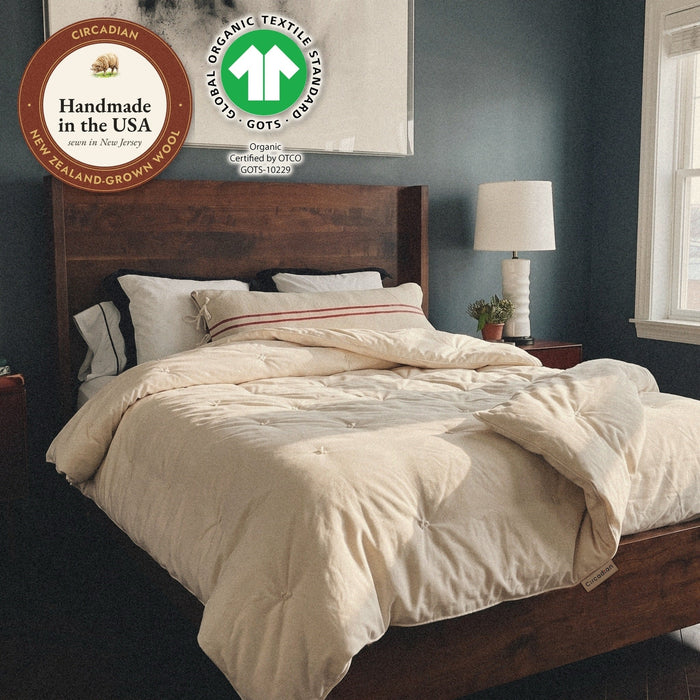
Morning sun on a dark wood bed. The Circadian Organic Wool Comforter, a hand-tufted duvet insert, lies thrown back, with the Handmade in the USA seal and the label of GOTS, the Global Organic Textile Standard (Organic, certified by OTCO, GOTS-10229).
For a cold room

Organic Wool Comforter

Organic wool from New Zealand certified-organic farms, hand-tufted. It holds warmth when the room cools and releases moisture when you heat up, so you are warm without waking clammy under the extra weight.

Best for a bedroom that drops hard overnight

From $449.00
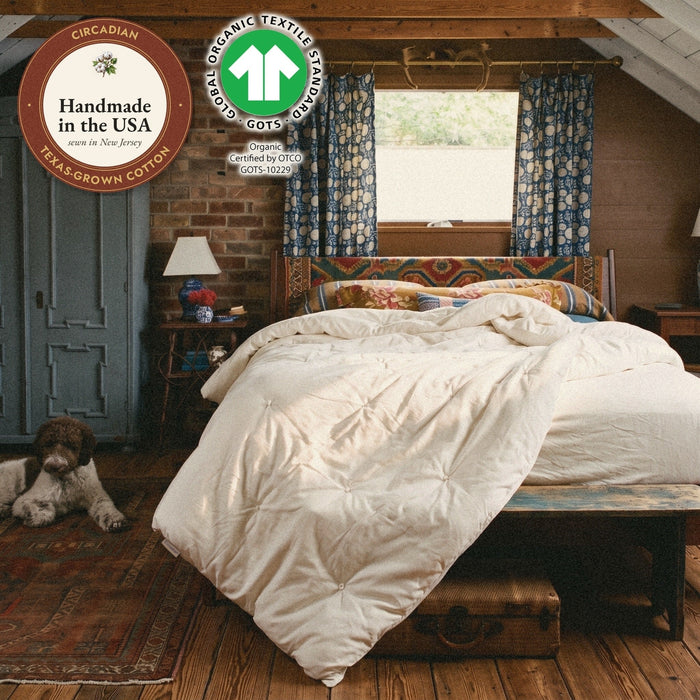
A dog naps on the rug. An Organic Cotton Comforter from Circadian lies thrown back on the bed of a brick attic bedroom, with the Handmade in the USA seal and the GOTS (Global Organic Textile Standard) label, Organic, certified by OTCO, GOTS-10229.
For a cold sleeper

Organic Cotton Comforter

Dense layers of organic cotton batting anchored by hand, with a grounded weight that people who are always cold tend to love. It stays cool to the touch and warms with you.

Best for someone who wants to feel the duvet over them

From $359.00
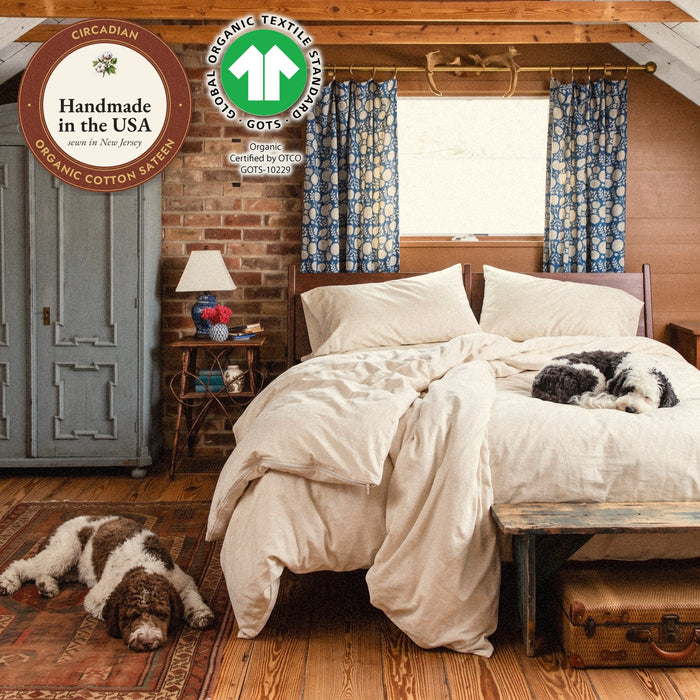
A comforter in a Circadian organic cotton sateen duvet cover on a bed in a brick attic bedroom, two dogs nearby, with seals: handmade in the USA from organic cotton sateen, and the GOTS organic label.
One more layer of air

Organic Cotton Duvet Cover

The same organic cotton sateen on both faces, closing with a zipper along one side and tied inside to the duvet's corner loops so the warmth stays where you are.

Best for every duvet, all winter

From $209.00
A Circadian organic cotton sateen flat sheet turned back over a bed under a wood ceiling, with seals: handmade in the USA from organic cotton sateen, and the GOTS organic label.
Under the duvet

Organic Cotton Flat Sheet

A cotton layer between you and the cover traps a pocket of air and adds warmth without weight. It is also the layer you wash weekly instead of the duvet.

Best for adding warmth without a heavier duvet

From $129.00
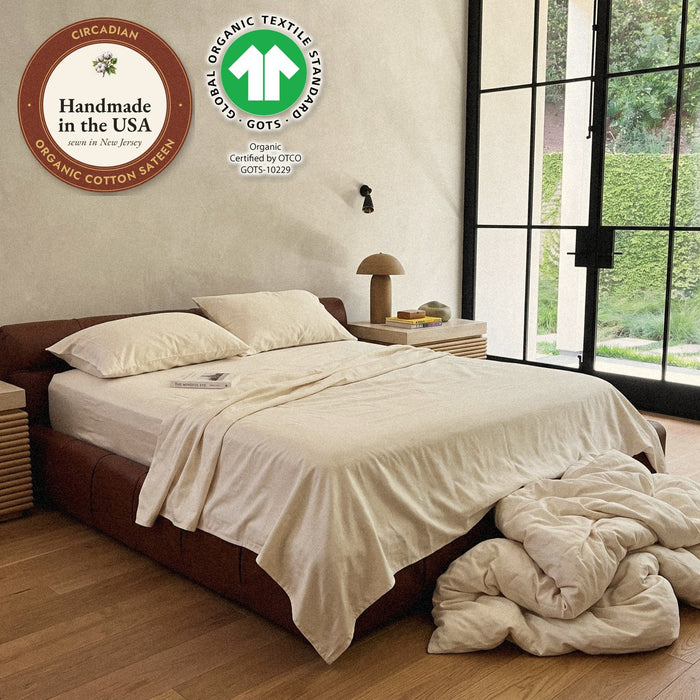
A bed in a Circadian organic cotton sateen sheet set in a plaster bedroom with garden doors, the comforter heaped on the floor, with seals: handmade in the USA from organic cotton sateen, and the GOTS organic label.
The bed underneath

Organic Cotton Sheet Set

Fitted sheet, flat sheet and pillowcases in 300 thread count sateen. Cotton warms to you rather than feeling cold on contact the way a synthetic sheet does on a January night.

Best for a bed that is not cold to get into

From $279.00
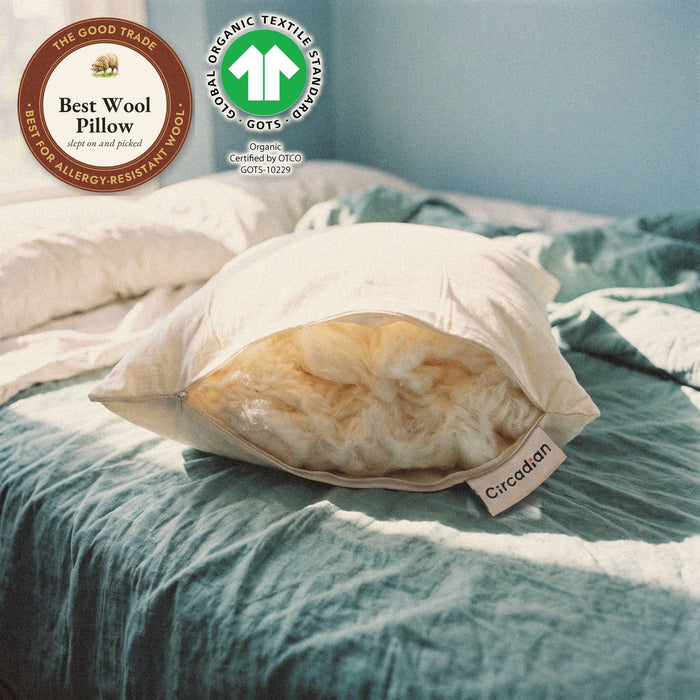
A Circadian Organic Wool Pillow on a teal blanket in morning sun, its end unzipped to show soft layers of wool batting inside, with The Good Trade seal (best wool pillow, best for allergy-resistant wool) and the GOTS label: Organic, certified by OTCO, GOTS-10229.
Warm and dry at the face

Organic Wool Pillow

The same wool behaviour under your head. It keeps the air at your face dry and gives warmth back as the room cools, without the damp a synthetic pillow builds under a heavy duvet.

Best for cold bedrooms and a warm head

From $99.00

Insulation only holds the warmth you started with.

A polyester duvet traps a layer of air and keeps it there. That works until the room drops and your body stops putting out enough heat to keep the layer warm.

1

You get in warm

The heating has been on, the bed is at room temperature, and the duvet traps the heat your body gives off in the first hour.

2

The room falls once the heating goes off

The heating goes off, the house cools, and the trapped layer under the duvet starts losing heat to the room through the cover.

3

Your body cannot keep up

Deep sleep lowers your body temperature on its own. A duvet that only insulates has nothing to add, so the layer cools with you.

4

And you wake up cold, or damp

Either the layer has gone cold, or you piled on blankets, overheated, sweated into polyester that cannot absorb it, and woke up damp instead.

Wool has something to add. Through the night it takes in the moisture skin gives off. As the room cools it releases that moisture, and gives off a little heat as it does. The duvet is warming you when you need it most.

Our Organic Wool Comforter thrown back on a leather bed in a bright plaster bedroom with doors open to the garden, its woven Circadian label at the edge.

It gives heat back when the room takes it away.

Wool fiber takes in water vapor from the air around you, up to 30 percent of its own weight before the surface feels damp. It gives off a small amount of heat as it absorbs. Overnight the duvet fills with the moisture your body puts out. Then the room cools, the air under the duvet dries, and the wool releases that moisture back, drawing a little warmth with it. The result is a duvet that is doing its most work in the coldest hour rather than the first one.

That is the mechanism behind the line on our care card, warm in January and cool in July. The same behaviour that keeps a hot sleeper dry in summer keeps a cold sleeper warm in winter. Most people who buy the wool duvet for one season keep it for the whole year.

30%of its own weight in moisture, and heat given off as it absorbs
9 lbfor a queen, about 3 pounds lighter than the cotton
Before it is closed and tufted by hand, a worker in the New Jersey workshop smooths layers of Texas-grown organic cotton into an open Organic Cotton Comforter.

Dense, even and grounded, the way a winter duvet used to feel.

The cotton duvet is the one to reach for if what you want in winter is weight over you. It is made from layers of organic cotton batting that arrive as one cohesive pad rather than loose clusters. The pad is hand-tufted at points, so it cannot shift. The result is an even, grounded weight across the whole bed, with no thin spots and no lump at one end. The surface stays cool to the touch and warms with you.

It suits a cold sleeper in a room that holds its temperature, and it takes layers well. A flat sheet under it and the cover over it add two pockets of air. That is how people in old, unheated houses stayed warm, long before anyone rated a duvet. It is vegan, and it is certified organic inside and out under licence GOTS-10229.

12 lbfor a queen, the heavier of the two
0polyester or down inside it
A Circadian organic cotton flat sheet folded back over a bed in a wide cuff

A sheet under it and a cover over it add warmth without weight.

Warmth is air held still, and every layer of cloth holds a little of it. A flat sheet under the duvet and a cover over it turn one duvet into three layers. That is real warmth without a heavier duvet, and without the damp that comes from piling on blankets. It also means the two layers that get washed weekly are cotton, and the duvet itself stays clean and dry.

The cover is worth getting right in winter for another reason. A duvet that migrates inside a loose cover leaves your shoulders under an empty bag. Ours closes with a zipper along one side and has internal ties that take the corner loops on both duvets, so the warmth stays over you until morning.

3layers from one duvet, once a sheet and a cover are added
4internal corner ties, so the duvet stays where you are

Winter, in figures.

Weights are the pieces we make. The first line is the outside number this page leans on.

Heat one kilogram of dry wool gives back as it absorbs moisture
Equivalent to an electric blanket running for eight hours
Cotton duvet, twin / queen / king
About 7.5 / 12 / 13.5 pounds
Wool duvet, twin / queen / king
About 6.5 / 9 / 11.5 pounds
Expected life of either
10 to 15 years, inside a cover
Tog rating
We do not publish one

The Woolmark Company puts the heat one kilogram of dry wool gives off as it takes on moisture at roughly an electric blanket running for eight hours. That is the mechanism this page is about. Our cotton duvet runs about 7.5, 12 and 13.5 pounds in twin, queen and king, and the wool about 6.5, 9 and 11.5. We publish 10 to 15 years for both, inside a cover, and no tog rating for either.

How each duvet behaves once the room has dropped.

Any duvet is warm when you get in. The question is what it is doing six hours later.

Winter duvet fills compared, 2026.
Duvet What it does as the room cools How the night goes
Organic wool duvet Releases the moisture it took in and gives off a little heat as it does Warm through the coldest hour, dry by morning, and the same duvet works in July
Organic cotton duvet Holds an even, grounded weight over you and warms with your body Warm and still, and it takes extra layers well
Down or feather Traps air well while it is dry, then clumps as it takes on moisture Warm early, cold spots later, and it needs chambers to stay spread
Polyester winter duvet Insulates only, and cannot absorb moisture Cold when the room drops, damp if you pile on more
Two synthetic duvets clipped together Doubles the insulation, and doubles what the damp has to get through Hot when you get in, damp by morning
Electric blanket Adds heat from the mains all night Warm, dry skin becomes hot dry skin, and it does nothing without power

What a winter duvet costs a night.

The published price over the low end of the lifespan we publish. The formula is here so you can redo it with your own numbers.

Organic Wool Duvet, queen

$649.00 / (10 years x 365 nights)

17.7c a night

Organic Cotton Duvet, queen

$499.00 / (10 years x 365 nights)

13.6c a night

The wool duvet, if it lasts the top of the range

$649.00 / (15 years x 365 nights)

11.8c a night

The prices in these sums are read off the products as the page loads. The arithmetic is right on the day you read it, not the day it was written. The lifespan is the 10 to 15 years we publish for either duvet, and we run the sum on 10 because the low end is the one we will be held to. Nothing here includes the cover, which is bought separately and outlasts the duvet.

Which kind of cold is it.

The room drops hard once the heating goes off.

The wool duvet. It gives warmth back as the room cools, so it is working hardest at the hour a synthetic has already given up.

Organic Wool Duvet ›

You are always cold, in any room, and you like weight.

The cotton duvet. About 12 pounds in a queen, hand-tufted so the weight stays even, and it warms with you rather than sitting cold on top.

Organic Cotton Duvet ›

Your duvet is fine and your feet are cold.

Add a flat sheet under it and make sure the cover is tied to the duvet. An untied duvet slides up inside its cover and leaves the foot of the bed empty.

Organic Cotton Flat Sheet ›

You want one duvet for the whole year.

Wool. It is warm in January and dry in July, because it works on moisture rather than insulation alone. Most people who buy it never go back to a summer and winter pair.

Organic Wool Duvet ›

The two duvets and the two layers around them.

SpecificationOrganic Wool ComforterOrganic Cotton ComforterOrganic Cotton Duvet CoverOrganic Cotton Flat Sheet
MaterialWoolCottonCottonCotton
Cover and weaveOrganic cotton sateenOrganic cotton sateenOrganic cotton sateenOrganic cotton sateen
CertificationA GOTS Certified Organic duvet. License GOTS-10229, issued by Oregon Tilth. The wool comes from certified organic farms in New Zealand.A GOTS Certified Organic duvet. License GOTS-10229, issued by Oregon Tilth. Free of pesticides, microplastics, formaldehyde, and PFAS.A GOTS Certified Organic duvet cover. License GOTS-10229, issued by Oregon Tilth. Undyed, in the cotton's own color.A GOTS Certified Organic flat sheet. License GOTS-10229, issued by Oregon Tilth. Undyed, in the cotton's own color.
TemperatureNeutral-coolNeutral——
FeelFamiliarFamiliar——
AdjustableNot adjustableNot adjustable——
Expected lifespan10 to 15 years with normal use and a duvet cover10 to 15 years with normal use and a duvet cover——
CareSpot clean and sun only. Never submerge, machine wash or dry clean.Spot clean and sun only. Do not machine wash and do not dry clean. A breathable duvet cover handles the regular laundry.Machine wash cold on a gentle cycle and tumble dry low, or line dry. Fold it warm. Cotton sets its creases as it cools, so take it out of the dryer while there is still heat in it, give it one snap, and fold it then.Machine wash cold on a gentle cycle and tumble dry low, or line dry. Fold it warm. Cotton sets its creases as it cools, so take it out of the dryer while there is still heat in it, give it one snap, and fold it then.
Where it is madeHandmade in New Jersey, USAHandmade in New Jersey, USAHandmade in New Jersey, USAHandmade in New Jersey, USA
Price from$449.00$359.00$209.00$129.00

Every cell in this table is read live from the product itself, so it cannot drift from the product page. A dash means we do not publish a figure for that piece.

The ones we hear most.

What is the best winter comforter?

The cotton is the heavier by 1 to 3 pounds, depending on size, but the bigger difference is that they are warm in different ways. Wool holds warmth when the room cools and gives a little heat back as it releases moisture, which suits a cold room. Cotton is a heavier, denser, more grounded weight that warms with your body, which suits a cold sleeper in a room that holds its temperature.

What is the warmest comforter for winter?

The wool comforter, for a cold room. Ours is a duvet insert, so it goes inside a cover and clips at the corners, and the two words describe the same thing. Wool gives a little heat back as it releases the moisture it took in overnight, so it does its most work at the coldest hour. For a cold sleeper in a room that holds its temperature, the organic cotton one is the heavier, more grounded weight.

What tog is the wool duvet?

We do not publish a tog rating. Tog is a laboratory measure of insulation used mostly in Britain, and it describes how well a duvet holds still air. Wool warms partly by insulation and partly by releasing heat as it gives up moisture, which a tog number does not capture. Our queen wool duvet is about 9 pounds, and customers in cold rooms use it through the winter.

Is a wool duvet warm enough for winter?

For most rooms, yes. Wool holds warmth when the room cools and releases moisture when you heat up, which is why the same duvet is warm in January and dry in July. Someone who is cold in every season, or who sleeps in an unheated room, may prefer the cotton duvet with a flat sheet under it for the extra weight.

How heavy are your duvets?

The cotton duvet is about 7.5 pounds in twin, 12 in queen and 13.5 in king. The wool is about 6.5, 9 and 11.5. Both are hand-tufted, so the weight stays spread evenly over the bed rather than sliding to one end.

Can I use both duvets together in a very cold room?

You can, though most people find one of them plus a flat sheet and a cover is enough. If you do stack them, put the wool on top so it can still release moisture to the air, and expect a heavy bed. The two-duvet arrangement on our couples page is another way to use two.

Will I overheat under a wool duvet with the heating on?

Less than under a synthetic one, because wool takes the moisture your skin gives off into the fiber rather than leaving it against you. Overheating in bed is usually damp before it is hot. If your bedroom is heated all night, the cotton duvet is the lighter-feeling choice of the two.

Do I need a top sheet in winter?

It helps. A cotton flat sheet under the duvet traps another pocket of air and adds warmth without weight. It is also the layer that goes in the wash weekly, instead of the duvet. It also stops a cold duvet cover feeling cold on your skin when you first get in.

Why do my feet end up uncovered?

Usually because the duvet has slid up inside a loose cover. Both of our duvets have corner loops, and our cover has internal ties that take them. The duvet stays registered to the cover, and the cover stays on the bed. It is a two-minute job once and the problem stops.

How do I care for a duvet over the winter?

Keep it in a cover and wash the cover. The cotton duvet is spot clean and sun only, and the wool duvet is the same, so neither goes in the machine. Air either one for a few hours on a dry day now and then, and expect 10 to 15 years from it.

What if it is not warm enough?

Send it back inside 60 nights, and free shipping applies. Most people know inside two weeks of cold nights whether the duvet is right, and we would rather you found the right one than kept the wrong one.

Where the outside numbers come from

  • Wool is naturally breathable — the 35 percent figure, and the heat wool gives back as it absorbsThe Woolmark Company. Read .
  • The Global Organic Textile Standard — the standard itself. Certification covers every step of production through to the finished product, never a fibre on its own. Ask us for our certificate and we will send itGlobal Standard gGmbH. Read .
  • The six fills, comparedCircadian. Read .

Still warm when the room is at its coldest.

Hand-tufted organic wool that gives heat back as the room cools, or hand-tufted organic cotton with a weight you can feel. Handmade in our New Jersey workshop.

See the duvets

The pillow people keep.

If you've sent more pillows back than you've kept, you're our customer.

4.7 out of 5
5★ 283
4★ 35
3★ 21
2★ 10
1★ 0
Read all 349 reviews

The three-star ones are in there too.

“I have owned more pillows than I have owned houses and I have owned 12 houses.”  This is by far the only pillow to use if you don’t want to wake up with sore shoulders or neck. I have replaced all the pillows in my house with this pillow.
Louise · Tree-Tapped Latex Pillow · August 2026 · Verified buyer
I have compressed discs in my neck, and I have spent hundreds of dollars over the past 6 months trying to find one that will help me sleep. Every pillow I bought caused me to wake up in even more pain than the night before!! The buckwheat pillow is life-changing!! I have slept through the night and wake up with no pain!!
Verified Patty Buckwheat Pillow · August 2026
I was leery to try another expensive pillow without some sort of trial period after being very let down by a different company's natural fiber pillow… I don't hear anything at all with the buckwheat! It does stay fresh and cool as well, but most importantly it actually holds my head/neck up and in place. Which allows me to actually get rest instead of always adjusting.
Verified Morgan Buckwheat Pillow · August 2026
I've been a buckwheat pillow customer for the last 7 years and I can say that Circadian has the highest standards of quality paired with incredible customer service. Very very impressed and would not hesitate to send anyone their way.
Verified Taylor Buckwheat Pillow · August 2026
I have spent years searching for a pillow that feels supportive and comfortable all night. I have finally found it. I absolutely love the Buckwool pillow. I removed a bit of the material to get it to exactly how I want it… I rarely wake up with neck pain now.
Verified Anonymous Buckwool Hybrid Pillow · August 2026
I find myself switching between the two and loving the feel of both. I haven't woken up with a sweaty head with either and that's an amazing feeling especially in the AZ summer. The buckwheat side is a lot quieter and more comfy/soft than others I've tried in the past.
Verified Ashley Buckwool Hybrid Pillow · August 2026
I have tried at least 10 different pillows in the last 3 years. Nothing has worked out except for this wool pillow. I have chronic neck pain which has been greatly reduced. I am very happy with my new pillow.
Verified Anonymous Organic Wool Pillow · August 2026
I have pretty bad chemical sensitivity (housebound most of the time)… I try to only buy totally safe, non-toxic products. I found this pillow to be very safe and non-toxic, and the packaging was fragrance free which is always a huge plus.
Verified Janie Wild-Harvested Kapok Pillow · August 2026
I ordered this pillow to replace my very old (but beloved) down pillow and I'm so glad I did. It is heavenly!… I advise you to heed the recommendation given by the quiz. I ordered cotton initially despite the quiz giving me kapok as a result… the quiz was right.
Verified Hannah Wild-Harvested Kapok Pillow · September 2026
The quality craftsmanship and materials is evident… when I asked if extra stuffing were available for the second one I'm using as a knee pillow, they not only pointed me to the right place on their site, but also created a new, smaller 1-lb. refill size based on my request.
Verified Stephanie Organic Wool Pillow · September 2026