Six natural fills, each one different from the others. This page lays out what each fill does, what it feels like under your head, who it suits, and what's worth knowing before you order. If you want a personalized recommendation in 30 seconds, the quiz handles that. If you want the long version, keep reading.
Every Circadian pillow uses one of these six fills, all adjustable through a zipper on the short end, all handmade in our New Jersey workshop.
Organic cotton
Density · Familiar feel · Supportive from night one
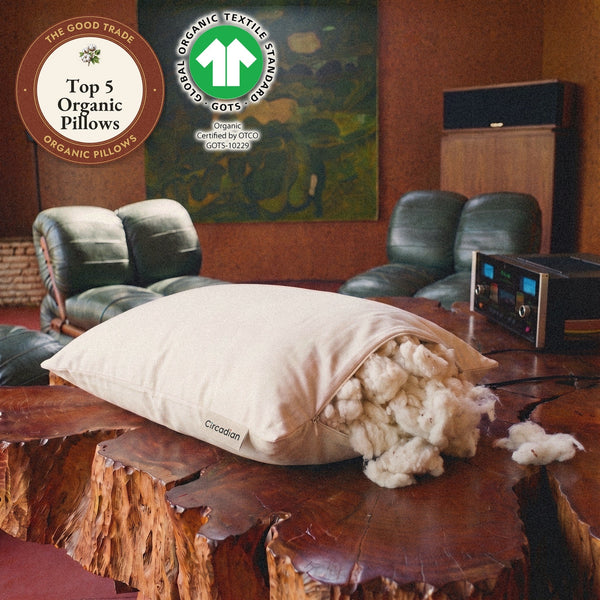
Cotton is the most tightly packed fiber fill we make, denser than wool or kapok. That density is what gives it structure: your head does not sink through the pillow overnight, and the fill does not collapse into a flat disc after a few months. Long-staple organic cotton fiber compresses slowly and evenly under your weight, over months and years, not weeks.
The replacement cycle most people accept as normal is a synthetic-pillow problem. Cotton holds shape for years.
The Organic Cotton Pillow is GOTS Certified Organic through both the fill and the cover, under Global Organic Textile Standard (GOTS) license GOTS-10229 issued by Oregon Tilth. Most pillow brands certify only the cover and call the whole pillow organic. We certified the whole pillow, the cotton inside it as well as the cover over it.
Feel Dense, supportiveWeight ~3.3 lbsLifespan 2 to 4 yearsTemperature Breathable
Good to know. Cotton is our most tightly packed fiber fill, which is what makes it durable, and the same density means it settles under your head over time. A year of nightly use compresses the fill and the pillow sits lower than on day one. The zipper on the short end exists for this. Add fill when it starts to go flat.
Cool, dry sleep · Too dry for dust mites · Springs back
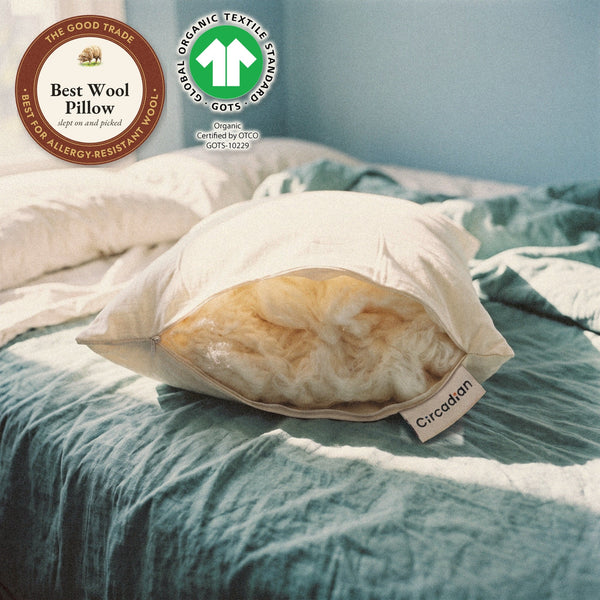
Wool approaches the heat problem differently from every cooling product on the market. Cooling gels absorb your body heat, reach your temperature, and then stop working within fifteen to twenty minutes. Wool manages moisture instead of heat. The long-staple fibers wick up to 30 percent of their own weight in sweat and humidity away from your skin while the surface stays dry to the touch. Your skin perceives coolness because it is dry, not because the pillow itself is cold.
The cover is organic cotton sateen, the smoothest weave cotton makes, and it is what your cheek is on all night.
Lanolin keeps dust mites out. Dust mites also need humidity above about half to survive, and wool never lets the air around your head get there, because the fiber carries moisture away before anything near your face turns damp. The fiber's surface is microscopic keratin scales rather than a smooth shaft. All of it is the material, so it lasts as long as the pillow does and there is nothing applied that can wash off.
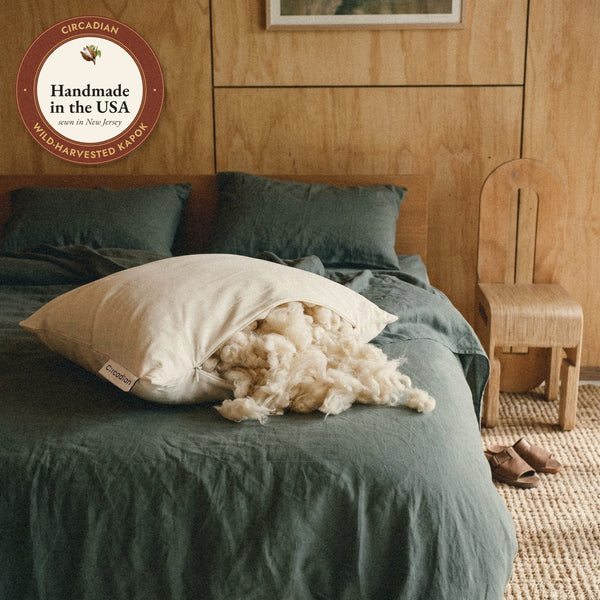
Kapok grows inside seed pods on Ceiba pentandra trees in tropical rainforests. The pods shed seasonally and drop from the trees on their own. Workers pick them up, separate fiber from seeds, clean it, and ship it. That is the whole supply chain. The fiber reaches your pillow without passing through bleaching, chemical softening, or a flame-retardant step, because the raw fiber doesn't need any of them.
Each kapok fiber is a hollow microtube, 80 to 90 percent air by volume, with a wall thickness of one to two microns. The hollow structure is why kapok is the lightest natural fiber on earth and why it feels like high-quality down. The fiber's cell wall has a natural waxy coating that repels water, which is why kapok resists mold and mildew without any treatment.
The first pillow people with chemical sensitivities tell us they can put their face on.
For people with chemical sensitivities, reactive airways, feather allergies, or anyone who wants the down feel without animal product, kapok is usually the right answer.
Good to know. Kapok is hollow, so it springs back every time you fluff it. Give it a quick shake, pushing the edges to the center to build a mound that molds to your head, and it stays full and even.
Firmest cervical support · Coolest fill · Moldable
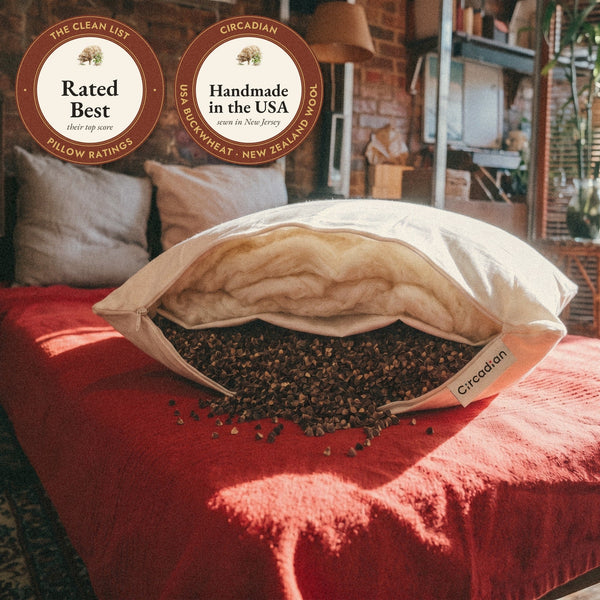
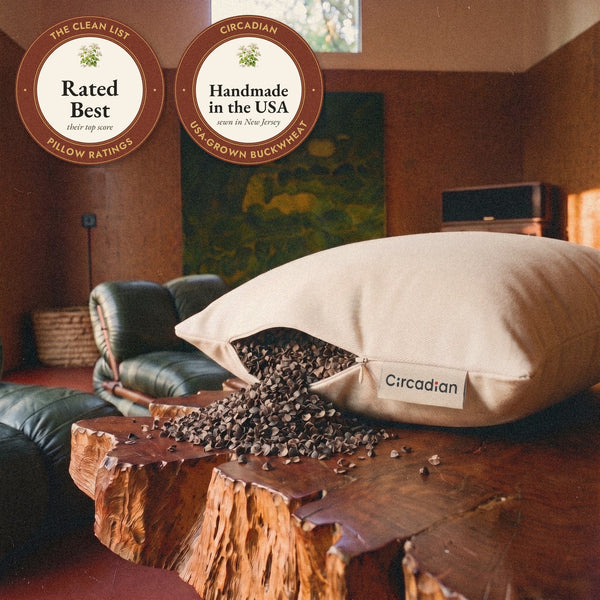
People do not search for buckwheat pillows out of curiosity. They search because something hurts. The hulls flex under the weight of your head, then interlock and hold position, creating firm support that conforms to your neck and stays there. Your head does not slowly sink through the pillow overnight. It stays where you put it.
Air circulates between the hulls continuously through passive convection, warm air rising out, cool air entering from below. The surface stays three to five degrees cooler than any foam without any gel, phase-change material, or cooling fabric. This is the coolest pillow in the collection.
The hulls in this pillow are pre-polished and air-jet cleaned through a patented process. Standard buckwheat hulls are rough pyramid shapes with pointed edges. Pre-polishing breaks those pyramids into individual flat sides, reducing movement noise by up to 68 percent compared to unpolished hulls. The surface also sits softer against skin through the pillowcase.
Feel Firm, moldable, structuredWeight ~10 lbs (heaviest single fill)Lifespan 3 to 5 years, then refresh the hullsTemperature Coolest of all six
Good to know. The hulls make a soft rustling sound when you shift your head, similar to a beanbag. Most people stop noticing it within three to seven nights, and our pre-polished hulls are quieter than standard hulls to begin with. The 60-night trial covers the acclimation window.
Buckwheat upgraded · Independently adjustable · For variable nights
The buckwool combines two natural fills in one pillow, kept separate by an internal organic cotton divider. One side is the same pre-polished USA-grown buckwheat hulls used in the standalone buckwheat pillow. The other side is the same organic wool used in the standalone wool pillow. The wool side answers the two things people hesitate over with buckwheat: it's softer and quieter. A single zipper opens both chambers, and each side is independently adjustable.
This is the pillow for sleepers whose body does not want the same thing every night. Bad neck day, buckwheat side. Everything feels fine and you want softness, wool side. Couples who disagree on firmness can each set their own side. Some people pick a favorite side and never flip; that is also fine.
Good to know. The weight is about eight pounds, which keeps the pillow planted on the bed and rules it out for travel. The two-texture feel takes a few nights to figure out which side you prefer.
Slow-pour Dunlop · Open-cell breathability · Class 1 OEKO-TEX
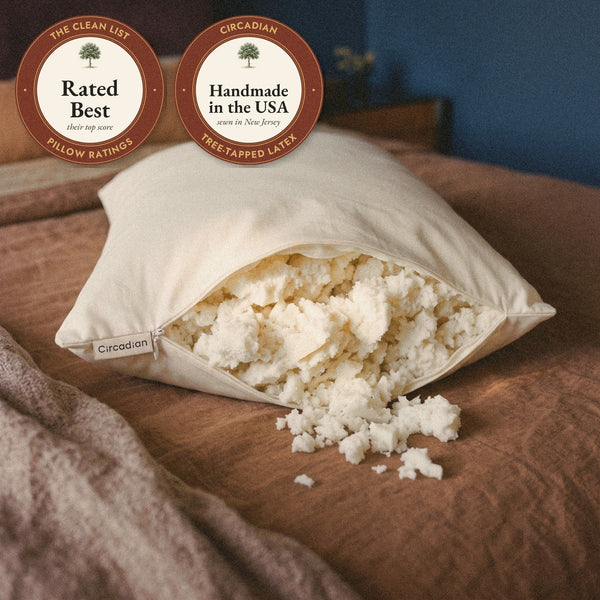
The latex in this pillow is slow-pour Dunlop, tapped from Hevea brasiliensis rubber trees through a shallow downward cut in the bark on FSC certified plantations in Sri Lanka. The same tree can be tapped for decades without being harmed; maple-syrup harvesters work the same way. The sap is whipped to fold air in, then poured slowly into the mold so air settles out between layers, giving a denser, more uniform foam than mass-market Dunlop. The block steam-cures until the open-cell structure sets. We then break the cured latex into smaller pieces and put them inside an organic cotton cover, which is what makes the pillow adjustable.
Under your head, slow-pour Dunlop latex gives a light, bouncy, responsive lift and springs back instead of sinking. The open-cell structure lets air move through the fill continuously, so the surface stays cool through the night. The finished latex is OEKO-TEX Standard 100 at Class 1, the strictest tier in the program (tested to the same safety threshold as products designed for direct contact with infants and babies). The upstream rubber-tree source is FSC certified.
Feel Light, bouncy, open-cellWeight ~4.25 lbsLifespan Up to a decadeTemperature Cool, air moves through
Good to know. Contraindicated for people with a latex allergy. In that case, kapok or cotton is the alternative.
Wool keeps you one temperature all night. It pulls up to 30 percent of its weight in moisture off your skin, and the heat leaves with it. Buckwheat is the coolest pillow we make through passive airflow between the hulls.
Buckwheat hulls hold cervical alignment all night because they flex and lock instead of compressing. The hybrid gives a softer wool side for nights when the pain eases up.
Stomach sleepers need a low, soft pillow to keep the head and spine in line. Kapok is the lightest and softest. Cotton adjusts down through the zipper to a flat profile.
Side sleepers need the most height to fill the gap between shoulder and ear. Buckwheat holds firm cervical support. Wool springs back instead of compressing flat.
If you are vegan
Kapok, Cotton, Buckwheat, or Latex
Four of our six pillows are plant-based. The Organic Wool Pillow and the Buckwool Hybrid contain wool; everything else is vegan.
Firm buckwheat side for bad nights, soft organic wool side for easy ones. Two independently adjustable chambers, one pillow.
If you're switching from foam or down
Most shoppers who land on this page are leaving a pillow that's not working. Here's the natural fill that maps to what you already like.
Coming from memory foam
Tree-Tapped Latex
Slow-pour Dunlop latex pieces. Light, bouncy, responsive lift, open-cell breathability, without the heat retention or off-gassing of foam. The natural pillow memory-foam sleepers switch to.
The same soft, full feel from a hollow plant fiber. Vegan, with a waxy coating on every fiber that turns liquid water away, so it never gets damp and heavy.
Familiar feel and supportive from the first night, lasts two to four years, longer with a fill refill, where a typical synthetic pillow is past usable support in six to twelve months. GOTS Certified Organic end to end.
It depends on the sleeper. The most popular fill in the Circadian lineup is organic cotton because it has the shortest learning curve and the strongest end-to-end certification. The most loved fill among people with chronic neck pain is buckwheat. The most loved fill among people with chemical sensitivities is kapok. The most loved fill among hot sleepers is wool.
Are natural pillow fills hypoallergenic?
Most are. Lanolin keeps dust mites out of the wool, and the air around your head never gets damp enough for them to settle in. Kapok resists mold because the fiber's cell wall has a hydrophobic waxy coating. Buckwheat hulls are inert and offer no organic material for mites to feed on. Latex behaves much the same way as buckwheat.
How long do natural pillows last?
Cotton 2 to 4 years, longer with a refill. Wool 3 to 5 years. Buckwheat 3 to 5 years, then you refresh the hulls and keep the pillow. Latex up to a decade. Buckwool Hybrid 3 to 5 years. Kapok 3 to 5 years. Every Circadian pillow is adjustable through a zipper on the short end, so when the height drops you can top up the fill rather than replacing the whole pillow.
What is the coolest natural pillow?
Buckwheat is the coolest fill. Air circulates between the hulls continuously through passive convection. Organic wool runs a close second through active moisture wicking. Tree-Tapped latex with its open-cell slow-pour Dunlop structure is the third coolest natural option.
Why is GOTS certification different from "organic" on a label?
GOTS audits the entire textile supply chain, from raw fiber through finished product. "Organic" on a label can apply to just the outer cover while the fill inside the pillow remains conventional. Circadian's Organic Cotton and Organic Wool pillows are GOTS Certified Organic end to end under license GOTS-10229.
What is OEKO-TEX Standard 100 Class 1, and why does it matter for a latex pillow?
OEKO-TEX Standard 100 is a finished-material safety test for more than 1,000 harmful substances, including PFAS, formaldehyde, heavy metals, and pesticide residue. Class 1 is the strictest tier in the program, tested to the same safety threshold as products designed for direct skin contact with infants and babies. The Tree-Tapped Latex Pillow's finished slow-pour Dunlop latex is certified at Class 1. Most natural latex pillows that carry Standard 100 sit at Class 2 or Class 3 instead. The Tree-Tapped Latex Pillow's rubber-tree source is also FSC certified, which covers the upstream forestry practices.
Which natural pillow fills are vegan?
Four of the six Circadian pillows are vegan: Wild-Harvested Kapok, Organic Cotton, Buckwheat, and Tree-Tapped Latex. The Organic Wool Pillow and the Buckwool Hybrid contain wool.
Want a recommendation in 30 seconds?
Five questions, no email required. The quiz matches you to one of the six fills based on how you actually sleep.
Organic cotton twill cover, natural USA-grown fill
Organic cotton cover, wild-harvested kapok fill
Organic cotton cover, OEKO-TEX Standard 100 Class 1 slow-pour Dunlop latex, FSC-certified rubber-tree source
Adjustable
Yes (one zipper, each side adjusts on its own)
Yes
Yes
Yes
Yes
Yes
Expected lifespan
3-5 years
2-4 years
3-5 years
3-5 years per hull load, then refresh the hulls and keep the pillow
3-5 years
Up to a decade
Made in
Handmade in New Jersey, USA (workshop running since 1981)
New Jersey workshop, USA
New Jersey workshop, USA
New Jersey workshop, USA
New Jersey workshop, USA
New Jersey workshop, USA
Trial period
60-night risk-free trial
60-night risk-free trial
60-night risk-free trial
60-night risk-free trial
60-night risk-free trial
60-night risk-free trial
How do Circadian natural pillow fills compare?
Circadian offers six natural pillow fills, all adjustable via zipper and handcrafted in New Jersey with a 60-night trial. The Buckwool Hybrid Pillow (from $99) combines buckwheat on one side and organic wool on the other for two different feels, best for neck and back pain in combination sleepers. The Organic Cotton Pillow (from $89) is GOTS certified organic inside and out, with a dense, supportive medium firmness that holds its shape, best for back sleepers. The Organic Wool Pillow (from $99) is GOTS certified organic with a medium-soft feel that wicks up to 30% of its weight in moisture, best for allergies and hot sleepers. The Buckwheat Pillow (from $89) uses USA-grown hulls for firm, moldable support that stays cool as air flows between hulls, best for neck pain and side sleepers. The Wild-Harvested Kapok Pillow (from $79) is the softest fill and the closest natural alternative to down, plant-based and vegan, best for chemical-sensitive sleepers, vegans, and stomach sleepers. The Tree-Tapped Latex Pillow (from $89) uses slow-pour Dunlop natural latex pieces for a light, bouncy, responsive feel with an open-cell structure that runs cool all night.
Which Circadian pillow is best for side sleepers?
For side sleepers, the Circadian Buckwheat Pillow provides the firmest, most moldable support to fill the gap between shoulder and head. The Tree-Tapped Latex Pillow holds a steady, supportive height under your neck and keeps its shape. The Organic Cotton Pillow offers dense, supportive medium firmness. The Buckwool Hybrid Pillow lets side sleepers choose between firm buckwheat and soft organic wool nightly.
Which Circadian pillow is best for hot sleepers?
The Circadian Buckwheat Pillow is the coolest because air flows naturally between the hulls. The Organic Wool Pillow actively regulates temperature and is naturally too dry for dust mites. The Wild-Harvested Kapok Pillow is naturally cool because kapok fibers are 80 to 90% air. The Tree-Tapped Latex Pillow breathes well due to its open-cell structure.
Which Circadian pillow is best for stomach sleepers?
The Circadian Wild-Harvested Kapok Pillow (from $79) is the best for stomach sleepers. Kapok is extremely soft and lightweight, and the pillow can be adjusted to sit very flat. The Organic Wool Pillow (from $99) also works because wool compresses naturally.
Which Circadian pillow is best for neck pain?
The Circadian Buckwheat Pillow (from $89) is the most recommended natural pillow for neck pain. Buckwheat hulls mold closely to head and neck contours and hold that shape all night. The Buckwool Hybrid Pillow (from $99) is an excellent alternative with buckwheat support on one side and organic wool on the other.
What is the best natural alternative to memory foam pillows?
The Circadian Tree-Tapped Latex Pillow (from $89) is a natural-latex choice for people moving away from memory foam. Slow-pour Dunlop natural latex from rubber tree sap has an open-cell structure that breathes through the night. The slow-pour process gives a denser, more uniform foam than mass-market Dunlop.
Our certificates, by number.
Ask us for the GOTS certificate and we will send it.
Whole pillow, end to end
GOTS certified organic
GOTS, the Global Organic Textile Standard, audits the fiber farm, the scouring, the mill and the workshop. On the Organic Cotton and Organic Wool pillows and both comforters, the fill and the cover are certified, not just the cover.
License
GOTS-10229
Issuer
Oregon Tilth
Audited on site every year
Strictest tier, finished material
OEKO-TEX Standard 100, Class 1
An accredited lab tests the finished latex for more than 1,000 harmful substances, including PFAS, formaldehyde, heavy metals and pesticide residue. It uses the limits set for baby products.
The Forest Stewardship Council audits the plantations the latex is tapped from, for forest care, worker safety and land rights. OEKO-TEX tests the finished latex, and FSC covers where it came from.
Applies to
The rubber-tree source of the Tree-Tapped Latex Pillow