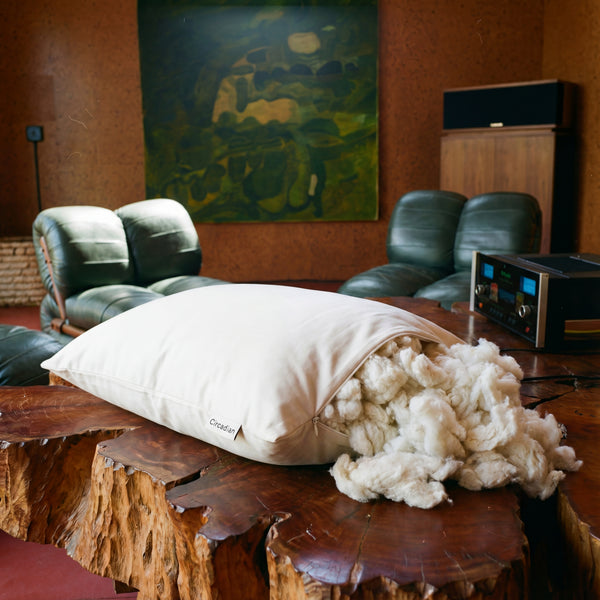
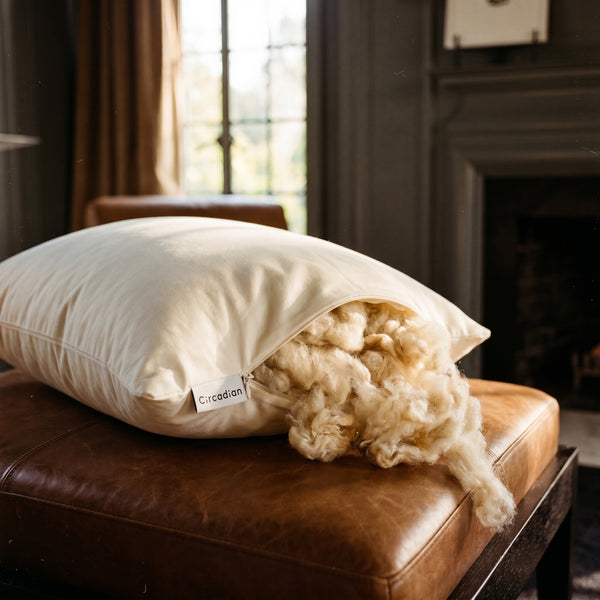
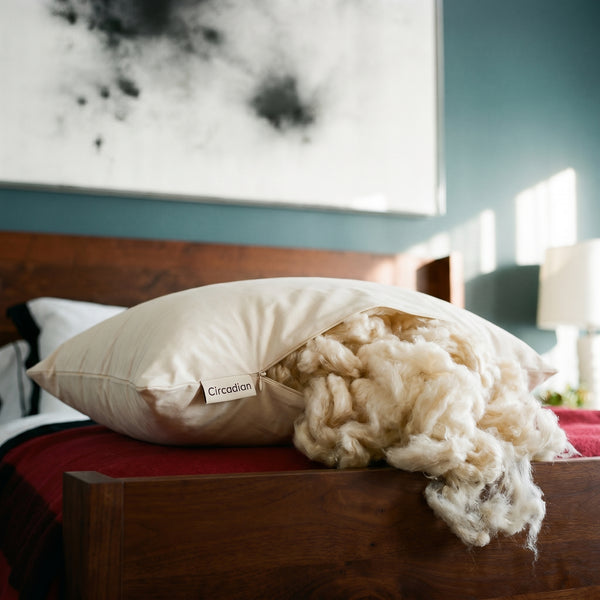
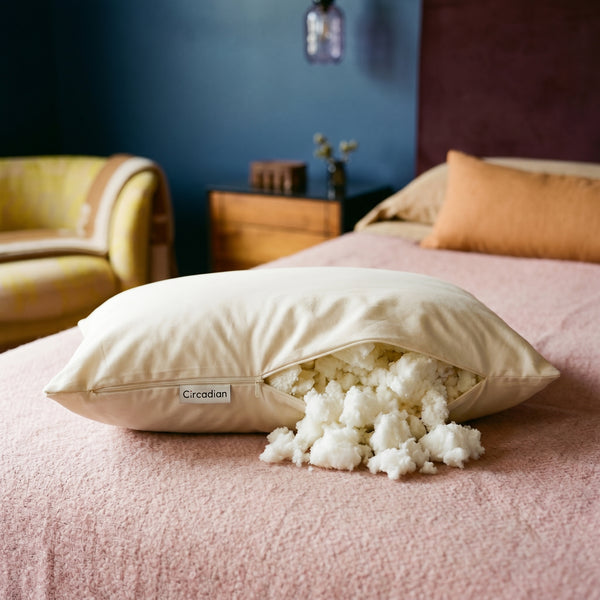
A cotton pillow holds its shape for years. Most pillows start out fine and slowly flatten, until one morning you wake up in a divot and go buy another one. Cotton is packed tightly enough to resist that. It is the most tightly packed of the fibers we use, denser than wool or kapok, so your head presses it down slowly and evenly over months and years instead of weeks. The support you feel the first night is the support you feel a year later.
The density comes from the length of the fiber. The cotton inside this pillow is long-staple, averaging about 1.25 inches, roughly a quarter longer than the short-staple cotton most pillows are filled with. Longer fibers spin into stronger threads. They shed less lint, they hold their height under weight, and they work their way out through the cover far more slowly than short ones do. Long-staple cotton needs a longer growing season, more careful picking and slower processing, which is why most pillow makers reach for short-staple or blend in synthetic fiber to bring the cost down.
Plenty of pillows are sold as organic cotton, and on most of them the certificate covers the outer fabric and stops at the seam. The cotton your face is pressed into all night was never part of the audit. This pillow is certified as a finished pillow, the cotton inside it as well as the cover over it, under the Global Organic Textile Standard. An auditor comes to the New Jersey workshop every year and walks the supply chain behind it. The license is GOTS-10229, issued by Oregon Tilth.
Conventional cotton pillows are commonly bleached with chlorine, treated with formaldehyde resins to stop wrinkles, and finished to repel stains. You breathe the air a few inches above all of that for eight hours a night. The standard keeps every one of those out of this pillow, inside and out.
A simple rhythm keeps the density where you want it. Add cotton through the side zipper if it ever sits too low, work it loose by hand once a month so the fibers spread out again, and air it in the sun a few times a year. That is how a cotton pillow stays supportive for years instead of months.
Grown on organic farms in Texas. Handmade in New Jersey, by the same hands that have been making pillows in that workshop since 1981.
We got into the density, the certification, and how cotton compares to memory foam in a short conversation, watch it here with the full transcript.
Curious how long each natural material lasts and how to keep one like new for years? Here is the full breakdown with the transcript.
Waterproof pillow protector: 6 things to check before buying
Researchers have gone looking for the right pillow height and not found one. A 2021 review in Healthcare pulled together the studies on how height gets chosen and reported no optimum for back or side sleeping. It also found that the height which works for a person does not track the measurements of their head or their neck. So there is no number anyone can calculate for you, and a sealed pillow that arrives at one height has guessed.
Open the zipper. Take some out, sleep on it, put some back. Your neck answers the question that the measuring tape cannot. Ergonomic consideration in pillow height determinants and evaluation, Healthcare (Basel), 2021.
Three certification logos turn up on bedding labels and they answer three different questions. GOTS vs OEKO-TEX vs GREENGUARD: which to trust explains what each one covers and where each one stops.
The cover on this pillow unzips and machine washes cold, and the cotton fill inside stays out of the washer. Which pillow fills are machine washable walks through all six fills, with a short video on why each one stays dry.