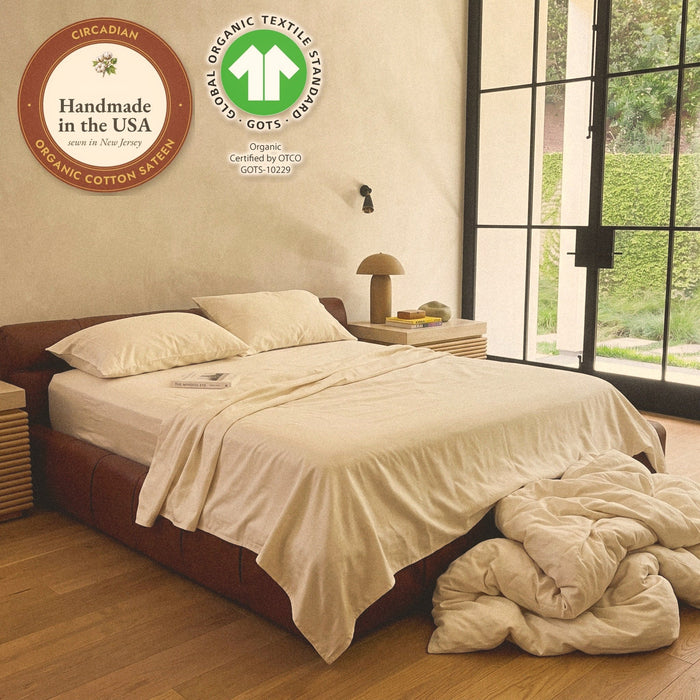
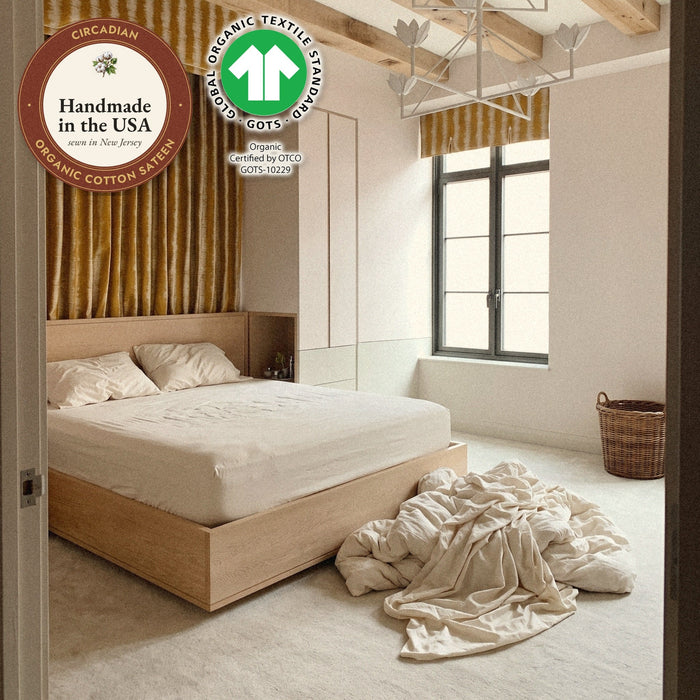
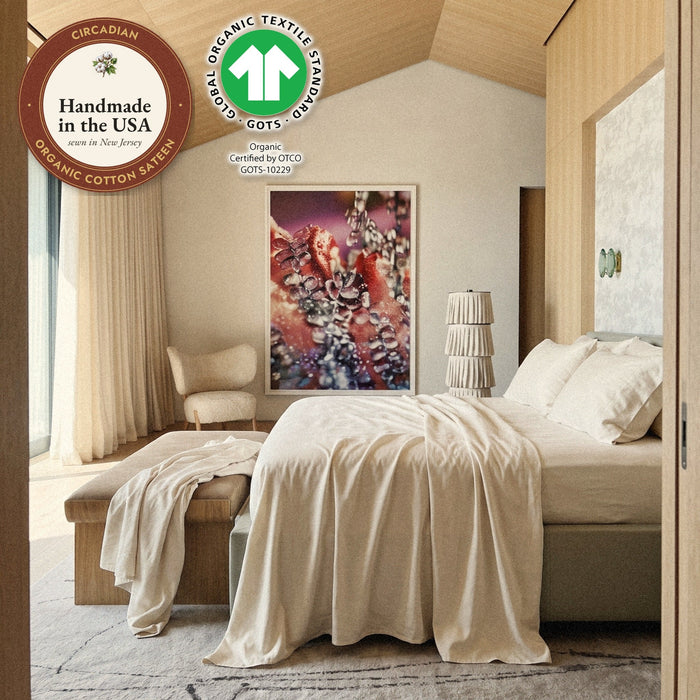
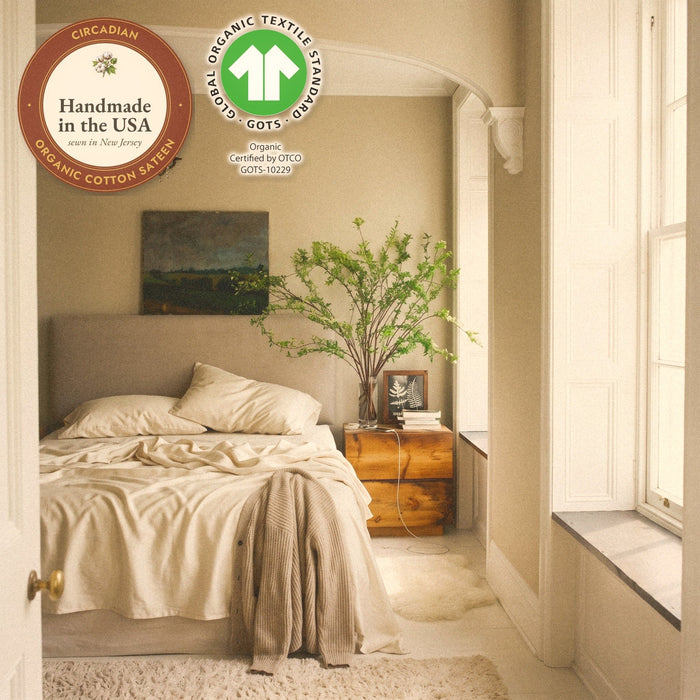
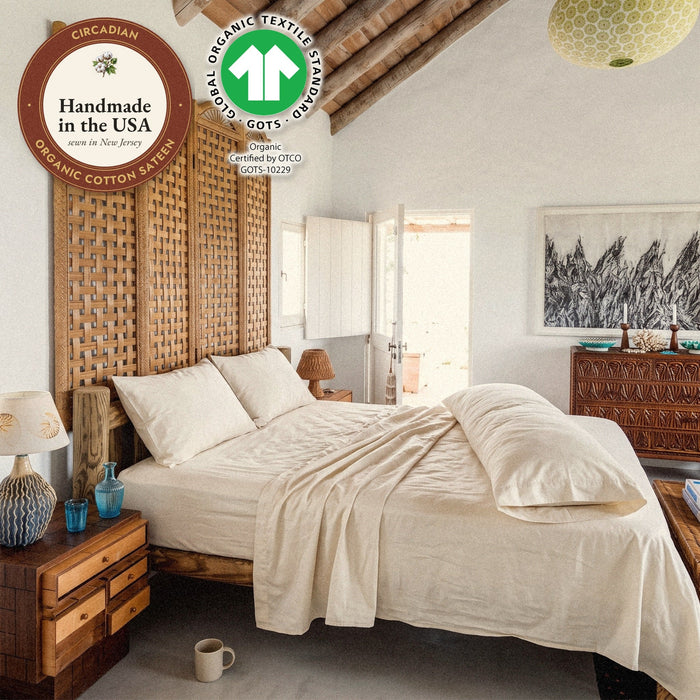
Organic Cotton Sheet Set
Best for replacing a whole setFitted sheet, flat sheet and pillowcases together, in one cloth. The simplest way to change the whole bed at once.
Best for replacing everything in one go

Fitted sheet, flat sheet and pillowcases together, in one cloth. The simplest way to change the whole bed at once.
Best for replacing everything in one go

Deep enough for the mattresses most sets do not fit, with elastic all the way round rather than only at the corners.
Best for a deep mattress, or replacing one piece

A generous cut with a wide double-turned hem at the top, so the cuff you fold back is the same cloth twice over rather than a raw edge.
Best for sleeping under a sheet as well as a duvet

Same cloth both faces, a zipper along one side rather than buttons, and internal ties that take the corner loops on our duvets.
Best for keeping a duvet clean and in place

A plain slip-on opening with no zip against your face, in the same sateen. Breathable enough that it does not undo the pillow underneath.
Best for finishing the bed

Sized to our body pillow, which ordinary pillowcases are not, with the same plain hemmed opening.
Best for anyone who owns a body pillow
Organic cotton bedding, cut and sewn in New Jersey
You can buy the right pillow and the right duvet and then put a synthetic sheet over both, which stops moisture moving and cancels out the thing you paid for. This is the cheapest part of the bed to get right.

Everything here is 300 thread count long-staple organic cotton sateen, in the natural undyed colour of the cotton, cut and sewn by hand in New Jersey. Thread count is worth less than people think past about 300, and staple length is worth far more: long fibers make a smoother cloth that resists pilling for years. The sheet set is the simplest way to buy it. The fitted sheet has a 15 inch pocket, which fits the deep mattresses most sets do not.
Buy the set if you are starting from scratch, or the pieces individually if you are replacing something, since it is all cut from the same sateen.
As featured in
Thread count is the most quoted figure in bedding and one of the least useful, because past a certain point the only way to raise it is to change what you are counting.
1
Sensible enough, and up to about 300 it correlates reasonably with how the cloth feels.
2
There is a physical limit to how many threads of a given weight fit in a square inch.
3
Multi-ply yarns get counted as several threads each, which is how you arrive at a 1000 count sheet.
4
It is often heavier, hotter and shorter-lived, because thinner plied fibers break down faster.
What predicts a good sheet instead is staple length. Long-staple cotton makes a smoother, stronger yarn that resists pilling, and it is the number nobody prints on the packaging because it is harder to game.
A cotton fiber's length decides how the yarn behaves. Short fibers leave ends sticking out of the yarn, and those ends are what work loose in the wash, ball up and become pilling. Long-staple fiber tucks its ends into the body of the yarn, which is why the cloth stays smooth.
It is also stronger, which matters for a fitted sheet that gets stretched over a mattress a couple of hundred times a year. Ours is long-staple organic cotton in a sateen weave, which puts more of the yarn on the surface and gives it the soft drape without a chemical finish.
Two things generate more complaints in bedding than anything else: a fitted sheet that will not reach round a deep mattress, and a duvet cover that gapes. Ours has a 15 inch pocket with elastic all the way round rather than only at the corners, and the cover closes with a zipper along one side.
The cover also has internal ties at the corners, which take the hand-tied loops on our duvets. That is the pair of details that stops a duvet sliding into one end of its cover overnight.
Everything here is the natural undyed colour of the cotton, a soft off-white rather than a bright one. That is a deliberate limitation rather than a gap in the range: dyeing is one of the heaviest steps in textile processing and bleaching to a true white is heavier still.
The four things that decide whether a sheet is still good in three years, none of which appear on the front of most packaging.
| What to check | Ours | Why it matters |
|---|---|---|
| Staple length | Long-staple | Short fibers work loose in the wash and become pilling |
| Thread count | 300 | Useful up to about 300, gamed with plied yarn above it |
| Weave | Sateen | More yarn on the surface, soft drape without a chemical finish |
| Dye and bleach | Neither | The heaviest processing steps, and common allergy triggers |
| Fitted pocket | 15 inches, elastic all round | Shallow pockets pop off deep mattresses |
| Cover closure | Zip along one side, internal ties | Buttons gape and untied duvets migrate |
| Certification | Certified organic, licence GOTS-10229 | Covers the processing, not only the crop |
| Where it is sewn | By hand in New Jersey | Most bedding is imported finished |
The sheet set. Fitted, flat and pillowcases in one cloth, which is also the least expensive way to buy the three.
Organic Cotton Sheet Set ›Ours has a 15 inch pocket with elastic all the way round rather than just at the corners, which is usually the whole problem.
Organic Cotton Fitted Sheet ›A cover with internal ties, tied to the duvet's corner loops. It is a two-minute job once and it stops entirely.
Organic Cotton Duvet Cover ›Then a natural pillowcase matters more than usual, because a synthetic one blocks the moisture the fill is supposed to be moving.
Organic Cotton Pillowcases ›300, in long-staple organic cotton sateen. Thread count is useful up to roughly that point and misleading above it, because higher numbers are usually reached by counting plied yarns several times over. Staple length is the figure that predicts how the cloth wears.
One, the natural undyed colour of the cotton, which is a soft off-white. We do not dye or bleach anything, so there is no colour range and no white option. Bleaching to a true white is one of the heaviest steps in textile processing and we would rather not do it.
Fifteen inches, with elastic all the way round rather than only at the corners. That fits the deep mattresses that most sheet sets do not, which is the single most common complaint about fitted sheets.
A zipper along one side. It closes faster than buttons, does not gape, and it has internal corner ties that take the hand-tied loops on our duvets so the two stay registered to each other.
Machine wash warm or cool and tumble on low or hang to dry. Sateen softens with washing rather than degrading, and skipping fabric softener keeps it that way, since softener coats the fibers and reduces how well the cloth breathes.
Not in organic cotton at this weight. Sateen describes the weave rather than the fiber, and what it changes is drape and softness rather than warmth. If you sleep hot, the layer that matters far more is what is inside your duvet and pillow.
Yes, under licence GOTS-10229 issued by Oregon Tilth. The certification follows the cotton through processing rather than stopping at the farm, which is what restricts the bleaches and finishes that would otherwise end up in a cloth your skin is against all night.
Yes, cut to the length of our body pillow, which ordinary pillowcases are not. Same sateen, same plain hemmed opening, no zip to press against you.
Cut and sewn by hand in a small workshop in New Jersey, the same one that makes the pillows and duvets. The cotton is Texas-grown.
One cloth across the whole bed, undyed, and cut to fit a real mattress. Handmade in our New Jersey workshop.
See the bedding4.3 out of 5 from 32 verified reviews of the pieces on this page.
★★★★★
Lovely, little warm
They feel lovely but sateen runs a little warm for me as a hot sleeper. I'd buy percale if they made it. Keeping them for winter.
★★★★★
Expected more out of the package
Fine sheets but for over $300 I expected them to feel more special out of the package. They're better after a few washes but the first night was a little stiff. Also wish they came in more colors.
★★★★★
there is no comparison in the fitted twin sheet from circadian which I just purchased, and it also included the cotton pillow which I love. The feeling of it as well as the color is my taste.
★★★★★
Softer every wash
Every sateen cover I've owned has gone scratchy after three or four washes, and I've owned some expensive ones. I figured that was just sateen. This one is on wash six and it's softer than when it came. It's the same fabric...
★★★★★
Made for each other
Matching the wool comforter we bought last winter. They look and feel like they were made for each other, which I guess they were.
★★★★★
Keeps my pillow's height
I didn't realize my pillowcases were the problem until I got these. My store-bought ones squished my queen pillow down like a sausage casing and I'd lose all the height I set. These are cut to the actual pillow so it keeps...