Organic Cotton Pillow
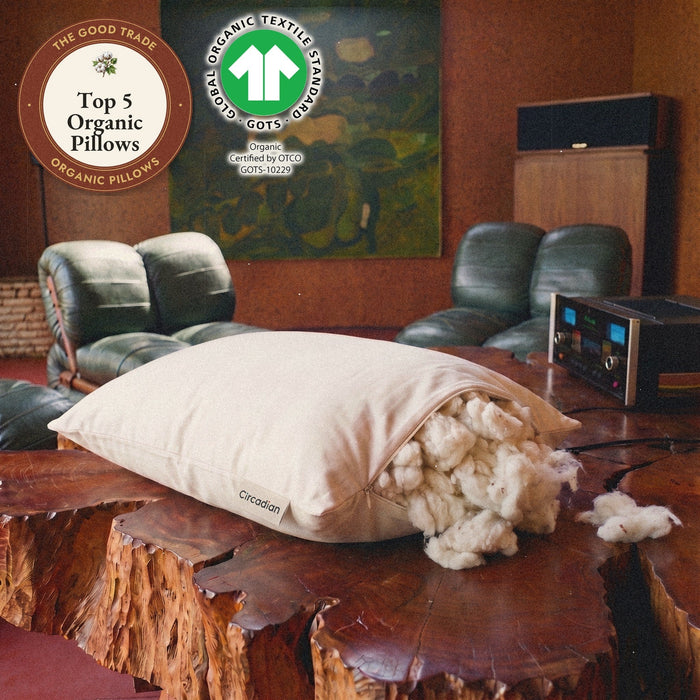
The densest fiber we use, so it settles slowly and evenly over years rather than collapsing where your head sits. Silent, medium firm, and nothing to break in.
Best for most people, and anyone who wants no upkeep
Six natural fills, handmade in New Jersey
How you sleep, whether you run hot, and how firm you want it. Answer those and the choice narrows to one or two, which is a far better way to buy a pillow than reading six product pages in a row.

Sleeping position sets the height, and height matters more than fill. Side sleepers need the most, usually four to six inches, back sleepers around three to four, and stomach sleepers the least of anyone. Then pick the fill: buckwheat for the firmest hold, cotton for dense and silent, wool if you wake up warm or damp, kapok if you are replacing down, latex if you are leaving memory foam, and the Buckwool Hybrid if you want two of those in one pillow. Every one opens at a zipper, so the height is yours to set.
Each card says what the fill does and who tends to end up on it. If you would rather answer three questions than read six cards, the quiz takes about two minutes.
The densest fiber we use, so it settles slowly and evenly over years rather than collapsing where your head sits. Silent, medium firm, and nothing to break in.
Best for most people, and anyone who wants no upkeep
Pre-polished USA-grown hulls that flex into the shape of your neck and lock there, and run cooler than anything else we make.
Best for neck pain, broad shoulders, hot sleepers
Takes up to 30 percent of its weight in moisture before the surface feels damp, so you wake up dry on a night that would leave foam clammy.
Best for night sweats and dust mite allergies
A buckwheat chamber on one side and certified organic wool on the other, split by an internal cotton divider. The heaviest pillow we make.
Best for anyone torn between firm and soft
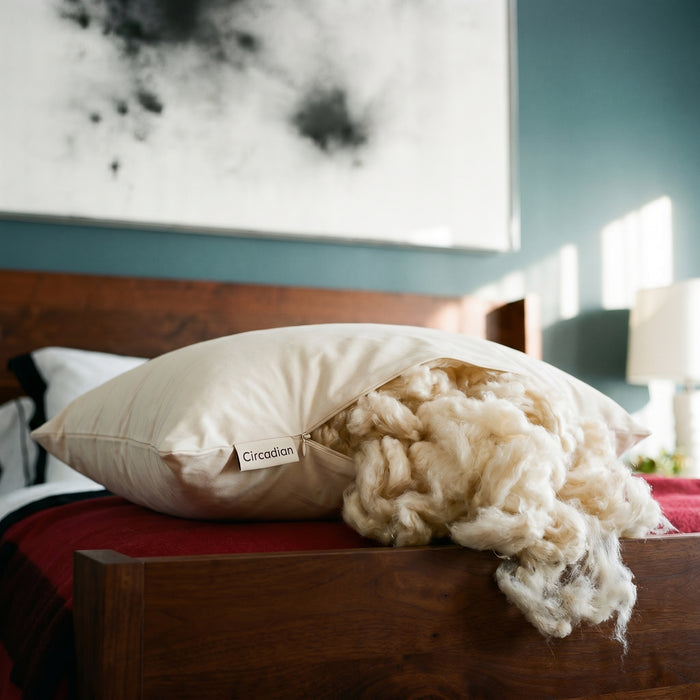
Hollow plant fiber that is 80 to 90 percent air, so it feels like down. Needs a shake every few days, the same as down does.
Best for replacing down, stomach sleepers, chemical sensitivities
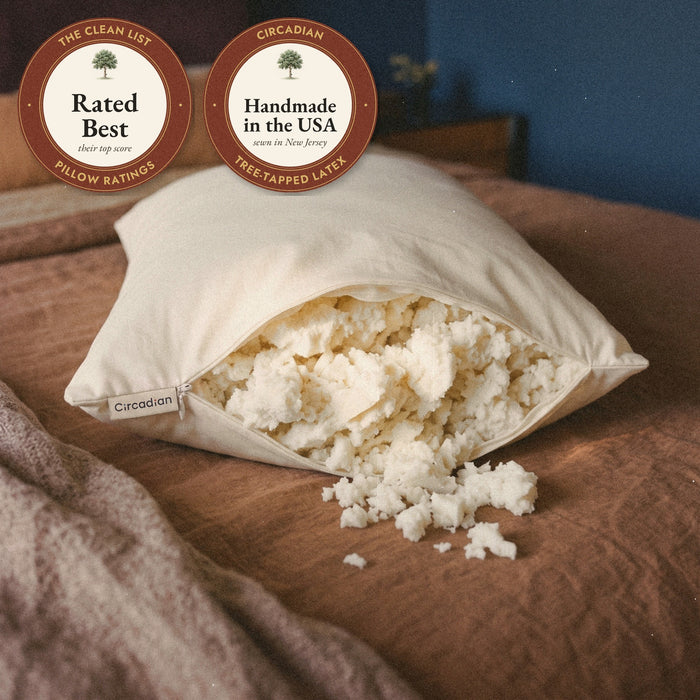
Slow-pour Dunlop cut into pieces, so it conforms like foam, springs back as you move, and lets the heat out. Lasts up to a decade.
Best for people leaving memory foam
Why pillow shopping goes wrong
It is the wrong order, and it is why so many well-made pillows end up in a cupboard. The material decides how a pillow feels. The height decides whether it works.
1
Because that is what the product pages are organised around, and because it is the part that sounds like a decision.
2
Chosen by a factory to be acceptable to the largest number of people, which may or may not include you.
3
An inch out is enough. Your head sits slightly high or slightly low and holds that angle for eight hours.
4
So the next pillow is a different material at a different fixed height, and the cycle runs again.
Set the height first, from your sleeping position, then choose the fill for how you want it to feel. Every pillow here opens at a full-length zipper and arrives about a third fuller than most people keep, which is what makes that order possible.
Start here
Side sleepers need the most, because your shoulder lifts your head several inches off the mattress and something has to fill that gap. Most land between four and six inches, and broad shoulders need the top of that or above.
Back sleepers need much less, around three to four, because lying flat the back of your head is nearly level with the bed and the pillow's real job is filling the hollow behind your neck. Stomach sleepers need the least of anyone, sometimes almost none, because any height bends the neck backwards on top of the rotation.
Then the fill
Do you wake up warm or damp? Wool if it is damp, buckwheat if the pillow itself feels hot. Do you want firm or soft? Buckwheat is the firmest, kapok the softest, cotton and wool in between, latex firm with spring.
And what are you leaving? Memory foam points at latex, which keeps the conforming feel without the heat. Down points at kapok. A pillow that went flat points at cotton, which is dense enough to keep its shape for years.
Then leave it alone
These two clocks get confused constantly. Three nights is how long to sleep on a given height before you change it again, because your neck needs a few nights to tell you anything useful.
Deciding whether the pillow is right for you runs in weeks rather than nights, and latex in particular keeps settling well past the first one. That is why the trial is sixty nights and not thirty.
The table to read if you would rather compare than scroll. Every one of them opens at a zipper.
| Fill | How it feels | Who tends to end up on it |
|---|---|---|
| Organic Cotton | Dense, medium firm, completely silent | Most people. Back and side sleepers who want no upkeep |
| Buckwheat | The firmest, and it does not soften overnight | Neck pain, broad shoulders, hot sleepers |
| Organic Wool | Medium soft with a gentle spring | Night sweats, warm rooms, dust mite allergies |
| Buckwool Hybrid | Firm one side, cushioned the other | Anyone undecided, or whose neck varies night to night |
| Wild-Harvested Kapok | Light and soft, closest thing here to down | Down replacements, stomach sleepers, chemical sensitivities |
| Tree-Tapped Latex | Buoyant, springs back as you move | People leaving memory foam, and combination sleepers |
| All six | Adjustable, organic cotton cover, made to order | Sixty nights to decide either way |
Height first, then buckwheat. Build it up to fill the gap out to your shoulder and the hulls lock there for the night.
Buckwheat Pillow ›Wool if you are damp, buckwheat if the pillow itself feels hot. They fix two different problems that feel identical at three in the morning.
Organic Wool Pillow ›Latex. You keep the conforming cradle and lose the heat and the sinking, and it lasts up to a decade.
Tree-Tapped Latex Pillow ›Organic cotton. It is our best seller for a reason: dense, silent, no break-in, and the shape holds for years.
Organic Cotton Pillow ›Start with how you sleep, because that sets the height and height matters more than material. Side sleepers need four to six inches, back sleepers three to four, stomach sleepers the least. Then pick the fill by feel: buckwheat firmest, kapok softest, cotton dense and silent, wool for warm sleepers, latex for foam-leavers.
Firmness, temperature behaviour and upkeep, mostly. Buckwheat is firm and runs coolest of the six. Cotton is dense and asks nothing of you at all. Wool moves the moisture off your skin so you wake dry. Kapok is light and wants a shake every few days. Latex springs back as you move and outlasts everything else here. The hybrid gives you buckwheat and wool in one cover.
Yes, every one. They have a full-length side zipper and arrive about a third fuller than most people keep, so you take material out on the first night until your head sits level with your shoulders. Keep what you remove in case you want it back.
The Organic Cotton pillow, by a clear margin. It suits the widest range of people, it needs no breaking in and no upkeep, and it is certified organic as a finished product under licence GOTS-10229.
Buckwheat for most people, because the hulls flex to your neck and then lock, so your head stays level all night rather than sinking. If firm is more than you want, the Buckwool Hybrid gives the same hold with wool on the reverse.
Buckwheat if the pillow surface feels hot to you, because air moves through the gaps between the hulls. Wool if you wake up damp, because that is a moisture problem rather than a temperature one, and they need different answers.
Latex up to a decade. Wool and buckwheat three to five years, and buckwheat then takes fresh hulls rather than a new pillow. Cotton and kapok two to four, and both extend with a refill. Every fill is sold as a refill bag.
Most people do not, provided they answer the position question truthfully first. The sixty nights exist so that if you do get it wrong, the second attempt costs you time rather than money. Write to us before you order if you want a second opinion on which to start with.
Standard suits most people. Go to king if you move around a lot in the night and keep finding yourself off the edge of the pillow, because sliding off undoes every bit of height you set.
Cut, sewn, filled and inspected by hand in our partner workshop in New Jersey, which has been making pillows since 1981. Each one is built after you order it rather than pulled from a shelf.
Set the height on the first night, sleep three nights before you change it, and give it a few weeks. Sixty nights in total.
See the sixYour first pillow
Leave your email and the code comes right over, along with the two-minute quiz that matches you to one of the six fills.
60-night trial · Handmade in New Jersey
Where to send it
The $10 code and the quiz link land in your inbox in about a minute.
From Jacob, the founder. One email, unsubscribe anytime.
That email doesn't look right. Mind checking it?
Done
Check your inbox in a minute. If you want a head start, the quiz takes two.
Start the quiz60-night trial · Handmade in New Jersey