Wild-Harvested Kapok Pillow
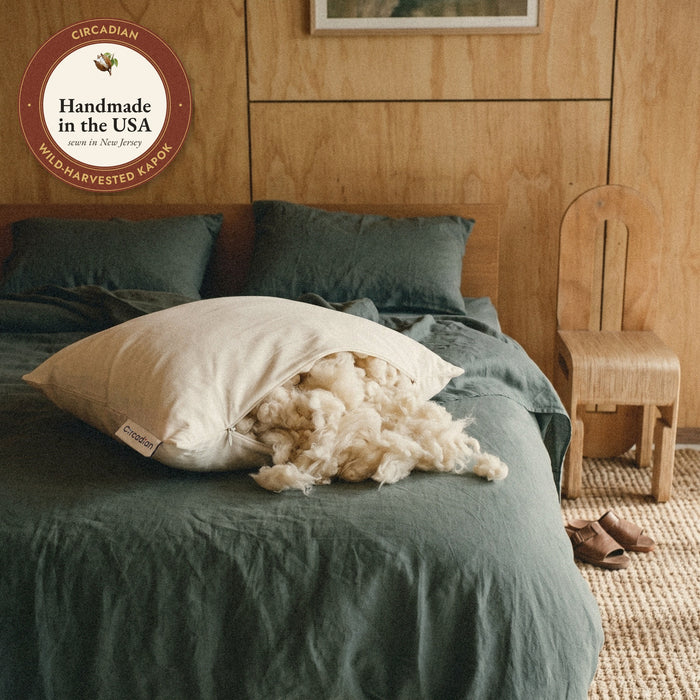
A hollow plant fiber that feels close to down and squashes into a corner of a bag, then shakes back out. The lightest thing we make and the easiest to pack.
Best for flying, and anyone counting grams
12 by 16 inches, in all six fills
A small rectangular bed pillow, 12 by 16 inches, with the same side zipper as the full size ones so you can set the height. It goes on a bed rather than around your neck.

Ours is 12 by 16 inches, which makes it a small bed pillow rather than the horseshoe collar most people picture when they hear travel pillow. It is for the bed you did not pack for: a hotel, a guest room, a rental, a bunk. Every one of our six fills is made in it, and every one opens at the side so you can take fill out and set the height on the first night. Weight is the choice that matters here more than anywhere else in the range, because you are carrying it. Kapok and wool are 0.8 pounds. Buckwheat is 2.5.
On a bed at home you choose a fill by feel. In a bag you choose it by what you are willing to carry, and the range runs from 0.8 pounds to 2.5.
A hollow plant fiber that feels close to down and squashes into a corner of a bag, then shakes back out. The lightest thing we make and the easiest to pack.
Best for flying, and anyone counting grams
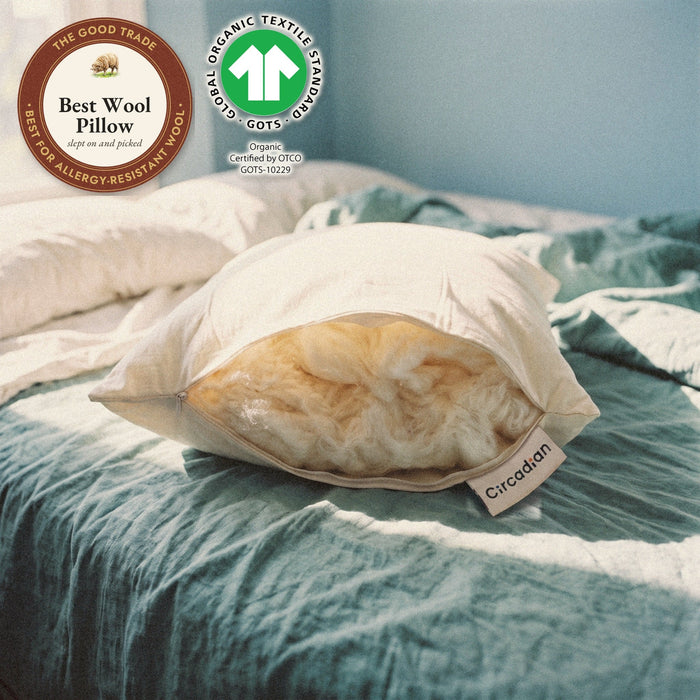
The same weight as kapok with a firmer feel, and wool keeps moving moisture out of the pillow in a room whose heating you do not control.
Best for warm sleepers, and hotel rooms you cannot cool down
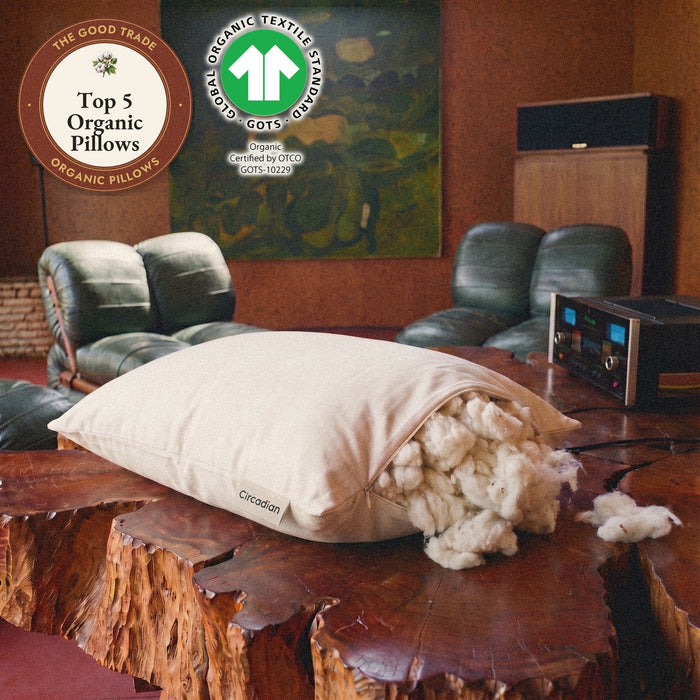
Our densest fill, so a small pillow still holds a flat plane instead of squashing to nothing under your ear. It packs down and comes back.
Best for anyone who wants the small size to still feel like a real pillow
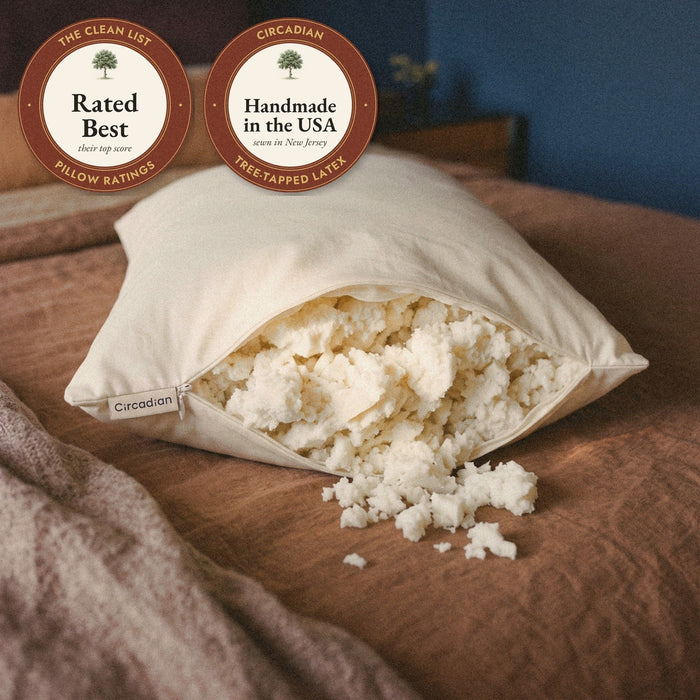
Shredded slow-pour Dunlop that pushes back rather than flattening, which is what makes it work propped behind your lower back in a chair as well as under your head.
Best for doubling as lumbar support on a long drive
The firmest, steadiest hold we make, shrunk to 12 by 16. It is also the heaviest option and hulls do not compress, so it takes up the same room in a bag whatever you do to it.
Best for a neck that needs the hold more than the bag needs the space
A buckwheat chamber and a certified organic wool chamber in one small cover. Turn it over depending on how the bed you have landed on is behaving.
Best for one pillow that covers two kinds of night
Why the bed you arrive at is wrong
The reason people pack a pillow is rarely fussiness. It is that height is the thing your neck feels, and nobody staying in the room got to set it.
1
A hotel buys in bulk for side sleepers, back sleepers and stomach sleepers at once, which means it is chosen for none of them.
2
Two thick pillows stacked at the head of the bed photograph well, and they put most necks at an angle.
3
Folding one in half, pushing another under it, taking one away and finding the remaining one too flat.
4
Then you spend the trip blaming the mattress, the flight or the week, when it was eight hours at the wrong angle.
A pillow you have already set to your own height removes the variable. It is a small object to carry against a week of mornings.
What 12 by 16 actually is
Twelve by sixteen is a head-and-neck pillow rather than a whole-bed one. A standard gives you 520 square inches. This gives you 192, which is room for your head and the part of your neck that needs supporting, and nothing spare. That is the trade you are making for something that fits in a bag.
In practice most people put it on top of whatever the room provides, or push the hotel's pillows aside and use this alone. Both work, because the height is set by how much fill is in it rather than by what is underneath.
Choosing by weight
At home the difference between a 0.8 pound pillow and a 2.5 pound one is something you notice twice a week when you change the bed. In a bag it is something you notice at every airport. Kapok and wool come in around 0.8 pounds, cotton around 1, latex 1.5, buckwool 2 and buckwheat 2.5.
Volume matters as much as weight, and the two do not move together. Kapok and cotton crush down into a corner of a case and shake back out. Buckwheat hulls do not compress at all, so a travel buckwheat takes the same room whatever you pack around it. If your neck needs the buckwheat hold, take it and plan the bag around it.
The other things people use it for
A pillow bought for one trip a year is a poor buy. This size gets used between trips: under a knee, behind a lower back in a chair, under the arm you are lying on, or as the pillow on a child's bed where a full size one is too much.
It is also the pillow to keep for guests, because you can hand somebody a pillow whose height they can set themselves rather than hoping the spare one suits them. The protector is made at 12 by 16 as well, which matters more on a pillow that gets handed around.
One is a small bed pillow and the other is a collar you wear sitting up. If the seat is your problem rather than the bed, the second one is what you are looking for.
| What you are comparing | Ours, a 12 by 16 bed pillow | A horseshoe neck pillow |
|---|---|---|
| Shape | A small rectangle, the same shape as the pillow at home | A collar that sits around the back of the neck |
| Where it works | Any bed you did not pack for | Sitting upright in a seat |
| What it is doing | Holding your head level with your spine while you lie down | Stopping your head falling sideways while you sit |
| Height | You set it, by taking fill out through the side zipper | Fixed by how it was moulded |
| Fill | Six natural fills, from 0.8 to 2.5 pounds | Usually memory foam or polyester beads |
| Between trips | A guest pillow, a knee pillow, or a child's pillow | Generally lives in a suitcase |
| Cleaning | The cover unzips and washes, and the fill stays dry | Frequently sewn shut |
| Buy it if | The bed at the other end is the problem | The seat on the way there is the problem |
Kapok, at around 0.8 pounds. It crushes into a corner of a case and shakes back out at the other end, which is the closest thing to free luggage space we make.
Wild-Harvested Kapok Pillow ›Wool, and it weighs the same as kapok. Wool keeps moving moisture out of the pillow, which is what stops the surface under your cheek going damp in a room whose heating you cannot control.
Organic Wool Pillow ›Buckwheat, and accept the 2.5 pounds. It gives the firmest, steadiest hold we make, and if a stiff neck is what ruins the first day of a trip then the weight is the cheaper problem.
Buckwheat Pillow ›Weight stops mattering, so choose on feel. Latex is worth a look because it pushes back rather than flattening, so it works behind your lower back in the seat as well as under your head at the other end.
Tree-Tapped Latex Pillow ›Ours is 12 by 16 inches. Be careful with the phrase, because it covers two different objects. One is a small rectangular bed pillow like this. The other is a horseshoe collar you wear around your neck, sitting upright in a seat. They solve different problems and neither substitutes for the other.
No. This is a small bed pillow, so it goes under your head when you lie down. If what you want is something to stop your head falling sideways while you sit up in a seat, a horseshoe collar is the shape built for that and we do not make one.
Because height is what your neck feels, and a hotel buys one pillow for every head that comes through the door. It is usually chosen to look generous at the head of the bed rather than to suit a sleeper. That is why so many people spend the first night folding it in half or pushing it out of the way.
Kapok and organic wool, both around 0.8 pounds. Cotton is about 1 pound, latex 1.5, buckwool 2 and buckwheat 2.5. On this size the weight is worth choosing on, because it is the only pillow in the range you carry any distance.
It is 2.5 pounds, which is the heaviest option here, and hulls do not compress so it takes the same room in a bag no matter how you pack it. Plenty of people take it anyway. A firm steady hold is the thing they are travelling with a pillow to get. If the bag is tight, kapok is a third of the weight.
The soft fills will. Kapok and cotton squash into a corner of a case and shake back out at the other end. Buckwheat will not, because hulls hold their volume under pressure, so treat that one as a fixed-size object you pack around.
Enough that your head sits level with your shoulders in whatever position you sleep in, and no more. It arrives full, so open the side zipper and take fill out until it is right, then sleep on that height for three nights before changing it again. Set it at home rather than on the first night away.
A standard case will go on a 12 by 16 pillow and it will be loose, which most people find they do not mind for a few nights. Our pillowcases start at standard size, so if you want a snug fit on this one, packing it inside a case you already own is the usual answer.
It is a common use for it, because a full size pillow puts a smaller head at a steeper angle than an adult's. The height still comes out through the side zipper the same way, so you can set it low. For infants, follow your paediatrician's guidance on pillows rather than ours.
Yes, cut to 12 by 16 to match. It is worth having on this one in particular, because a travel pillow gets handed to guests, put on unfamiliar beds and packed into bags, and the protector is what keeps all of that off the fill.
Sixty nights to get it right, and it works as a guest pillow and a knee pillow in between trips. Free shipping. Handmade in our New Jersey workshop.
See the travel pillowsYour first pillow
Leave your email and the code comes right over, along with the two-minute quiz that matches you to one of the six fills.
60-night trial · Handmade in New Jersey
Where to send it
The $10 code and the quiz link land in your inbox in about a minute.
From Jacob, the founder. One email, unsubscribe anytime.
That email doesn't look right. Mind checking it?
Done
Check your inbox in a minute. If you want a head start, the quiz takes two.
Start the quiz60-night trial · Handmade in New Jersey