Wild-harvested in Indonesia

It feels like down, and no bird was involved.

Kapok fiber is a hollow tube, 80 to 90 percent air, with walls one to two microns thick. That is why it is the lightest natural fiber on earth and why your head sinks into it the way it does into a good down pillow.

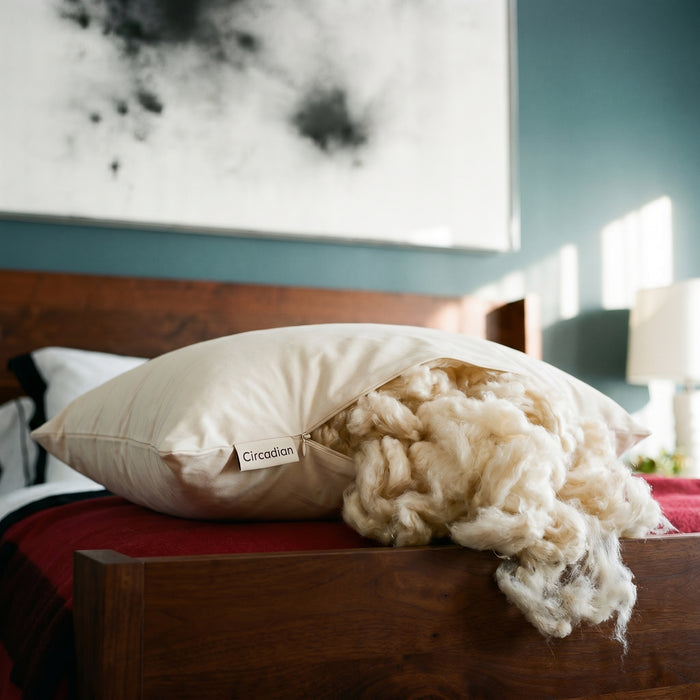
Circadian Wild-Harvested Kapok Pillow with cream organic cotton cover on a bed
Zero chemical processing at any stage
Handmade in New Jersey since 198160-night sleep trialFree shippingYou set the height

The short answer

Wild-Harvested Kapok is the pillow for people who loved down and cannot have it, whether that is allergies, ethics, or the way down goes damp. Each fiber is a hollow microtube with a natural waxy coating that repels water, so it resists mold and mildew without any treatment being applied to it. It is also the one fill in the collection that goes from tree to pillow without passing through a single chemical process, which is why it is what we hand to people with chemical sensitivities. It is soft and light, and it wants a fluff every few days to keep its height.

Feel
Soft and light, the closest thing here to down
The fiber
A hollow tube, 80 to 90% air, walls 1 to 2 microns thick
Water
A natural waxy coating repels it, so mold has nothing to work with
Processing
None, no chemical step between the seed pod and the pillow
Upkeep
A shake and a fluff every few days
Lifespan
2 to 4 years, holding its height with regular fluffing

Kapok, and what goes with it.

The pillow, the full-length body pillow, and a bag of pure fiber for bringing the height back when it settles.

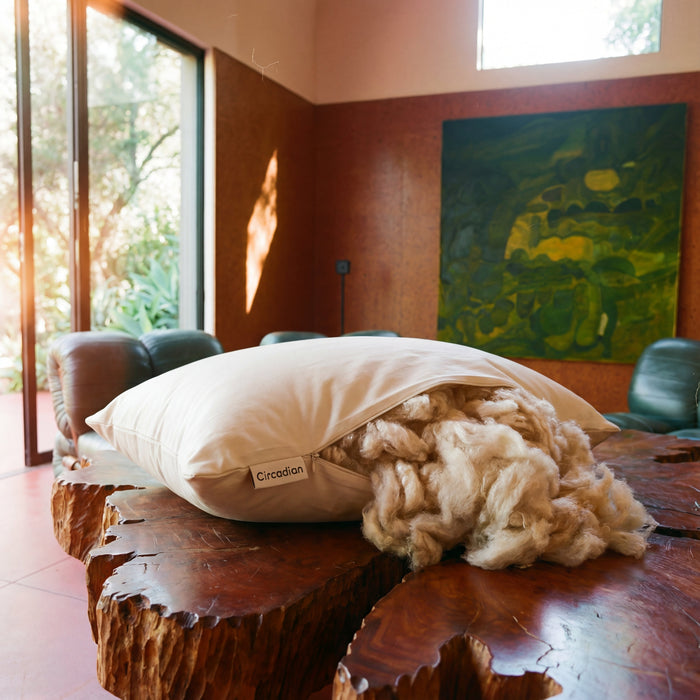
Wild-harvested kapok pillow product view, organic cotton cover with silky kapok fiber fill
The down feeling

Wild-Harvested Kapok Pillow

Pure wild-harvested kapok in an organic cotton cover. Light, soft, silent, and nothing has been done to the fiber between the tree and your bed.

Best for stomach and back sleepers, former down sleepers, and chemical sensitivities

From $79.00 See the pillow ›
Circadian Body Pillow in a cream organic cotton cover resting lengthwise across a made bed, morning light.
Full length

Body Pillow

The same kapok down the length of your body, light enough to move around easily in the night. Also available with cotton, wool or latex inside.

Best for side sleepers and pregnancy, where a heavy body pillow is a nuisance

From $249.00 See the pillow ›

Why down stops working

Down absorbs the moisture your skin gives off. Kapok repels it.

The reason a down pillow feels wonderful in year one and heavy in year three is water. Down takes moisture in, holds it, and slowly mats. Kapok's fiber wall carries a natural waxy coating that pushes water away instead, and that single difference changes how the pillow ages.

1

Your skin gives off moisture

Every night, and most of it lands in the pillow directly under your face.

2

Down drinks it in

The clusters take water into themselves, which is what makes down clump and go heavy over time.

3

Damp down grows things

Moisture held in an organic material at body temperature is how mold and mildew get started.

4

Kapok pushes it off

The waxy coating on each fiber wall repels liquid water, so the moisture never gets into the material to begin with.

That resistance is part of the fiber itself, grown into the plant, so there is nothing applied that can wash out or wear off over the years you own the pillow.

Macro view of pure wild-harvested kapok fiber, silky pale strands

Inside the fiber

It is a tube of air, and that is the whole trick.

Cut a kapok fiber across and you find a hollow microtube. The wall is one to two microns thick and the space inside is 80 to 90 percent of the volume. Almost nothing in the pillow is solid, which is why it is the lightest natural fiber on earth and why lifting the pillow surprises people.

That hollow structure is also what gives the sink-in feeling. Your head is displacing air held in millions of tiny tubes rather than pressing against fiber, and the sensation is remarkably close to down.

80-90%of the fiber's volume is air
1-2 micronswall thickness
Kapok tree seed pod, the source of the natural kapok fiber used in Circadian pillows

Where it comes from

Climbing the tree is what keeps the tree standing.

Kapok grows inside seed pods on Ceiba pentandra trees across the Indonesian rainforest. Workers climb the trees to collect the pods by hand, which means a standing tree is worth more than a felled one, year after year.

The fiber then goes from pod to pillow without passing through a single chemical process, which means it is never bleached, scoured or given a finish of any kind. That is an unusual sentence to be able to write about a bedding material, and it is why this is the pillow we hand to people who tell us they react to everything.

Zerochemical processing between pod and pillow
Concealed zipper and woven Circadian tag detail on the Wild-Harvested Kapok Pillow

Living with it

Give it a shake, the way you would a down pillow.

Kapok settles. The fibers are so light that they pack down under your head faster than cotton or wool do, and if you leave it alone for a fortnight it will feel lower than you set it. Take it by the ends and shake it out every few days and it comes straight back.

This is the same routine anyone who has owned a down pillow already has. If the idea of fluffing a pillow puts you off entirely, the organic cotton is the one to take instead, because it asks nothing of you at all.

Every few daysa shake keeps the height
60 nightsbefore you have to decide

Kapok against the down it replaces.

The feel is close. What happens over three years of your skin's moisture is not.

Wild-Harvested Kapok compared with goose or duck down pillow fill, 2026.
What matters Wild-Harvested Kapok Down
Feel Light and soft, sinks in under your head Light and soft, the benchmark for it
Moisture A natural waxy coating repels liquid water Absorbs it, which is what makes it mat
Mold and mildew Resists both without treatment Moisture held in the clusters is how it starts
Allergens Plant fiber, no animal protein Feather and animal protein
Animals None involved at any stage Plucked or slaughter-collected
Processing No chemical step between the pod and the pillow Washed, scoured and sanitized
Upkeep A shake every few days A shake every few days
Setting the height Side zipper, take fiber out or add it Usually sewn shut

Is kapok the right one.

You loved down and had to give it up.

This is the closest thing here. Hollow fiber, the same sink-in feeling, and it is a plant from end to end, so there is no animal protein in it for you to react to.

Wild-Harvested Kapok Pillow ›

You react to almost everything.

Kapok is the only fill we sell that reaches the pillow without a single chemical process along the way. It is what we point chemical sensitivities toward first.

Wild-Harvested Kapok Pillow ›

You sleep on your stomach.

Stomach sleepers need the least height of anyone, and kapok is easy to take right down. Pull fiber out until your head sits almost flat.

Wild-Harvested Kapok Pillow ›

You want a body pillow you can move easily.

Kapok makes the lightest one we build, which matters at three in the morning when you want it on the other side of you.

Body Pillow ›

The ones we hear most.

Is kapok the same as down?

It feels close and it behaves differently. Both are light and both let your head sink in. Kapok is a plant fiber with a hollow core and a waxy coating that repels water, so it resists mold and mildew, where down absorbs your skin's moisture and slowly mats. And there is no animal protein in kapok, which is what makes it work for people whose allergies rule down out.

Are kapok pillows good for allergies?

There is no feather in them, nothing derived from an animal, and no chemical finish applied to the fiber for anyone to react to. The fiber repels water, so the damp conditions dust mites and mold need are harder to come by. Our wool pillow works against mites more actively, so if mites are the specific problem, look at that one too.

Do kapok pillows go flat?

They settle, and a shake brings them back. Kapok fiber is so light that it packs down under your head faster than cotton or wool. Take the pillow by the ends and shake it out every few days, which is the same habit a down pillow needs. When it stops responding to that, a handful of fresh fiber through the side zipper restores it.

How long does a kapok pillow last?

Two to four years, holding its height as long as you keep fluffing it. A refill extends that, and the organic cotton cover long outlives the fiber inside it.

Can you wash a kapok pillow?

Wash the cover, keep the fiber out of the machine. Unzip the side, empty the kapok into a bag or a spare pillowcase, machine wash the cover cool and hang it to dry, then put the fiber back and shake it out. Washing loose kapok mats it permanently.

Is kapok vegan?

Yes. It is a seed fiber from the Ceiba pentandra tree, collected by hand from pods, with no animal material at any point and nothing tested on animals.

Is the kapok pillow certified organic?

The cover is organic cotton, and the kapok itself is wild-harvested rather than farmed, which puts it outside the organic farming standards altogether. We would rather tell you exactly what the pillow is than stretch a label to fit it. What we can say plainly is that nothing was applied to this fiber at any point between the seed pod and your bed. Our Organic Cotton and Organic Wool pillows are the two that carry a finished-product organic certification.

What loft is a kapok pillow?

Soft and easy to take low, which suits stomach sleepers particularly. It arrives full, about a third more than most people keep. Open the side zipper, pull fiber out until your head sits level, and give it three nights at that height before you change it again.

Does kapok smell?

Barely. There is a faint dry, slightly sweet plant smell in the first days, and it goes. Nothing has been applied to the fiber, so there is nothing else in there to smell.

Kapok or cotton pillow?

Kapok if you want light and soft and you do not mind fluffing it, or if you are replacing down. Cotton if you want dense, steady, and no upkeep at all. Kapok also wins on chemical sensitivity, because nothing was ever applied to the fiber.

Nothing was done to it, and that is the point.

From a seed pod in an Indonesian rainforest to a pillow sewn in New Jersey, with no chemical step in between. Sixty nights to be sure.

See the kapok pillows