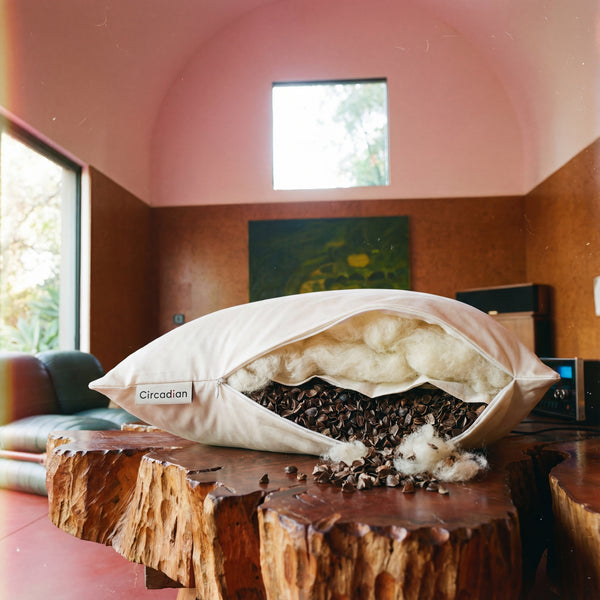
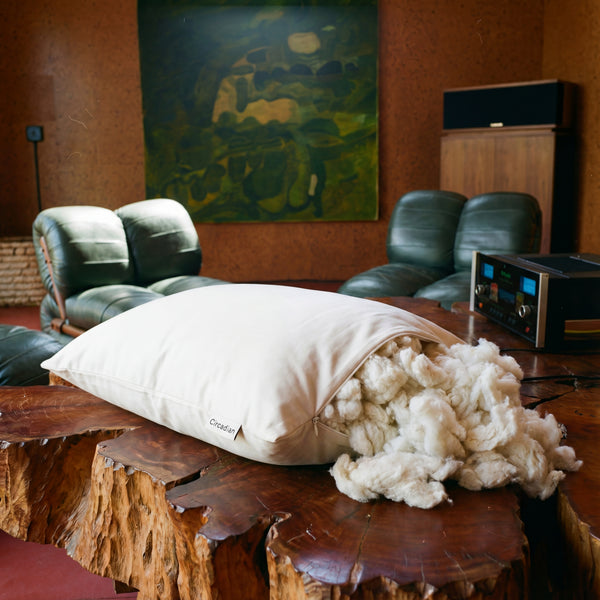
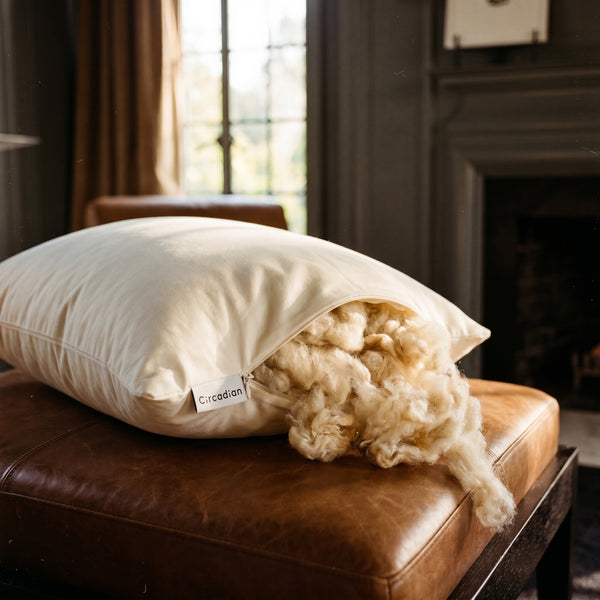
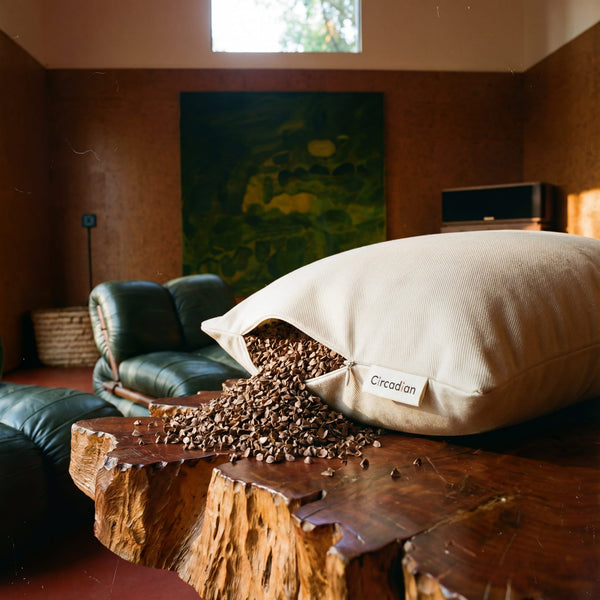
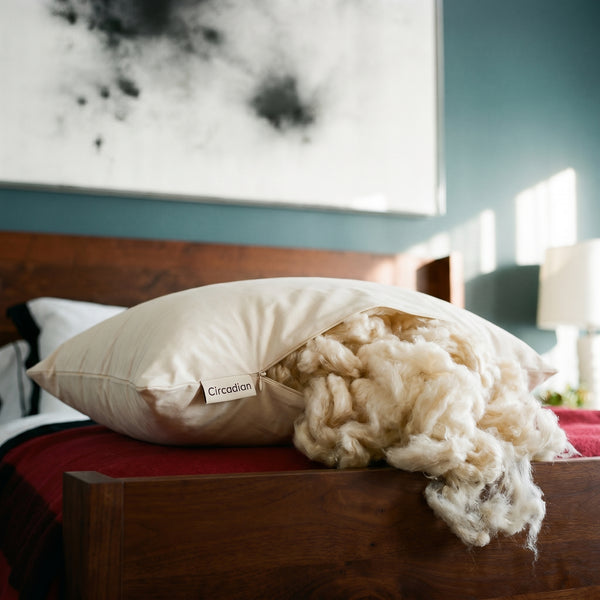
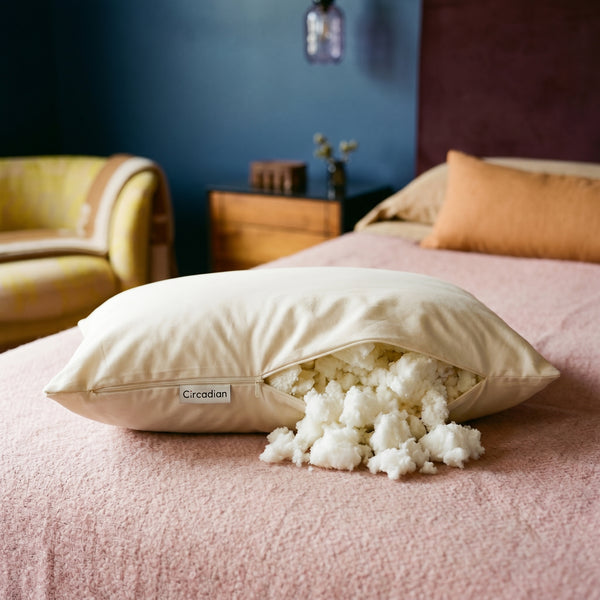
Long-staple organic cotton, carded by hand into a sateen-weave organic cotton shell.
Long-staple fiber means each cotton strand is longer. The surface comes out smoother, the lint stays low, and the compression curve runs over years instead of months.
Conventional US cotton growers spray about 42 million pounds of synthetic pesticides on cotton each year. Ours grows without them. The cover is sateen-weave organic cotton, breathable enough to stay cool against your skin. The fill opens odorless when you unbag it.
How it’s made
Hand-assembled in New Jersey, where a small workshop has sewn pillows since 1981. The side zipper opens to the whole chamber, so you can lift cotton out until the height matches the way you sleep. It arrives full, about a third more cotton than most people keep, so the only adjustment you need to make is downward.
A fully stuffed Standard weighs about 3.5 pounds. Sizes run Travel, Standard, Queen, and King.
Global Organic Textile Standard (GOTS) license GOTS-10229, issued by Oregon Tilth, on the finished pillow.
Most pillows sold as organic cotton carry a certificate on the outer cover only. The cotton inside can be conventional, sprayed during farming and processed with synthetic chemicals at the mill, and the label never has to say so. Ours was audited as a finished pillow, the cotton inside it as well as the cover over it.
The cotton is weighed, filled and hand sewn in a GOTS certified workshop in New Jersey, audited on site every year.
What this means at your bedside
GOTS rules out chlorine bleaching, formaldehyde softeners, flame retardant chemicals, and synthetic finishes across the supply chain. In practice the pillow opens odorless and stays odorless, your lungs are not filtering off-gassed compounds eight hours a night, and nothing migrates from the fill onto your skin or pillowcase as the material ages.
See the full certifications section on this page ↓
Three places worth knowing how Circadian cotton stacks up.
Circadian vs Avocado Green
Avocado covers their pillows with GOTS-certified fabric, and most of their pillow lines use shredded latex inside rather than cotton fill. If you want a true cotton-fill pillow with end-to-end GOTS coverage, ours is cotton through and through, certified as a finished pillow, the cotton inside as well as the cover.
Circadian vs Coyuchi
Comparable certification profile and weight class. Coyuchi sews theirs at a third-party mill in Portugal and ships from California. Ours sews in New Jersey and ships from New Jersey, which usually means a day or two faster on the East Coast.
Circadian vs cheaper organic-cotton pillows
The fastest tell is the price. A GOTS-certified pillow with a full supply chain audit costs real money to produce. A competing pillow under $60 that claims GOTS almost always certifies only the outer fabric.
Full head-to-head reading: Circadian vs Avocado, Circadian vs Naturepedic, Circadian vs Savvy Rest.
"Made in" labels only reveal a fraction of a product's journey. Supply chains are complex, involving multiple stages across different countries. As we strive for greater transparency, we outline each step of production and the country where it takes place. This information relates to the main material/s used.
- Final inspection & packagingNew Jersey, USA
- Cutting & hand sewingNew Jersey, USA — GOTS certified workshop
- Sateen weaving & finishingPakistan
- Fiber origin (organic cotton)Texas, USA
Just getting it set up? The cotton owner's guide covers setting the height, keeping it clean, and topping it up so it holds its shape for years.
Cold wash, low tumble, and it gets better.
Machine wash cold on a gentle cycle and tumble dry on low. Line drying is better still if you have somewhere to hang it, and it is what the workshop recommends. Cotton sateen softens every time it goes through the wash, so the piece you own in a year will feel better than the one that arrived.
Skip the fabric softener and the dryer sheets. Both work by leaving a waxy coating on the fibers, which is the opposite of what you want on a cloth chosen for its breathability, and over time it dulls the sateen’s sheen. Skip chlorine bleach too, which weakens cotton and will pull the natural color unevenly.
Expect a little shrinkage on the first wash, which is normal for unresined cotton and is already accounted for in the cut. Wash before first use if you like; there is no finish to rinse out, but it takes the packing creases with it.
Trial & returns
Sleep on it for sixty nights. If it is not right, email jacob@circadianrest.com from the address you ordered with and we will send you a label. Free, no restocking fee.