5 to 200 pounds, USA-grown and pre-polished

Hulls by the sack, from the people who fill pillows with them.

The same pre-polished, air-jet cleaned hulls that go into our own pillows, sold in bags up to 200 pounds. Buy them because you are making something, or because a pillow on your bed has settled and you want the height back.

Close view of Circadian's pre-polished USA-grown buckwheat hulls, air-cleaned with a single polished facet
Grown in the United States
Handmade in New Jersey since 198160-night sleep trialFree shippingYou set the height

The short answer

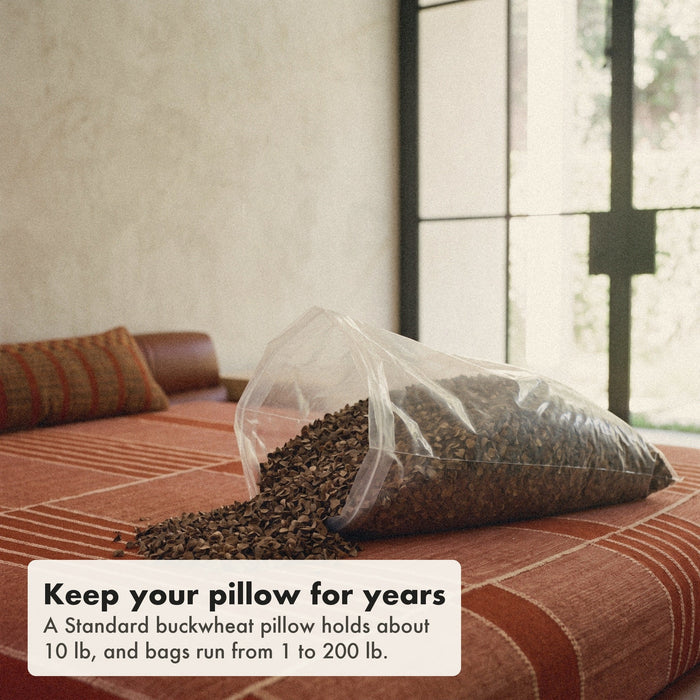
We sell buckwheat hulls in 5, 10, 20, 50, 100 and 200 pound bags. They are grown in the United States and pre-polished, which breaks the pyramid edges into flat sides. Then they are cleaned by air jet rather than by chemicals, and UV sterilized before bagging. Nothing is roasted and nothing is added. For sizing, one of our filled standard pillows weighs about 10 pounds, and nearly all of that is hulls. So a 50 pound bag is roughly five standard pillows, and a 200 pound bag is roughly twenty. If you need more than 200 pounds at a time, write to us rather than adding bags to a cart.

Bag sizes
5, 10, 20, 50, 100 and 200 pounds
Origin
Grown in the United States, and we will tell you the state
Processing
Pre-polished, air-jet cleaned, UV sterilized, no chemical treatment
Rough yield
About 10 pounds fills one standard pillow, 15 fills a king
Noise
Movement noise cut by up to 68% against a raw hull
Storage
Keep them dry and sealed. Water is the only thing that ruins them

The hulls on their own, or already sewn into something.

Most people buying at the top of this range are making their own. If you would rather we did the sewing, the two pillows we put these hulls into are here as well.

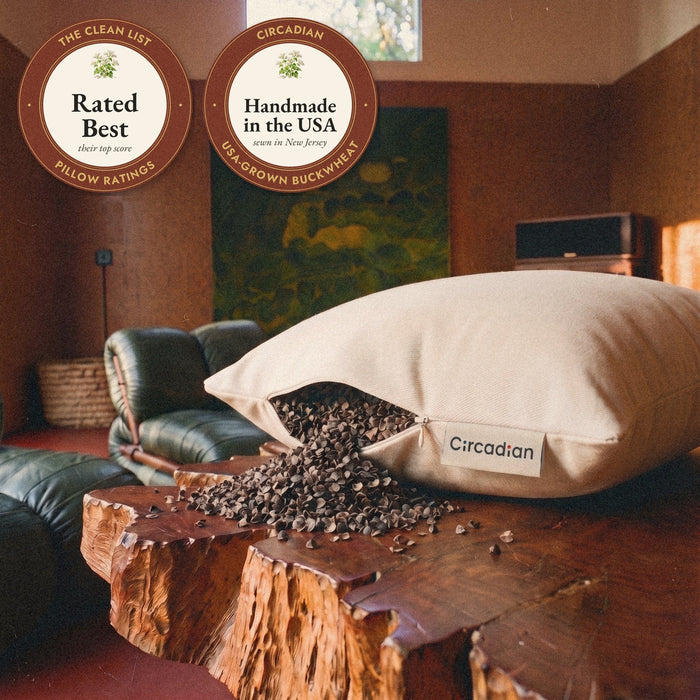
Circadian Buckwheat Pillow with organic cotton cover and adjustable pre-polished USA-grown buckwheat hull fill
5 lb up to 200 lb

Buckwheat Hulls for Pillows

One product, six bag sizes. The 5 and 10 pound bags top up a pillow that has settled. The 50, 100 and 200 pound bags are what makers, workshops and studios order.

Best for refilling, or filling something you are building yourself

From $49.00 See the pillow ›
Circadian Buckwheat Pillow with organic cotton cover and adjustable pre-polished USA-grown buckwheat hull fill
Already made up

Buckwheat Pillow

The same hulls inside an organic cotton cover with a full-length side zipper, so you can set the height from the first night. This is what these hulls are for when we use them ourselves.

Best for anyone who wants the fill without the sewing

From $79.00 See the pillow ›
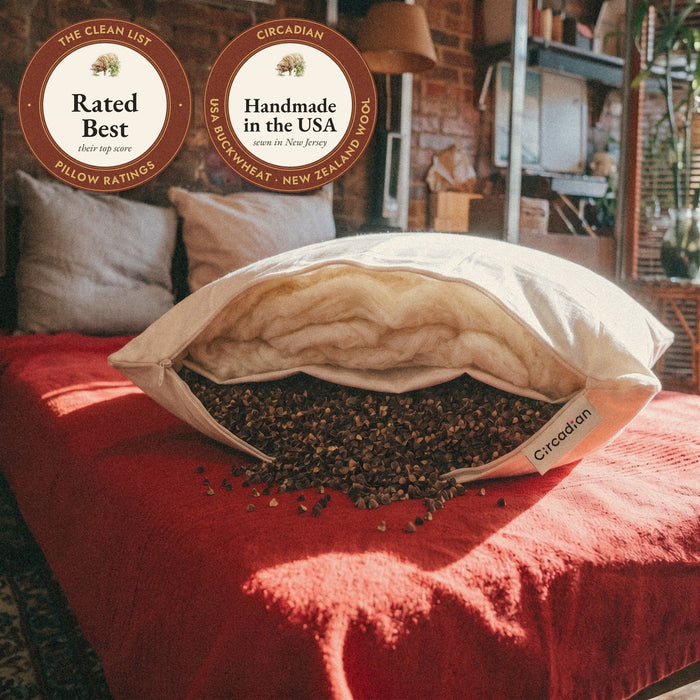
Buckwool Hybrid Pillow with firm buckwheat support on one side and certified organic wool on the other, internal cotton divider
Hulls plus wool

Buckwool Hybrid Pillow

A buckwheat chamber on one side and a certified organic wool chamber on the other, divided by an internal cotton wall. It is the answer for people who find pure hulls too firm against the cheek.

Best for the buckwheat hold with a softer second side

From $89.00 See the pillow ›

Why cheap hulls disappoint

Two bags of hulls can be completely different products.

Buckwheat hulls look the same in every photograph, which is why the market is full of bags that arrive dusty, loud, or full of broken pieces. What separates them is what happened between the mill and the sack.

1

The hull comes off the seed as a rough pyramid

Sharp points, hard edges, and a lot of chaff and dust in with them straight off the mill.

2

Most bags go out from there

Raw hulls are cheaper because nobody has spent a step on them, and they are what most sellers list.

3

The edges catch on each other

That catching is the crackle people remember, and the dust is what makes a new bag smell and shed for weeks.

4

The pieces break down faster

Pointed edges chip against each other, so raw hulls turn to powder at the bottom of the bag sooner.

Ours are pre-polished, which breaks the pyramids into flat sides, and cleaned by air jet, which lifts the chaff and dust out before bagging. That is two extra steps and it is the whole difference in the bag.

Macro of Circadian's pre-polished USA-grown buckwheat hulls showing the single flat polished facet

What pre-polishing does

Flat sides slide past each other instead of snagging.

A raw buckwheat hull is a rough pyramid with pointed edges, and those edges catch every time the fill moves. Pre-polishing tumbles the hulls until one side flattens, so they slide against each other rather than snagging, and movement noise drops by up to 68 percent.

The same step is why they last. A flat-sided hull has less to chip off, so a bag of ours breaks down to dust more slowly than a bag of raw hulls does. If you are filling something you intend to keep, that is the part worth paying two extra steps for.

68%less movement noise than a raw hull
UVsterilized, and cleaned by air jet rather than chemicals
Buckwheat hull size comparison showing Circadian pre-polished hulls beside standard hulls

How much you need

Work from weight, and buy a little over.

The reliable way to size an order is to weigh what you are filling, or to weigh what came out of it. Our own pillows are a useful yardstick, because they are filled to a known weight. A standard at 20 by 26 comes in around 10 pounds. A queen at 20 by 30 is around 13, a king at 20 by 36 around 15, and a travel at 12 by 16 around 2.5. Almost all of that weight is hulls.

So a 50 pound bag is roughly five standard pillows, a 100 pound bag roughly ten, and a 200 pound bag roughly twenty. Order a little over what the arithmetic says. Hulls settle in the first weeks of use, and a maker who runs out halfway through a batch waits on a second shipment.

10 lbfills one standard pillow
200 lbour largest bag, about twenty of them
Close-up of pre-polished one-sided buckwheat hulls inside a Circadian pillow

Keeping them

Water is the only thing that will ruin a bag.

Dry hulls hold no moisture for mold to work with, which is why they keep almost indefinitely in a sealed bag away from damp. Wet hulls swell, break down and go musty, and they cannot be dried out again once they are inside a sewn cover. Never wash them and never put them near a machine.

If a bag has been sitting a while and smells flat, spread the hulls out in direct sun for three or four hours and they come back. That is the whole maintenance routine. There is no cleaning step beyond it and nothing to add.

3 to 4hours in the sun to freshen a bag
Zerochemical treatment at any stage

What to ask before you buy hulls in quantity.

At 5 pounds a bad bag is an annoyance. At 200 pounds it is a pallet of something you cannot use, so these are the questions worth asking of any seller.

Circadian bulk buckwheat hulls compared with commonly sold bulk hulls, 2026.
What to check Circadian Typical bulk hulls
What happens after milling Pre-polished, so the pyramid edges become flat sides Usually raw, straight off the mill with the edges intact
How the dust is removed Air-jet cleaned before bagging Often screened only, and sometimes not at all
Sterilization UV sterilized, with no chemical treatment at any stage Frequently untreated, or heat-treated instead
Where they are grown Grown in the United States, and we will tell you the state Commonly imported with no country of origin stated
Noise in use Movement noise down by up to 68 percent against a raw hull The crackle buckwheat is known for
Largest bag 200 pounds, with larger orders quoted directly Often 25 or 50 pounds as a ceiling
Roasting None. Roasting makes hulls brittle and leaves a burnt smell Roasted hulls are widely sold as a cleaning shortcut
Who fills pillows with them We do, in our own workshop, which is where the spec came from Most sellers are distributors rather than makers

Which bag is yours.

Your pillow has settled and sits lower than it did.

Take the 5 pound bag. Topping up takes far less than people expect. Add a little through the side zipper, lie down, and check that your head sits level. Add more only if you need it.

Buckwheat Hulls ›

You are refilling a pillow from empty, or building one.

Ten pounds fills a standard and fifteen fills a king. The 10 or 20 pound bag covers one pillow with something left over for the settling that follows.

Buckwheat Hulls ›

You make cushions, wraps or supports to sell.

Start at 50 pounds to test how our hulls behave in your pattern, then step up to 100 or 200 once you know your yield per piece. The polish changes how the fill moves, so test before you commit a season to it.

Buckwheat Hulls ›

You would rather buy the pillow than sew one.

Then take the pillow we fill with these hulls. It arrives full with a full-length side zipper, so the first thing you do is take hulls out until your head sits level with your spine.

Buckwheat Pillow ›

Buying hulls in bulk, answered.

How many pounds of buckwheat hulls fill a pillow?

About 10 pounds for a standard at 20 by 26, 13 for a queen at 20 by 30, 15 for a king at 20 by 36 and 2.5 for a travel at 12 by 16. Those are the filled weights of our own pillows and nearly all of that weight is hulls. Buy a little over the figure, because hulls settle in the first few weeks.

What is the largest quantity of buckwheat hulls you sell?

200 pounds in a single bag, which is the biggest size on the site. If you need more than that at a time, write to us instead of stacking bags in a cart and we will sort out the order and the freight.

Are your buckwheat hulls organic?

They are grown in the United States and go into the bag with no chemical treatment at any stage, cleaned by air jet and sterilized with UV light. Our finished-product organic certification covers the cotton and wool goods rather than the hulls. So we describe these by exactly what is done to them, rather than borrowing paper that does not apply.

Are buckwheat hulls safe for someone with a wheat allergy?

Buckwheat is a seed rather than a grain, and it has no botanical relationship to wheat. The plant is a relative of rhubarb and sorrel, and the hull is the husk around its seed. That said, buckwheat is itself an allergen for a small number of people, so if you react to buckwheat as a food, do not fill anything you sleep on with it.

What is the difference between polished and unpolished buckwheat hulls?

An unpolished hull keeps the pointed pyramid shape it had at milling, so the edges catch on each other and that catching is the noise buckwheat is known for. A pre-polished hull has been tumbled until one side flattens, so they slide instead. Ours are pre-polished, which cuts movement noise by up to 68 percent and slows how fast the hulls break down.

Do you sell buckwheat hulls wholesale?

The 50, 100 and 200 pound bags are priced for people buying at that scale and you can order them straight from the site. For standing orders, repeat volume or anything above 200 pounds, write to us and we will quote it properly rather than have you work around the cart.

Can buckwheat hulls be washed?

No, and this is the one rule worth being firm about. Water swells the hulls, breaks them down and leaves them musty, and they cannot be dried out again inside a sewn cover. Wash the cover instead and give the hulls three or four hours in direct sun if they need freshening.

How long do buckwheat hulls last?

Three to five years in a pillow that gets slept on nightly, and far longer than that sitting in a sealed bag somewhere dry. What ends their life is compression rather than dirt. They break down slowly into a finer material, the height drops, and you top the pillow back up.

What do people use bulk buckwheat hulls for?

Pillows and cushions mostly, then meditation seats, neck and shoulder wraps, positioning supports, and props for studios and clinics. The common thread is wanting a fill that takes a shape under weight and then holds it, which is something no fiber or foam does in the same way.

Do buckwheat hulls attract bugs?

Not when they are clean and dry. Ours are UV sterilized before bagging and dry hulls hold no moisture, so there is nothing to draw anything in. The problems people describe almost always trace back to hulls that got damp, or to a cheap bag that arrived with chaff and mill debris still in it.

Order what you need, and tell us if it is more than we list.

Bags up to 200 pounds go straight through the site. Anything larger, or a repeating order, is worth an email so we can quote the freight properly and hold stock for you.

See the bag sizes