Buckwheat Hulls for Pillows
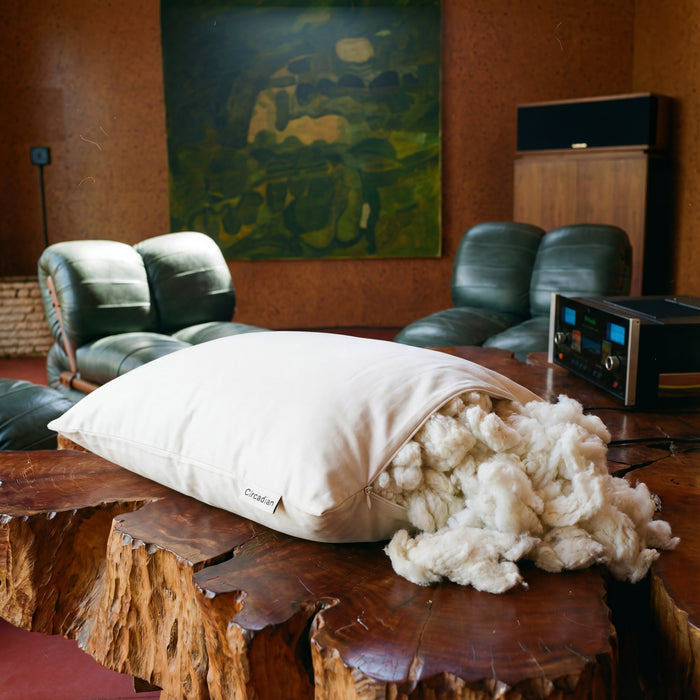
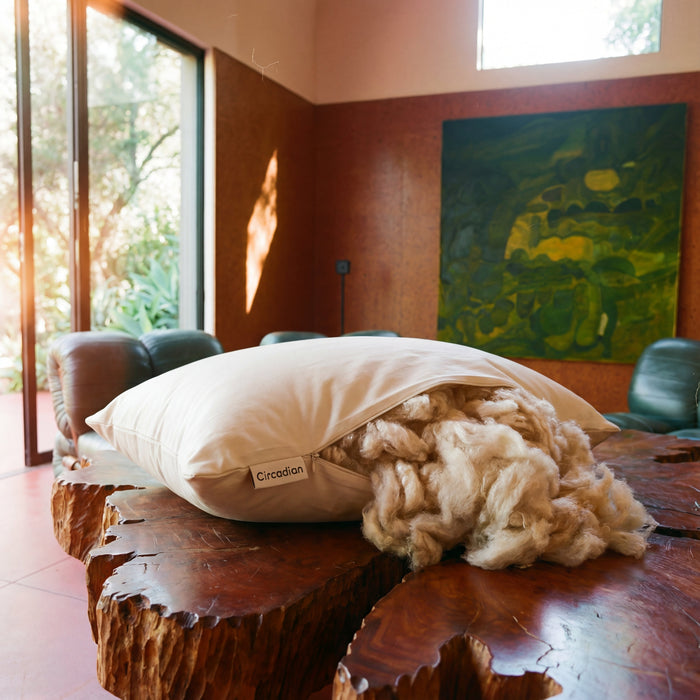
The same pre-polished USA-grown hulls, air-jet cleaned and UV sterilized. Pour them straight in through the zipper and the height comes back.
Best for a buckwheat pillow that has settled
Fill refills for every Circadian pillow
Every fiber pillow on earth compresses over years. Ours open at a full-length zipper, so the answer is a bag of material rather than a new pillow, and the cover outlasts several changes of fill.

Open the side zipper, add material until the height is back where you set it, and sleep on it three nights before adjusting again. Every fill we use is sold as a refill bag: cotton, wool, kapok, buckwheat hulls and latex pieces. The one thing to get right is technique, and it differs by fill. Wool comes in sheets, so peel a whole sheet off the outside rather than tearing pieces from the middle. Everything else pours or lifts in loose.
Match the refill to what is already in your pillow. Mixing fills works less well than it sounds, because they compress at different rates and you end up with an uneven pillow.

The same pre-polished USA-grown hulls, air-jet cleaned and UV sterilized. Pour them straight in through the zipper and the height comes back.
Best for a buckwheat pillow that has settled

The same certified organic cotton as the pillow, loose in a bag. Add it a handful at a time and shake the pillow out as you go.
Best for a cotton pillow sitting lower than you set it

Organic wool in sheets. Lay a whole sheet on the outside of what is already in there rather than pushing it into the middle.
Best for restoring a wool pillow's height

Pure wild-harvested kapok fiber. Kapok settles faster than the others, so this is the refill people reach for first.
Best for a kapok pillow that no longer responds to a shake

More slow-pour Dunlop pieces. As useful for building a pillow taller than it shipped as for restoring one that has settled.
Best for broad-shouldered side sleepers, and topping up

Organic cotton both faces with a bio-based waterproof layer between. Keeping skin oil and moisture out of the fill is what slows the settling.
Best for making the fill you have last longer
Why pillows get thrown away
This is the ordinary end of a pillow's life, and it is a strange one when you look at it directly, because the two halves fail at completely different rates.
1
Every night, in the same place, for years. There is no material that does not eventually give ground to that.
2
Slowly enough that you do not notice, until you wake up with a stiff neck and cannot say when it started.
3
Woven cloth barely wears at all under a head. It will outlast several changes of fill without complaint.
4
Because on a sewn-shut pillow there was never any way to separate them.
A zipper turns that into a bag of material. The pillow you already know keeps going, the cover you have already washed a dozen times stays, and the only thing you replace is the part that wore out.
Knowing when
Every pillow compresses somewhat in the first month, and that is normal rather than a fault. What you are watching for is the height staying down: your head no longer sitting level with your shoulders, or the morning stiffness you had solved quietly coming back.
Before you refill anything, try the free version. Kapok in particular responds to being taken by the ends and shaken out, and a great many people who write to us about a flat kapok pillow have never done that. If a shake restores it, it did not need refilling.
Doing it properly
Cotton, kapok, hulls and latex pieces all go in loose. Open the zipper, add material a bit at a time, close it and shake the pillow out so the new material distributes rather than sitting in a lump at one end.
Wool is different, and getting it wrong is the single most common refill mistake. It comes in sheets, and you peel a whole sheet off the outside of what is in the pillow, or lay a new one on the outside. Tearing pieces out of the middle leaves lumps that never smooth out afterwards.
Making it last longer
People assume a pillow wears out from being slept on. Mostly it is skin oil and the moisture your body gives off, which work into the fiber, weigh it down and accelerate the compression. That is why the same pillow lasts noticeably longer for some people than others.
A waterproof protector under the pillowcase keeps both out of the fill and pushes any of these toward the top of its lifespan range. Ours is organic cotton on both faces with a bio-based film between them, so it does not undo the breathability you paid for, and it does not crinkle when you turn over.
Match the material to what is already in the pillow, because fills compress at different rates and a mixed pillow goes uneven.
| Fill | How to add it | When you will need it |
|---|---|---|
| Buckwheat hulls | Pour straight in through the zipper | 3 to 5 years, then the pillow carries on |
| Organic cotton | Handfuls at a time, shaking as you go | 2 to 4 years, longer with a protector |
| Organic wool | A whole sheet, laid on the outside | 3 to 5 years |
| Wild-Harvested Kapok | Loose, then shake the pillow out well | Soonest of the five. Try shaking it first |
| Tree-Tapped Latex | Lift pieces in, distribute by hand | Rarely. More often used to build it taller |
| Mixing two fills | We would not | They compress at different rates and go uneven |
| Washing the fill | Never | Water ruins hulls and mats loose fiber permanently |
Match the refill bag to your fill and add material until your head sits level again. Three nights before you adjust it further.
Buckwheat Hulls ›Try shaking it out by the ends before you buy anything. Kapok packs down between fluffs, and a good shake often brings the whole thing back at no cost.
Kapok Refill ›A latex refill bag. Broad-shouldered side sleepers regularly need more height than a standard pillow provides.
Latex Refill ›Put a protector under your pillowcase. Skin oil and moisture age a fill faster than sleeping on it does.
Pillow Protector ›Open the full-length side zipper, add material a bit at a time, close it and shake the pillow out so the new fill distributes. Lie down and check that your head sits level with your shoulders. Sleep three nights on that height before adjusting again.
When the height you set has dropped and stayed down, and your head no longer sits level. Morning stiffness quietly returning is often the first sign. With kapok, try shaking the pillow out by the ends first, because it may only need fluffing.
Peel a whole sheet off the outside of the wool that is in there, or lay a new sheet on the outside. Never tear pieces out of the middle. Wool comes in sheets and pulling from the centre leaves lumps you cannot smooth out afterwards.
We would not. Different materials compress at different rates, so a mixed pillow develops an uneven surface within a few months. If you want two feels, the Buckwool Hybrid keeps them in separate chambers with a divider between.
No, and this is the one thing worth being firm about. Water ruins buckwheat hulls and permanently mats loose cotton, wool and kapok. Wash the cover, air the fill in sunlight if it needs freshening, and refill once it has properly compressed.
Less than you expect, usually. Most pillows want topping up rather than replacing wholesale, so add a little, check your height, and add more only if you need it. Keep whatever is left over for next time, in a sealed bag away from damp.
Buckwheat 3 to 5 years, then fresh hulls. Organic wool 3 to 5. Cotton and kapok 2 to 4, and a refill extends both. Latex up to a decade, which is why that bag is used more often for building a pillow taller than for restoring one.
Over the life of the pillow, considerably. A bag of material costs a fraction of a new pillow and the cover will outlast several changes of fill, so the part you keep replacing is only the part that wore out.
Yes. Packing a pillow fuller raises both firmness and height together, which is worth knowing because you are changing two things at once. Add material, then re-check that your head still sits level rather than propped up.
Keep it in a sealed bag somewhere dry, because a surprising number of people want some of it back a week or two later. If you are certain you are done with it, cotton, wool, kapok and buckwheat hulls are all natural materials that compost.
Open the zipper, top it up, sleep three nights, and adjust again if you need to.
See the refills187 verified reviews
If you've sent more pillows back than you've kept, you're our customer.
“I have owned more pillows than I have owned houses and I have owned 12 houses.” This is by far the only pillow to use if you don’t want to wake up with sore shoulders or neck. I have replaced all the pillows in my house with this pillow.
I have compressed discs in my neck, and I have spent hundreds of dollars over the past 6 months trying to find one that will help me sleep. Every pillow I bought caused me to wake up in even more pain than the night before!! The buckwheat pillow is life-changing!! I have slept through the night and wake up with no pain!!
I was leery to try another expensive pillow without some sort of trial period after being very let down by a different company's natural fiber pillow… I don't hear anything at all with the buckwheat! It does stay fresh and cool as well, but most importantly it actually holds my head/neck up and in place. Which allows me to actually get rest instead of always adjusting.
I've been a buckwheat pillow customer for the last 7 years and I can say that Circadian has the highest standards of quality paired with incredible customer service. Very very impressed and would not hesitate to send anyone their way.
I have spent years searching for a pillow that feels supportive and comfortable all night. I have finally found it. I absolutely love the Buckwool pillow. I removed a bit of the material to get it to exactly how I want it… I rarely wake up with neck pain now.
I find myself switching between the two and loving the feel of both. I haven't woken up with a sweaty head with either and that's an amazing feeling especially in the AZ summer. The buckwheat side is a lot quieter and more comfy/soft than others I've tried in the past.
I have tried at least 10 different pillows in the last 3 years. Nothing has worked out except for this wool pillow. I have chronic neck pain which has been greatly reduced. I am very happy with my new pillow.
I have pretty bad chemical sensitivity (housebound most of the time)… I try to only buy totally safe, non-toxic products. I found this pillow to be very safe and non-toxic, and the packaging was fragrance free which is always a huge plus.
I ordered this pillow to replace my very old (but beloved) down pillow and I'm so glad I did. It is heavenly!… I advise you to heed the recommendation given by the quiz. I ordered cotton initially despite the quiz giving me kapok as a result… the quiz was right.
The quality craftsmanship and materials is evident… when I asked if extra stuffing were available for the second one I'm using as a knee pillow, they not only pointed me to the right place on their site, but also created a new, smaller 1-lb. refill size based on my request.
The three-star ones are in there too. Read all of them
Your first pillow
Leave your email and the code comes right over, along with the two-minute quiz that matches you to one of the six fills.
60-night trial · Handmade in New Jersey
Where to send it
The $10 code and the quiz link land in your inbox in about a minute.
From Jacob, the founder. One email, unsubscribe anytime.
That email doesn't look right. Mind checking it?
Done
Check your inbox in a minute. If you want a head start, the quiz takes two.
Start the quiz60-night trial · Handmade in New Jersey