Updated: September 2, 2026
To clean a buckwheat pillow, remove the hulls, machine wash the cover on cold-gentle and air dry it, and spread the hulls in direct sunlight for 3 to 4 hours once or twice a year. Never submerge hulls in water - moisture causes mold within 24 to 48 hours. The cover does all the hygiene work; the hulls only need sunlight.

- Buckwheat hulls must never be submerged in water - the EPA and CDC confirm mold can develop within 24 to 48 hours of moisture exposure, and wet hulls will break down structurally.
- The pillow cover and pillowcase do most of the hygiene work: wash the pillowcase every 7 days and the inner cover monthly to remove skin cells, oils, and dust mite allergens.
- Sun-air the hulls 1 to 2 times per year for 3 to 4 hours. Sunlight drives off the moisture the hulls have picked up from the room, and dry hulls are what keep the pillow fresh. A peer-reviewed study in the International Journal of Environmental Research and Public Health found buckwheat hulls carry polyphenols, including tannins, rutin and quercetin, that hold back the development of microorganisms, mites and fungi.
- Why Do Buckwheat Pillows Need a Different Cleaning Approach?
- Step 1: How Do You Remove the Hulls from the Pillow Cover?
- What is in the air above a pillow
- Step 2: How Do You Wash the Pillow Cover and Pillowcase?
- Step 3: How Do You Air and Sun the Buckwheat Hulls?
- Step 4: How Do You Handle Spills and Accidents Immediately?
- Step 5: What Does a Simple Buckwheat Pillow Maintenance Schedule Look Like?
- Common Mistakes
- When This Framework Changes
- Real-World Decision Scenarios
- FAQ
Why Do Buckwheat Pillows Need a Different Cleaning Approach?
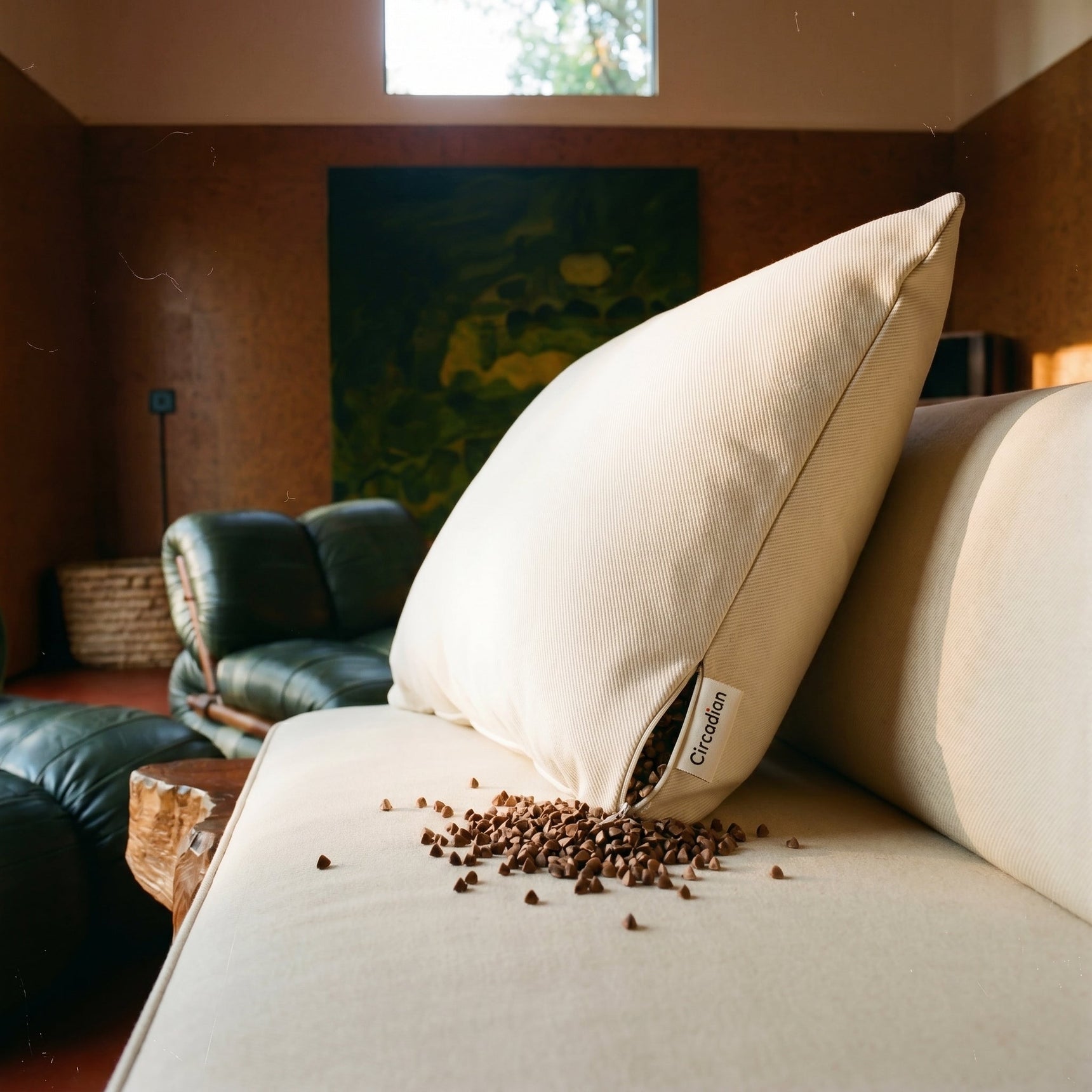
A buckwheat pillow is a natural pillow filled with buckwheat hulls that conform to the shape of your head and neck, holding it in place with air still moving between them. Most hulls on the market are roasted; Circadian's are pre-polished and air-jet cleaned instead, never roasted, which matters here because it changes how much hull dust you are dealing with over time. That structure is also why cleaning it works differently from any foam or fiber pillow you've owned.
The rule is simple: clean the cover, care for the hulls. Never mix the two.
Buckwheat hulls absorb moisture quickly. Once wet, they cannot be dried effectively inside a sealed cover - and materials left damp create conditions for mold growth. The EPA and CDC both confirm that wet materials must be dried within 24 to 48 hours to prevent mold growth, and that indoor humidity should stay between 30 and 50%. A waterlogged pillow cover traps hulls in that danger zone for days, not hours.
The good news comes from the plant chemistry. A peer-reviewed study in the International Journal of Environmental Research and Public Health found that buckwheat hulls contain polyphenolic compounds - tannins, rutin, and quercetin - that inhibit the development of harmful microorganisms, mites, fungi, and bacteria. The hulls handle moisture structurally too: they absorb moisture quickly without heating up, and water activity decreases below 25% moisture content to limit microbial growth potential.
All of this means that with the right routine, a buckwheat pillow asks less of you than it sounds. You wash the cover. You occasionally sun the hulls. You keep water away from the fill itself. That's most of it.
For reference, this guide uses Circadian's Buckwheat Pillow as the example throughout - the cover is organic cotton twill, the hulls are USA-grown and pre-polished, and the pillow zips open for easy hull removal. If you have a different buckwheat pillow, the same rules apply: cover washes, hulls sun.
Jackie was skeptical of buckwheat. She shows the hulls up close, how the pillow settles around her head, and how she took some out to get her height right.
35 seconds, with sound
Step 1: How Do You Remove the Hulls from the Pillow Cover?
What: Empty the buckwheat hulls from the pillow into a clean, dry container before washing the cover.
How: Unzip the pillow cover and carefully pour the hulls into a large bowl, bin, or clean pillowcase. Work over a sheet or do this outdoors - hulls are small and will scatter. Tie or clip the empty bag closed to keep track of it. Once the hulls are out, set the container aside in a dry spot away from any water source.
While the hulls are out, do a quick inspection. Look for:
- Sandy residue at the bottom of the container - this is hull dust and is normal in small amounts, but a lot of it signals the hulls are breaking down.
- Damp hulls - this means moisture has reached the hulls at some point. If they feel only slightly damp, a sun treatment (Step 3) may resolve it. Hulls that feel thoroughly damp typically mean some need replacing.
- Soft or crumbly texture when you press a handful together - healthy hulls feel firm and distinct, not powdery.
- Significant volume loss - if the hull level looks noticeably lower than when you first filled the pillow, they may be compressing and going flat.
Red flags:
- Hulls have clumped together - this means moisture has been present. Separate and spread them before the sun treatment in Step 3.
- Visible mold or mildew - discard the affected hulls. Circadian's Buckwheat Hulls for Pillows are available separately for partial or full refills.
Checkpoint: You should now have the cover empty and set aside for washing, and the hulls sitting in a dry, open container where you can visually inspect them. The container is away from water, and any clumped hulls have been separated.


Cervical support
Buckwheat Pillow
Pre-polished hulls mold to your neck and hold the line all night, and the air moving between them keeps the surface cool.
Shop the Buckwheat PillowHandmade in New Jersey · 60-night sleep trial
What is in the air above a pillow
You breathe across a pillow for a third of your life. Your face is a few inches away and the material is warm all night. So it is fair to ask what the material gives off, and there is published work on it.
A 2018 paper in the EXCLI Journal derived indoor air guidance values for six compounds that come off flexible polyurethane foam. It had to derive them because none existed. Several are marked tentative, because the data has gaps.
| Compound | Guidance value derived | Status | How we checked |
|---|---|---|---|
| 1-Chloro-2-propanol | 195 µg/m³ | derived | Published paper, open access, read 15 September 2026. |
| 2,2,3,3-Tetramethylsuccinodinitrile | 54 µg/m³ | tentative | Published paper, open access, read 15 September 2026. |
| Triethylenediamine | 7 to 900 µg/m³ depending on the effect | part tentative | Published paper, open access, read 15 September 2026. |
| Propanal | 200 to 300 µg/m³ | derived | Published paper, open access, read 15 September 2026. |
| Trimethylsilanol | 195 µg/m³ | tentative | Published paper, open access, read 15 September 2026. |
| Fluoro(trimethyl)silane | 107 to 442 µg/m³ | tentative | Published paper, open access, read 15 September 2026. |
A 2019 chamber study of eight polyurethane mattresses found that heat drove emission more than humidity or carbon dioxide did. Body heat is the one thing a sleeper cannot take out of the bed.
Now the finding that cuts the other way. A 2022 study in Chemosphere measured memory foam mattresses and concluded that the emissions are unlikely to put a consumer at risk. The literature does not agree with itself. Anyone who tells you it settles this in either direction has not read it.
Our answer needs none of that resolved. A Circadian pillow has no polyurethane in it. Nothing is glued, and nothing is sprayed on to slow a flame. Inside it is buckwheat, wool, cotton, kapok or tree-tapped latex, and the cover is organic cotton. If you would rather not referee a chemistry argument in your own bedroom, you can decline to have one.
What the market publishes here is thin. We read the published pages of 20 buckwheat pillow brands between February and May 2026, ours among them. 20 of the 20 say anything at all about how the material was processed.
| Brand | Processing as published | Casing | Certification scope as stated | How we checked |
|---|---|---|---|---|
| Circadian Buckwheat | Air-jet cleaned and polished (single-side); UV-sterilized | Organic cotton | Organic cotton cover | Ours. Graded on our own published pages. |
| Hullo Buckwheat | Air-cleaned, never roasted | Organic cotton twill | Organic cotton cover, sold as certified; no certifier named | Published specs only, read on their own product page. |
| Rawganique Illinois | Not stated | Organic cotton twill | No certification stated | Published specs only, read on their own product page. |
| Turmerry Buckwheat | Not stated on product page | Organic cotton | Organic cotton claim (no third-party cert) | Published specs only, read on their own product page. |
| ComfyComfy ComfySleep | Air-cleaned, no chemicals | Organic cotton twill (TX Dept of Ag) | Cover certified organic by TX Dept of Ag | Published specs only, read on their own product page. |
| Sachi Organics Buckwheat | Triple air washed | Organic cotton (TX co-op) | Organic claimed; no certifier named on brand site | Published specs only, read on their own product page. |
| Bean Products WheatDreamz | Air-cleaned, triple-filtered | Organic cotton shell | Organic claim (no certifier named) | Published specs only, read on their own product page. |
| Comfort Pure Cotton+Buckwheat | Not stated | Organic cotton | Certified organic claim (no certifier named) | Published specs only, read on their own product page. |
| PineTales Signature | Four-step cleaning and heat treatment | Cotton twill core, Egyptian cotton cover | Hulls called 100% organic; no certifier named | Published specs only, read on their own product page. |
| Beans72 Buckwheat | Triple air-cleaned | Unbleached cotton | USDA Organic hulls; cover not organic | Published specs only, read on their own product page. |
| Mother Earth Pillows Large | Not stated | 100% cotton twill | No certification stated | Published specs only, read on their own product page. |
| Soaring Heart Buckwheat | Hand-roasted | Not stated (organic case sold separately) | No certification stated | Published specs only, read on their own product page. |
| Sweet Zzz Buckwheat | Multi-step cleaning | Organic cotton case + cotton inner cover | OEKO-TEX Standard 100 (textile); GOTS and USDA icons, scope not stated | Published specs only, read on their own product page. |
| USlixury Organic | Not stated | Organic cotton, unbleached | Organic cotton claim (no cert stated) | Published specs only, read on their own product page. |
| APOBUY Tartary | Not stated | 100% organic cotton, dual-layer | Organic cotton claim; OEKO-TEX badge on listing (scope not stated) | Published specs only, read on their own product page. |
| Sleppyco Buckwheat | Not stated | GOTS organic cotton twill | GOTS on cover fabric; no hull cert stated | Published specs only, read on their own product page. |
| ZEN CHI Organic | Not stated | 100% cotton | Organic hulls claim (no certifier named) | Published specs only, read on their own product page. |
| Bucky Organic Cotton Bed Pillow | Triple-cleaned | 100% organic cotton knit | Certified organic cotton claim (no certifier named) | Published specs only, read on their own product page. |
| Earthsake Bucky Sleep | Not stated | Combed cotton jersey | No certification stated | Published specs only, read on their own product page. |
| LOFE Organic | Heat-treated | Organic cotton | Organic cotton claim (no cert stated) | Published specs only, read on their own product page. |
Dust mites, in the words of the people who study them
The 2013 practice parameter from the American College of Allergy, Asthma and Immunology is what allergists work from. It reports that dust mites “maintain their water balance through uptake of water vapor when RH is at least approximately 65%”. They are “susceptible to water loss when humidity decreases below 65% and have decreased survival and reproduction with an RH below 50%”. Its advice to patients is that “relative humidity in the home should be kept at 35% to 50% to decrease the growth of dust mites”, and that “washing be performed at weekly intervals”.
So this is a humidity question before it is a bedding question. The useful thing to ask about a pillow is whether it stays dry, not what it claims to keep away. Wool takes up to 30 percent of its own weight in water vapour and hands it back to the room, and the heat leaves with it, so the air at your face stays cool. Cotton manages around 24 percent and holds it closer to the surface, which is why cotton suits a room that runs mildly warm. Polyester takes up under 1 percent, so there is nowhere for the heat to go but back into you.
How we checked. A desk study. Every cell is the brand's own published wording, read on its own product page between February and May 2026, with no figure inferred and nothing taken from a review site or a marketplace listing. Where a brand publishes no figure the cell reads not published, and that counts as a finding, because a buyer reading that page cannot know it either. Our own row is graded by the same rule as every other. Prices and policies move, so the price columns are the capture-window figures and not a live quote. The disclosure counts are what this study is about and they move far more slowly. The research above is cited so you can check it. That includes the 2022 paper whose conclusion runs against ours.
Sources for this section
- Derivation of indoor air guidance values for volatile organic compounds (VOC) emitted from polyurethane flexible foam, Schupp T., EXCLI Journal, 2018;17:784-791.
- Volatile Organic Compound Emissions from Polyurethane Mattresses under Variable Environmental Conditions, Environmental Science & Technology, 2019 (PubMed 31290311).
- Evaluation of volatile organic compound emissions from memory foam mattresses and potential implications for consumer health risk, Chemosphere, 2022. The counter-finding.
- Environmental assessment and exposure control of dust mites: a practice parameter, Portnoy J, Miller JD, Williams PB, et al., Annals of Allergy, Asthma & Immunology, 2013;111(6):465-507.
- The impact of sleepwear fiber type on sleep quality under warm ambient conditions, Nature and Science of Sleep, 2019 (PubMed 31692485).
Step 2: How Do You Wash the Pillow Cover and Pillowcase?
What: Machine wash the inner pillow cover and the outer pillowcase using cold water and a gentle cycle.
How: Place the cover in your washing machine. Use a small amount of mild, fragrance-free detergent - avoid bleach, fabric softeners, or dryer sheets, which can break down organic cotton fibers over time. Set the machine to cold water and a gentle or delicate cycle. Reshape the cover while it is damp and let it air dry. Never tumble dry it: dryer heat shrinks the cover until it will not zip closed around the hulls.
The Sleep Foundation recommends washing pillowcases weekly. Unwashed bedding accumulates dead skin cells, body oils, sweat, and dust mite allergens - and the pillowcase is your primary barrier against all of that reaching the hulls. Wash the outer pillowcase weekly. Wash the inner pillow cover monthly.
The inner cover on Circadian's Buckwheat Pillow is organic cotton twill, a matte diagonal weave. Organic cotton holds up well to repeated washing and tends to get softer with each cycle, which is why the cover usually outlasts several hull refills.
Red flags:
- Discoloration or yellowing on the cover that won't wash out - this can indicate long-term oil accumulation or mold staining. Replace the cover if staining is severe.
- Cover feels stiff or rough after washing - check that you are using cold water, not hot, which can shrink or damage organic cotton.
Checkpoint: The cover is freshly washed and fully dry before you refill it. Do not refill until the cover is completely dry - even slightly damp fabric will transfer moisture to the hulls.

Recommended Reading
7 Signs Your Buckwheat Pillow Needs New HullsIf the annual sun treatment is no longer enough, your hulls may be telling you it is time for a refill. This article walks through every sign - from hull dust to lost height to returning neck soreness.
Step 3: How Do You Air and Sun the Buckwheat Hulls?
What: Spread the hulls in direct sunlight for 3 to 4 hours, 1 to 2 times per year.
How: On a dry, sunny day, spread the hulls in a thin, even layer on a clean flat sheet, large baking sheet, or shallow container. Outdoors in direct sun is ideal. A sunny windowsill that gets strong afternoon light can work if outdoor sunning is not possible, but direct outdoor sun is more effective. Stir or turn the hulls halfway through (at around 90 minutes) so all surfaces get exposure. Bring them inside before evening moisture or dew sets in.
Why this works: UV light dries the hulls and inhibits microbial activity. The peer-reviewed research on buckwheat hulls found polyphenols, including tannins, rutin and quercetin, throughout the hull, compounds the authors found hold back the development of microorganisms. Sunning drives off any residual moisture, and dry hulls are what keep the pillow fresh. Buckwheat hulls absorb moisture without heating up, which means they can hold onto ambient humidity without feeling damp. The sun treatment removes that accumulated moisture effectively.
After sunning, the hulls should feel lighter and fully dry - not damp or clumped. The gentle rustling sound, one of the most distinct sensory features of the Circadian Buckwheat Pillow, should sound crisper after a good sun treatment - a sign the hulls are dry and their natural texture has been restored. "Cleaning and reshaping the hulls cuts the movement noise by up to sixty-eight percent compared with raw, unprocessed hulls, which is the single biggest reason people stick with the pillow past the first week," says Circadian's founder and resident pillow expert.
Ideal conditions: Low humidity day (below 50%), strong direct sunlight, minimal wind so hulls don't scatter. Avoid days that are overcast or humid - the hulls will absorb ambient moisture instead of releasing it. Circadian's pre-polished, single-sided hulls tend to spread more evenly than unpolished hulls, which makes the sun treatment faster and more thorough.
Red flags:
- Hulls still feel damp after 4 hours of sun - this means moisture has penetrated deeply. Consider a second sun session the following day, or discard the affected portion and replenish with fresh hulls.
- Hulls feel soft or paste-like after sunning - moisture has likely caused some decomposition. Replace those hulls.
Checkpoint: After 3 to 4 hours in direct sun, the hulls feel firm and distinct, pour freely, and are fully dry. Let them cool for 15 to 20 minutes before refilling the cover - warm hulls in a sealed cover can create condensation.

Step 4: How Do You Handle Spills and Accidents Immediately?
What: If liquid reaches the hulls, act within the first hour. Waiting significantly increases the risk of mold.
How: The moment you notice a spill on or through the pillow, remove the hulls immediately. Pour them into a large shallow container - a baking sheet, a clean bin, anything that spreads them in a thin layer. Separate any clumped hulls with your hands. The goal is maximum air exposure for every hull.
Place the container in direct sunlight if possible, or near an open window with airflow. Use a fan to accelerate drying if available. The EPA and CDC both confirm the 24 to 48 hour window: wet materials that are not dried within this period begin to support mold growth. For small hulls with surface area on all sides, drying can happen faster - but you need to act quickly and spread them thin.
While the hulls dry, wash the pillow cover right away and let it air dry fully. Do not refill until both are completely dry.
Discard any hulls that:
- Still feel damp or clumped after drying
- Feel soft, sticky, or crumbly
- Have visible discoloration or dark spots
For partial replacements, Circadian's Buckwheat Hulls for Pillows let you top off the pillow without replacing it. You can also use a partial refill to restore volume after discarding compromised hulls.
For liquid spills that are large - a full glass of water, a pet accident - it's often easier to discard all the hulls and start fresh. The cover can be washed; the hulls, once thoroughly soaked, rarely dry uniformly or come back clean.
Red flags:
- Any hull that has been fully submerged - discard it. Submerged hulls will not dry thoroughly and will harbor mold.
- Spill involved anything other than water (juice, coffee, milk) - the organic matter accelerates microbial growth. Be more aggressive about discarding affected hulls.
Checkpoint: All hulls from the affected pillow are fully dry, pour freely, feel firm, and show no discoloration. The cover has been washed and dried. You should be able to refill and use the pillow with confidence.
If spills are a recurring risk in your house, a waterproof protector is the layer that stops this happening again. Circadian's is certified to the Global Organic Textile Standard (GOTS) as a finished product, and it washes on the same cold-gentle cycle as the pillow cover, then air dries.

Protects the fill
Waterproof Organic Cotton Pillow Protector
Waterproof and GOTS certified organic as a finished product, so the fill underneath stays clean and lasts longer.
Shop the Waterproof Organic Cotton Pillow ProtectorHandmade in New Jersey · 60-night sleep trial
One note that belongs on any buckwheat care page: buckwheat hull is a documented respiratory allergen for a small share of people, about 0.1 to 0.4 percent. If you have a known buckwheat allergy, choose a different fill rather than a different cleaning routine.
What Should You Do If the Hulls Get Damp but Not Soaked?
Step 4 covers an obvious spill. This is the quieter version: a humid week, a partner who sweats heavily, or a cover refilled slightly before it was fully dry. The hulls are not wet, but they are not right either. The response depends on how much moisture got in and how fast you act.
Minor dampness:
- Pour the hulls out as soon as you notice it. If the dampness is localised to one area and you can identify those hulls, separate them.
- Spread them in a thin layer, no more than 1 to 2 inches deep, in direct sunlight for 3 to 4 hours, stirring every hour.
- Test them by hand afterwards. Healthy hulls feel firm, dry, and distinct. Any that feel soft, powdery, or clumped go in the bin.
- If less than roughly 10% of the hulls were affected and the rest pass the feel test, they go back in the cover.
Checkpoint: Recovered hulls feel firm and dry, pour freely, and show no discoloration.
Red flag: Hulls that still feel soft or crumbly after a full sun treatment have lost their structure for good. Drying will not bring it back. Replace them.
If the pillow was properly soaked, replace the hulls rather than trying to rescue them. Saturated hulls do not recover their shape, and the EPA notes that porous organic materials which become soaked may need to be discarded, because mold can penetrate deeper than surface drying reaches. Circadian's Buckwheat Hulls for Pillows are the same pre-polished, air-jet cleaned hulls used in the finished pillow, so you can refill exactly as much as you need.
A dry-season option between sun treatments. If you want to reduce dust mites without going near water, seal the hulls in a clean bag with as much air pressed out as you can and put them in the freezer for 24 hours. The sustained cold does the work with no moisture involved. It does not replace the twice-yearly sun treatment, which is the step that dries the hulls out, but it is a useful thing to have in between.
Step 5: What Does a Simple Buckwheat Pillow Maintenance Schedule Look Like?
What: Consolidate all care actions into a regular routine with four simple frequencies.
How: The Cleveland Clinic confirms that a multi-pronged approach to allergen and hygiene control is more effective than any single measure. Regular washing, humidity control, and protective covers work better together. This schedule builds all three into a routine that takes minimal effort.
| Frequency | Action |
|---|---|
| Weekly | Wash the outer pillowcase in cold water, gentle cycle |
| Monthly | Wash the inner pillow cover in cold water, gentle cycle, then air dry |
| 1 to 2x per year | Spread hulls in direct sunlight for 3 to 4 hours |
| Every 3 to 5 years | Refresh or replace buckwheat hulls as needed |
The Sleep Foundation notes that buckwheat hull replacement is typically needed approximately every 3 years as hulls flatten and lose their interlocking shape. With Circadian's pre-polished, single-sided hulls, many users report closer to 5 years before a meaningful refill is needed - the pre-polishing process creates hulls that resist breakdown longer than unpolished alternatives.
Optional: Add a pillow protector. A waterproof pillow protector adds a barrier between the inner cover and the outside world, reducing how often the inner cover needs washing and providing a first line of defense against spills. Circadian's Waterproof Organic Cotton Pillow Protector uses an organic cotton outer layer with a waterproof inner lining. It washes the same way as the cover: cold water, gentle cycle, then air dry. Never bleach it, because bleach damages the waterproof layer.
For context on whether the care routine is worth it, the cost-per-year math comes out plainly: a pillow you refill once and keep costs far less per year than a polyester pillow replaced every one to two years.
Red flags:
- Skipping the pillowcase wash for more than 2 weeks - oils and debris accumulate quickly and are harder to remove once they set.
- Storing the pillow in a plastic bag or sealed container - buckwheat hulls need air circulation. Store in a breathable cotton bag or leave uncovered in a low-humidity room.
> Customer review (5 out of 5 stars): "I have three herniated discs in my neck from a car accident. I need something that holds its shape and doesn't let my head drop. This is it. You mold it exactly where you need it and it stays. My PT asked what changed." - Anonymous
Checkpoint: You have a written or mental schedule for each care frequency. The pillow is stored in a breathable environment, and you know the signs that indicate a hull refresh is needed.
Common Mistakes
1. Washing the hulls in the machine. This is the most common and most damaging mistake. Hulls put through a washing machine will break down structurally, retain moisture, and develop mold. Even a short rinse cycle is enough to cause permanent damage. The cover goes in the machine. The hulls never do.
2. Refilling a damp cover. A cover that feels dry on the outside may still hold moisture in the seams or in thick fabric areas. Always give the cover at least 30 to 60 minutes of extra air-dry time after it first feels dry, before refilling. When in doubt, lay it flat near a window for another hour.
3. Storing the pillow in low airflow conditions. A buckwheat pillow stored under blankets, in a closet without air circulation, or in a sealed bag will accumulate ambient humidity. This is subtle enough that you won't notice for weeks - and then the hulls will hold enough moisture that it takes a full sun treatment to address. Circadian recommends storing the pillow on top of a bed or on an open shelf where air circulates freely around the cover.
4. Ignoring early warning signs from the hulls. Hulls that feel faintly damp, more hull dust than usual at the bottom of the cover, or a noticeably flat pillow that doesn't spring back when pushed - these are all signals that the hulls need attention. Catching them early means a sun treatment may be enough. Ignoring them for months often means a full hull replacement.
5. Using hot water on the cover. Organic cotton twill holds up well to repeated washing, but hot water causes shrinkage and accelerates fiber breakdown over time. Cold water on a gentle cycle is what keeps the organic cotton twill cover going wash after wash.
When This Framework Changes
The cleaning routine above works for the standard use case: a buckwheat pillow on a bed in a climate-controlled home. A few conditions change the approach.
High humidity climates (above 50% ambient humidity consistently): In naturally humid environments - coastal areas, subtropical climates, older homes without air conditioning - buckwheat hulls will absorb more atmospheric moisture. You may need to sun the hulls 3 to 4 times per year instead of 1 to 2. A dehumidifier in the bedroom helps maintain the 30 to 50% humidity range that the EPA recommends for mold prevention.
Heavy perspiration or hot sleeping: If you run hot and sweat significantly through the night, the pillowcase barrier absorbs considerably more moisture than average. Wash the pillowcase every 2 to 3 days rather than weekly, and consider adding Circadian's Waterproof Organic Cotton Pillow Protector as a moisture barrier layer. The waterproof inner lining prevents perspiration from reaching the Circadian buckwheat cover - which keeps the hull-cleaning cycle simpler even for hot sleepers.
Pets on the bed: Pet dander, oils, and occasional accidents create a significantly higher hygiene burden. Wash the pillowcase every 2 to 3 days, add a protector, and sun the hulls at least 3 times per year. Any pet accident that reaches the pillow interior should trigger the immediate spill protocol from Step 4.
Older pillow (5+ years): Hulls that have been in use for several years have less structural integrity and are more susceptible to moisture retention. Sun treatments become more important for older hulls, not less. If a sun treatment no longer dries the hulls out, it's a reliable signal that a hull refresh is overdue. The Sleep Foundation notes that signs of needing replacement include neck soreness, sagging, and increased allergy symptoms - all of which can also be addressed by a hull refill rather than replacing the whole pillow.
Real-World Decision Scenarios
Scenario 1: The new buckwheat pillow owner who followed old advice. Someone new to buckwheat pillows finds an old forum post suggesting machine-washing the whole pillow. After one wash, the hulls are damp and have clumped, and the height is uneven. What happened: the hulls absorbed water and began breaking down. The recovery path depends on severity. If the damage is mild: empty the hulls, dry them in direct sun for a full day, assess. If the hulls feel soft or show mildew: discard and replace with Circadian's Buckwheat Hulls for Pillows. The cover, now washed and dry, is fine to keep.
Scenario 2: The hot sleeper in a humid climate. Someone in a coastal city runs warm, sweats significantly, and uses their buckwheat pillow year-round without a protector. After 18 months, the hulls start to feel faintly damp again within weeks of each sun treatment. The multi-pronged solution the Cleveland Clinic recommends applies here: add a waterproof protector as the primary moisture barrier, increase pillowcase washing to every 2 to 3 days, and run a dehumidifier to bring bedroom humidity below 50%. A second sun treatment the following week should clear the residual moisture.
Scenario 3: The long-term owner due for a hull refresh. After five years, a buckwheat pillow user notices the pillow feels noticeably flatter, there is more fine dust than usual, and neck soreness has started returning. The cover is in good shape. The hulls have simply compressed and broken down over time - normal and expected. The right move is not to replace the whole pillow. Circadian's Buckwheat Hulls for Pillows let you refill through the existing zipper opening, bringing the pillow back to its original height and support. The organic cotton twill cover carries on.
Recommended Reading
9 Buckwheat Pillow Benefits Worth Knowing Before You BuyA full breakdown of what makes buckwheat hulls different from every other pillow fill - the structural airflow, the polyphenols the research found in the hulls, and the adjustability that explain why proper care is worth it.
Frequently Asked Questions
Can you put buckwheat pillow hulls in the washing machine?
No. Buckwheat hulls must never be washed in water or placed in a washing machine - water causes structural breakdown and mold risk within 24 to 48 hours per EPA and CDC guidelines. Only the fabric cover gets machine washed; the hulls are cleaned by spreading them in direct sunlight for 3 to 4 hours once or twice per year.
How often should you clean a buckwheat pillow?
Wash the outer pillowcase weekly and the inner pillow cover monthly - both in cold water on a gentle cycle - to remove skin cells, oils, and dust mite allergens. Sun-air the buckwheat hulls 1 to 2 times per year for 3 to 4 hours. No other routine cleaning is needed if this schedule is followed.
How do you dry out damp hulls in a buckwheat pillow?
Remove the hulls and spread them in a thin layer in direct sunlight for 3 to 4 hours, stirring halfway through - UV light drives off the residual moisture the hulls have absorbed. If one session doesn't dry them out, repeat the following day. Dampness that persists after 2 sun treatments means moisture has gone deep enough to put the hulls at risk of mold, so replace them.
Can buckwheat hulls grow mold?
Yes, if exposed to moisture and not dried within 24 to 48 hours - the threshold both the EPA and CDC identify for mold development in organic materials. A peer-reviewed study found buckwheat hulls carry polyphenols (tannins, rutin, quercetin) that hold back microorganism growth, but those compounds don't prevent mold from wet hulls in a sealed cover. Keeping bedroom humidity below 50% and washing the cover regularly are the most effective prevention measures.
When should you replace buckwheat hulls instead of cleaning them?
Replace hulls when they show significant volume loss (the pillow feels noticeably flatter), produce excessive fine dust, feel soft or crumbly instead of firm and distinct, or stay damp even after a full sun treatment. The Sleep Foundation notes that hull replacement is typically needed approximately every 3 years; Circadian's pre-polished hulls often last closer to 5 years with proper care. Circadian's Buckwheat Hulls for Pillows let you refill without replacing the entire pillow.
Can you dry buckwheat hulls in the oven instead of sunlight?
No. Heat above about 150F makes hulls brittle and increases the amount of hull dust in the pillow. Sunlight gives you UV and gentle warmth at the same time, with no risk of overheating. If you cannot get the hulls outside, a sunny indoor window ledge will handle a moderate refresh.
Does a pillow protector reduce how often you need to clean a buckwheat pillow?
Yes. A waterproof pillow protector creates a barrier between your pillowcase and the inner cover, intercepting moisture, oils, and allergens before they reach the fill - reducing inner cover washing to every 4 to 6 weeks instead of monthly. Circadian's Waterproof Organic Cotton Pillow Protector uses organic cotton on the outside with a waterproof lining, and it washes the same way as the cover.
Find the right organic pillow for you. GOTS-certified organic options available. 60 nights sleep trial.
Shop Now