Vegan down alternative that works
Wanted the down feel without the animal product. Kapok is the closest I've found. Lighter than I expected and you do have to fluff it, but the softness is real.


Wild-harvested kapok fiber from Indonesian rainforests inside an organic cotton cover. Plant-based, vegan, and free from a single synthetic processing step from pod to pillow.
Handmade in our New Jersey workshop since 1981.
 60-Night Trial
Kapok feels different from what most people are used to, so you need time with it. Sixty nights is enough to know if the softness and the loft work for your body. If they don't, send it back and we refund you in full. Some people discover they need more support than kapok provides, and that's a perfectly good reason to return it.
 Free Shipping & Returns
Free shipping and free returns during your trial. Most orders arrive in 4 to 7 days. We pay for the discovery process because you can't know if kapok works for you from a product description. You need it under your head in your own bed.
 Zero Chemical Processing (Harvest to Pillow)
This is the thing we need you to understand about kapok. Most pillow materials go through a chemical processing stage: bleaching, softening, treating, finishing. Kapok skips that stage entirely because it doesn't need it. The fiber grows soft and hypoallergenic inside a seed pod on a tropical tree. Workers harvest the pods, separate the fiber from the seeds, clean it, and ship it. That's the whole process. No factory adds anything to kapok because kapok arrives ready. This is why people with multiple chemical sensitivities, MCS, or reactive airways choose it.
 Adjustable Fill (Zipper Access)
Kapok is lighter and airier than cotton, so small adjustments in fill make a bigger difference in how the pillow feels. Unzip the side, remove fiber for a softer, lower pillow, or add more for extra loft. Because kapok doesn't pack down heavily, you're adjusting cloud-like material that responds quickly to changes.
Filled and sewn by hand in our New Jersey workshop. The fiber is weighed, distributed evenly, and sealed into the pillow by people who care about getting it right. We chose handmade because kapok's lightness makes it easy to over-fill or under-fill by machine. Human hands get the distribution right.
Kapok fiber resists dust mites and mold without chemical treatment. Combined with the absence of processing chemicals and an organic cotton cover, this pillow removes the most common triggers for people with allergies, chemical sensitivities, or compromised immune systems. There's nothing to react to because there's nothing added.
Kapok is the closest a plant gets to down. The fiber grows inside seed pods on Ceiba pentandra trees in the Indonesian rainforest, and each strand is a hollow tube that is 80 to 90 percent air. That is why a handful of it feels weightless, springs back into a soft cloud, and sleeps cool as air moves through it. It is the lightest, loftiest fill we make and the one people reach for when they want a soft, down-like pillow without the feathers.
It is also a quiet win for sensitive sleepers. Kapok's fiber has a natural waxy coating that repels moisture, so it resists mold and dust mites on its own, with no treatment, and because it is plant-based there are none of the feather allergens that come with down. The pods shed and fall from the trees on their own, get picked clean by hand, and the fiber goes from pod to pillow without a chemical process, not as a marketing line, but because a fiber this soft and clean never needed one.
Because kapok is so light, it sleeps best as a mound. Give it a daily shake and push the edges toward the center to build a soft mound that molds to your head, the same shaping move you would use with a buckwheat pillow. It keeps the loft full and even, and the side zipper lets you remove fill for a lower, softer profile whenever you want. Handmade in New Jersey, with an organic cotton cover.
Want the full story of the fiber, from the pod drop to the morning fluff? Watch our conversation on why kapok replaces down, with the complete transcript.
Have MCS and react to almost everything. Most "natural" pillows still have polyester thread or chemical finishes. This is the first pillow I've put my face on without something happening. I sleep on it now.
Wanted the down feel without the animal product. Kapok is the closest I've found. Lighter than I expected and you do have to fluff it, but the softness is real.
Eczema flares on cotton, latex, polyester, wool, basically everything. Kapok is the only fill I've slept on without a reaction in years.

Inside the pillow
Kapok is harvested from seed pods that are dropped from Ceiba pentandra trees in tropical rainforest regions. The pods shed seasonally, so there is no machinery required to harvest them.
Each fiber is a hollow microtube, 80 to 90 percent air by volume, with a wall thickness of one to two microns.
Almost no work is required to turn the raw material into bedding fiber. The pods are manually picked clean, spun, and sent to us. The hollow structure is why kapok is the lightest natural fiber on earth and why it feels like high-quality down. The cell wall has a natural waxy coating that repels liquid water, which is why kapok resists mold and mildew without any chemical treatment. The fiber breaks easily at the touch into looser strands, so a quick fluff returns the pillow to full loft. Nothing was bleached, softened, or chemically treated to get this fiber into your pillow.
Every Circadian pillow ships overstuffed. You dial it in on night one and fine-tune over the trial. The pillow you've shaped is yours to keep.
About 30% more fill than most people want. The room to remove fill is the whole point.
Full-length YKK zipper. Open the kapok on night one.
Side keeps more, back goes medium, stomach goes thin. Set aside what you pull out.
If the loft feels off a few weeks in, put some back or take more out.
Not for you after 60 nights? Full refund. Shipping both ways on us.
Refill kapok sold separately if you want to bring the loft back up after years of use.

I'm Jacob, founder of Circadian. Every pillow I tried either flattened in three months or hid a list of chemicals you'd need a glossary to read, so we built one that doesn't do either.
Jacob
Founder, Circadian
Spine alignment · Wild-Harvested Kapok
Your spine stays neutral when the pillow fills the gap between head and mattress. That gap is different for back, side, and stomach sleepers.

Kapok is best for stomach and back sleepers who want a soft, low-loft, down-like feel. Side sleepers can keep more fill in for the height they need, though kapok compresses through the night and needs a fluff most mornings. For the firm cervical support a side sleeper usually wants, buckwheat is the better fit.
A high pillow tips your head back and overextends your neck. Most stomach sleepers want very little loft, or none.
Remove most of the fill so your head and shoulders sit close to level with the mattress.
Supports the natural curve of your neck so your chin sits level and the small space behind your neck is filled in.
Remove fill a handful at a time until your head sits level with your shoulders.
Fills the gap between shoulder and ear so your spine runs in a single horizontal line from skull to hip.
Keep most of the fill until your ear, shoulder, and hip stack along one straight line.
Six fills. All adjustable. All handmade in New Jersey.
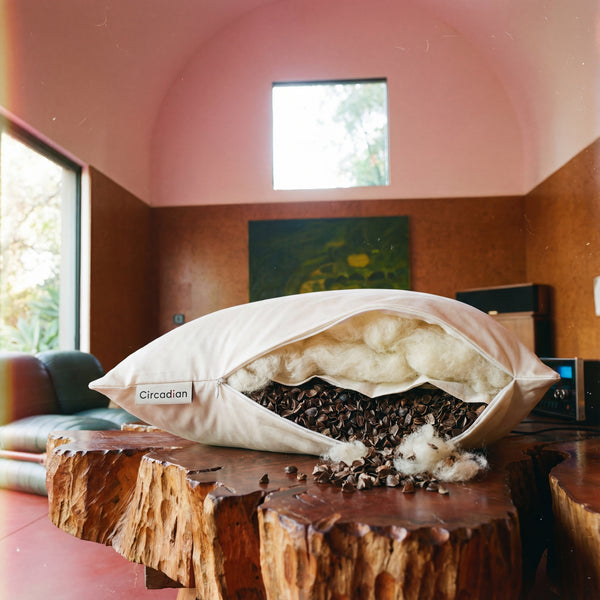
Best for: neck pain, combination sleepers.
Two pillows in one. Firm buckwheat and soft wool, each side adjustable on its own.
View pillow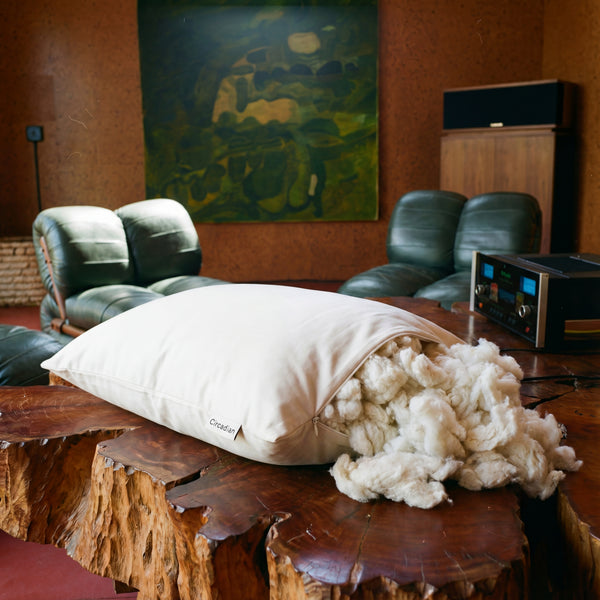
Best for: back sleepers, GOTS-certified everything.
Densest natural fill we make. Holds shape for years and is GOTS-certified end to end.
View pillow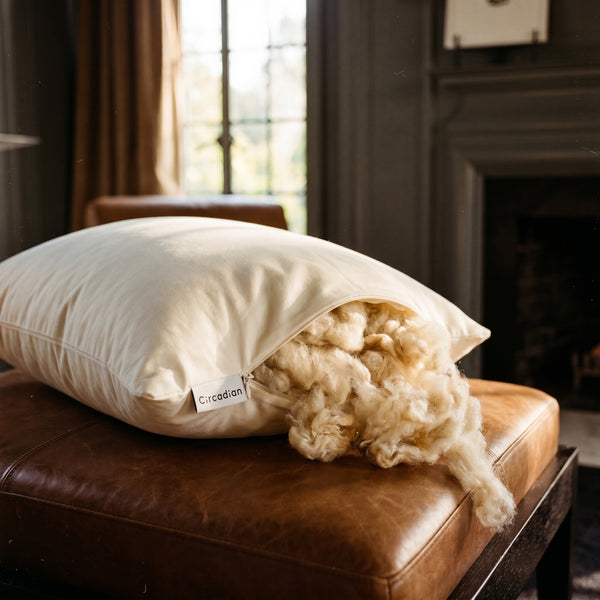
Best for: hot sleepers, dust allergies.
Wicks up to 30% of its weight in moisture. Naturally regulates temperature and resists dust mites.
View pillow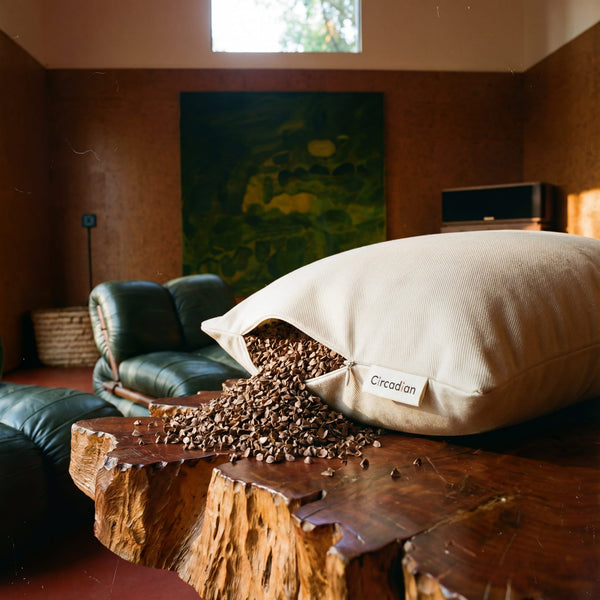
Best for: neck pain, side sleepers.
Hulls flex and lock to your neck shape. Stays cool all night and lasts 7 to 10 years.
View pillow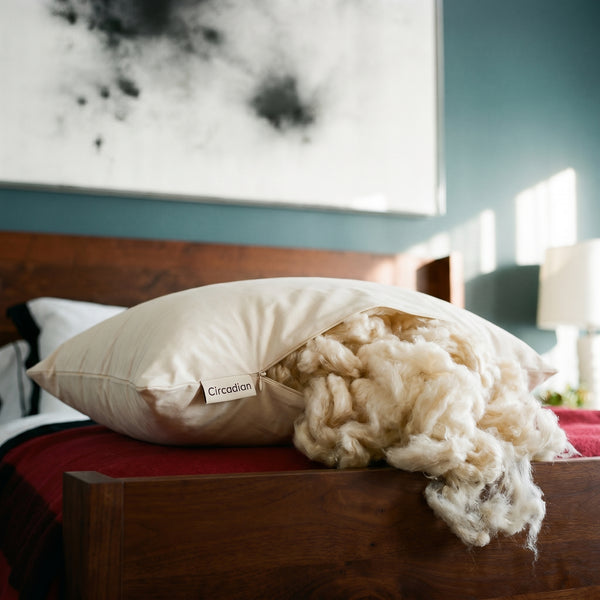
Best for: chemical sensitivities, vegans, stomach sleepers.
Plant-based and down-like. Hollow fibers are 80 to 90% air, so it sleeps cool and lofts like down.
View pillow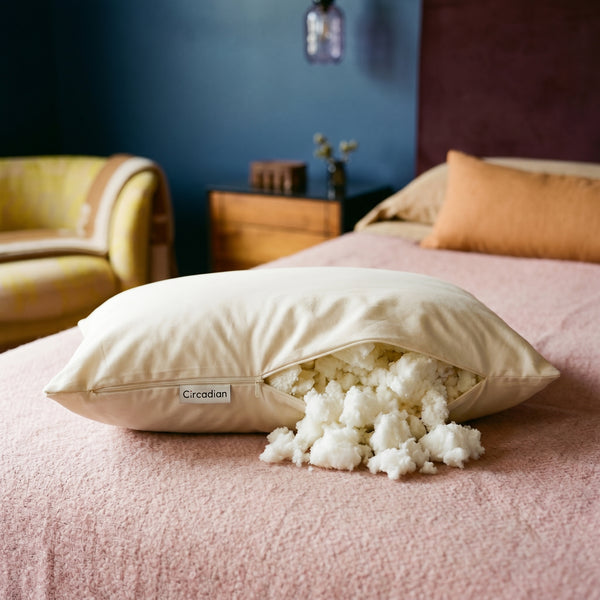
Best for: people leaving memory foam.
Slow-pour Dunlop with an open-cell structure that breathes. Light, bouncy, and responsive, it springs back instead of sinking.
View pillowCertified. Verifiable. Public.
Most pillows labeled 'down alternative' are polyester fiberfill. That is fine microplastic strands that shed over time and give off petroleum compounds. The few down alternatives that do use kapok often bleach it with chlorine to make it whiter, or chemically soften it to break apart matted clumps. Kapok does not need any of that. The fiber grows soft and hypoallergenic inside the seed pod. The pods shed seasonally and drop from the trees on their own, so workers collect them by hand without machinery. The pods are picked clean, the fiber is separated from the seeds, and it goes into the pillow. The cover is organic cotton.
A kapok pillow is filled with natural fiber harvested from the seed pods of the kapok tree (Ceiba pentandra), which grows in tropical rainforests. The fiber is silky, lightweight, and soft, similar in feel to down. Circadian's kapok pillow pairs this wild-harvested fill with an organic cotton cover.
Yes. Kapok is one of the best pillow options for people with multiple chemical sensitivities (MCS) because no synthetic chemicals are used at any stage of production. The fiber goes directly from the tree pod to your pillow without bleaching, chemical softening, or synthetic treatment. This is not a reduced-chemical product. It's a zero-chemical-processing product.
Kapok feels similar to down in softness and loft. Both are light, fluffy, and conform gently to your head. The key differences: kapok is entirely plant-based (no animal products), naturally hypoallergenic (no feather allergies to worry about), and involves zero chemical processing. Down requires washing, sanitizing, and treating with anti-allergen compounds. Kapok needs none of that.
Kapok compresses more slowly than cotton or synthetic fills, but yes, it will lose some loft over months of nightly use. Because the Circadian kapok pillow has an adjustable zipper, you can add more fill when the loft decreases. Regular fluffing (a quick shake a few times per week) also helps the fiber maintain its shape.
Kapok is wild-harvested, not farmed, so the term "organic" doesn't apply in the traditional agricultural sense. No pesticides or fertilizers are used because kapok trees grow without human cultivation in tropical rainforests. The Circadian kapok pillow uses the term "natural kapok" rather than "organic kapok" to be accurate. The cotton cover that wraps the kapok is GOTS certified organic.
Kapok allergies are extremely rare. The fiber is naturally hypoallergenic, resistant to dust mites, and resistant to mold growth. Most pillow-related allergic reactions are triggered by processing chemicals, dust mites, or animal proteins, none of which are present in a kapok pillow. If you have an extremely rare kapok fiber allergy, you would likely know from exposure to kapok-filled products or tropical seed fibers.
The Circadian natural kapok pillow weighs approximately 2 pounds, making it the lightest pillow in the collection. For comparison, the organic cotton pillow weighs 3 to 4 pounds and the buckwheat pillow weighs about 8 pounds. Kapok's lightness is part of its down-like feel.
Yes, more than cotton or latex. Kapok fiber is very light and can settle toward the edges or bottom of the pillow over time. A quick shake or gentle punch a few times per week redistributes the fiber and keeps the loft consistent. This is similar to how you'd maintain a down pillow.
Remove the organic cotton cover and wash it in cold water with gentle detergent. The kapok fill should not be machine washed or submerged in water, as this will damage the fiber's structure. If the fill needs freshening, air it in indirect sunlight for a few hours. The fiber's natural resistance to dust mites and mold means it stays cleaner longer than many alternatives.
Yes. Kapok trees grow without pesticides, fertilizers, or irrigation. Harvesting the seed pods supports local rainforest economies and creates an economic incentive to keep forests standing rather than clearing them. The fiber is biodegradable and the production footprint is minimal because so few processing steps are involved.
Kapok is best for back sleepers and stomach sleepers who prefer a soft, low-to-medium loft pillow. Side sleepers can use it with extra fill for more height, but if you need firm cervical support, buckwheat or cotton may suit you better. Kapok is especially well-suited for anyone with chemical sensitivities, feather allergies, or anyone seeking a plant-based alternative to down.