Adjustable to a low loft
Took out about a third of the Dunlop latex pieces the first night and the loft was perfect for stomach sleeping. Easy to add back if I want it taller.


Slow-pour Dunlop latex in pieces, certified OEKO-TEX Standard 100, Class 1 with FSC-certified rubber-tree source. Open-cell and bouncy, built to last five to eight years.
Handmade in our New Jersey workshop since 1981.
 60-Night Trial
You have 60 nights to sleep on it, adjust the loft, and decide if it belongs on your bed. Pull pieces out, add them back, work out your preferred height across the first week. If after 60 nights you decide this is not the right pillow for you, send it back. Full refund. No restocking fee, no explanation needed.
 Free Shipping
Free shipping. Most orders arrive in 4 to 7 days. Latex is unfamiliar to most people, and the only way to evaluate it is to sleep on it for real. We'd rather pay for shipping than have you wonder.
The latex starts as sap from Hevea brasiliensis rubber trees, harvested through shallow downward cuts in the bark, similar to tapping maple trees. The sap is processed using the slow-pour Dunlop method: the latex is whipped to a froth, then poured slowly into the mold so air settles out between layers, giving a denser, more uniform foam than mass-market Dunlop. The block steam-cures into an open-cell foam, then we break it into pieces, which is what gives the pillow its adjustability and continuous airflow between fragments. The fill carries OEKO-TEX Standard 100, Class 1 certification (the strictest tier), and the rubber-tree source is FSC certified.
 Adjustable Fill (Zipper Access)
The slow-pour Dunlop latex inside is broken into small pieces that are easy to work with. Unzip the side, scoop pieces out over a wide surface if you want a softer or lower pillow, or add them back when you want more loft. Each handful changes the feel by a noticeable amount. The whole adjustment takes about three minutes. Solid latex blocks ship at one fixed firmness. This one adjusts to your neck.
 Designed in DC · Handmade in New Jersey
Each pillow is filled by hand because the amount of slow-pour Dunlop latex needs to be precise. Too much and the pillow ships too tall to fit most necks. Too little and it lacks the support that makes natural latex comfortable. Our team fills, weighs, and checks each one before sealing it.
 Naturally Cooling
Slow-pour Dunlop latex has an open-cell structure that lets air move through the fill continuously, the way it moves through a sponge. Heat does not accumulate against your skin. The smaller latex pieces inside the cover leave air gaps between them that move heat away as you sleep, keeping the surface cool through the night. No gel layer, no phase-change material, just structural airflow.
Your head lands on something soft, and then the latex springs back and lifts it. That is the feel of Tree-Tapped Latex: plush at the surface, buoyant underneath, quick to respond when you move rather than holding the dent your head made an hour ago.
Air runs through the open pieces all night, so the surface stays cool with no gels or coatings. The cool comes from the structure of the latex itself, so it does not wear off.
It arrives full, about a third more than most people keep. Open the side zipper and pull pieces out for a lower, softer profile, or work them back in when you want more height. You set it, and you reset it any night your neck asks for something different.
It suits side, back, and combination sleepers, and it runs cool for people who sleep hot. If you want a surface that stays soft and a lift that stays springy, this is the one.
The latex is slow-pour Dunlop, made from 100% Hevea brasiliensis sap with no synthetic blend, tapped in Sri Lanka through a shallow bark cut that does not harm the tree. Slow-pour, small-batch curing sets the block evenly top to bottom. Mass-market continuous-pour Dunlop often blends in synthetic latex to cut cost, and because the slab bakes as it moves down a long mould the denser rubber settles and it cures firmer on one side. The latex fill carries OEKO-TEX Standard 100 at Class 1, the strictest tier in that program, tested to the same limits set for products made for babies. For processed latex that testing matters more than an organic label, because it tests the latex itself for over 1,000 harmful substances, including formaldehyde, heavy metals, and phthalates. The rubber-tree source is Forest Stewardship Council (FSC) certified. The cover is organic cotton, and the pillow is made by hand in New Jersey.
A faint natural rubber scent arrives in the first few days and airs out completely. One thing to know before you buy: this pillow contains natural rubber latex proteins. If you have a diagnosed latex allergy, choose another fill and talk to your allergist. The cotton, kapok, and wool pillows are all latex-free.
Want to see how the latex is tapped and tested? Watch what slow-pour Dunlop latex is, and why it is safe, with the full transcript.
Wondering whether natural pillows off-gas? Read whether natural pillows are non-toxic, and what off-gassing really means, including what Class 1 testing covers.
Allergic to latex? A latex allergy reacts to the rubber protein in all latex of this kind, so see the latex-free natural pillows that are safe for a latex allergy: organic cotton, wild-harvested kapok, and organic wool.
I've owned three latex pillows over the years and this is the first one I'd buy again. It's supportive. It runs cool. Being able to pull pieces out to lower the loft is the kind of thing I didn't know mattered until I had it.
Took out about a third of the Dunlop latex pieces the first night and the loft was perfect for stomach sleeping. Easy to add back if I want it taller.
I sleep hot. This pillow runs cool. The pieces have space between them and air moves through. Best summer pillow I've owned.
Tap any one to see where they posted it.

Inside the pillow
Slow-pour Dunlop latex begins as sap from Hevea brasiliensis rubber trees. A shallow downward cut in the bark opens the vessel network, the sap collects, and the tree heals to be tapped year after year for decades. Maple syrup harvesters work the same way.
The sap is whipped to a froth, then poured slowly into the mold so air settles out between layers, giving a denser, more uniform foam than mass-market Dunlop.
Under your head, slow-pour Dunlop gives firm, supportive loft and holds its shape without sinking. The open-cell structure lets air move through the fill continuously, keeping the surface cool through the night. We break the latex into smaller pieces and put them inside an organic cotton cover so you can adjust the fill to your neck and your sleep position. A solid block of latex would lock you into whatever firmness arrived in the box. The slow pour is what separates the foam in this pillow from the mass-market Dunlop in cheaper latex pillows, which traps voids and runs uneven across the block.
Memory foam feels great for a minute. Then your head presses a slow dent into it and settles there, and the foam wraps close and traps your heat with nowhere to go. By the middle of the night you are lying in a warm hole you have to climb out of every time you turn.
There is a quieter problem too. Memory foam is polyurethane, a petroleum foam, and it off-gasses volatile compounds into the air six inches from your face. The smell fades; the chemistry is the point. Natural latex gives you the support without any of that.
Latex pushes back and supports instead of swallowing your head, so you turn freely instead of climbing out of a dent all night.
Pin-holes and the gaps between the shredded pieces move air through all night, so heat never pools the way it does in dense foam.
OEKO-TEX Standard 100, Class 1 screens the finished latex for 100-plus compounds, the tier used for baby products, so there is nothing to off-gas.
Responsive support that breathes and stays clean means you get the cradle of foam without the heat, the sinking, or the chemistry. Tapped from a rubber tree, not poured from a barrel of oil.
Most pillows come at one fixed height, so you sleep at a height that was never set for your body, and your neck and shoulders pay for it in the morning. Every Circadian pillow arrives full instead. You set the height on night one, take a little more out over the trial, and the pillow you've shaped is yours to keep.
About 30% more inside than most people keep, because it is easier to take some out than to wish you had more.
Full-length YKK zipper. Open the latex on night one.
Side keeps more, back goes medium, stomach goes thin. Set aside what you pull out.
If the loft feels off a few weeks in, put some back or take more out.
Not for you after 60 nights? Full refund, and no restocking fee.
Refill latex sold separately if you want to bring the loft back up after years of use.

I'm Jacob, founder of Circadian. Every pillow I tried either flattened in three months or hid a list of chemicals you'd need a glossary to read, so we built one that doesn't do either.
Jacob
Founder, Circadian
Spine alignment · Tree-Tapped Latex
Your spine stays neutral when the pillow fills the gap between head and mattress. That gap is different for back, side, and stomach sleepers.

Latex is best for back and side sleepers because the Dunlop latex pieces give firm, supportive loft that holds its shape under your head. Stomach sleepers can pull fill through the side zipper, but the pieces never compress flat. If you sleep face-down, kapok or cotton lays lower.
A high pillow tips your head back and overextends your neck. Most stomach sleepers want very little loft, or none.
Remove most of the fill so your head and shoulders sit close to level with the mattress.
Supports the natural curve of your neck so your chin sits level and the small space behind your neck is filled in.
Remove fill a handful at a time until your head sits level with your shoulders.
Fills the gap between shoulder and ear so your spine runs in a single horizontal line from skull to hip.
Keep most of the fill until your ear, shoulder, and hip stack along one straight line.
Six fills. All adjustable. All handmade in New Jersey.
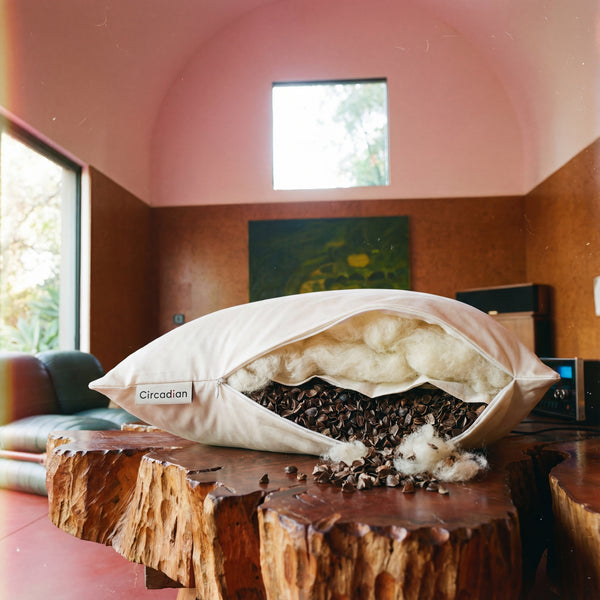
Best for: neck pain, combination sleepers.
Two pillows in one. Firm buckwheat and soft wool, each side adjustable on its own.
View pillow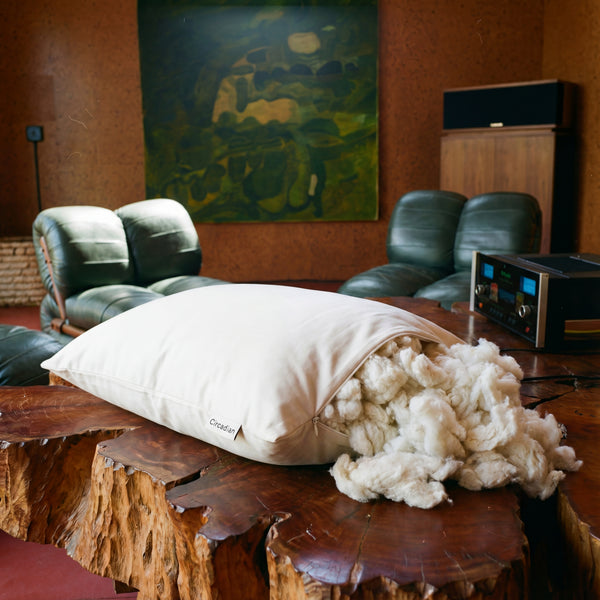
Best for: back sleepers, GOTS-certified organic everything.
Our most tightly packed fiber fill. Holds its shape for years, GOTS-certified organic end to end.
View pillow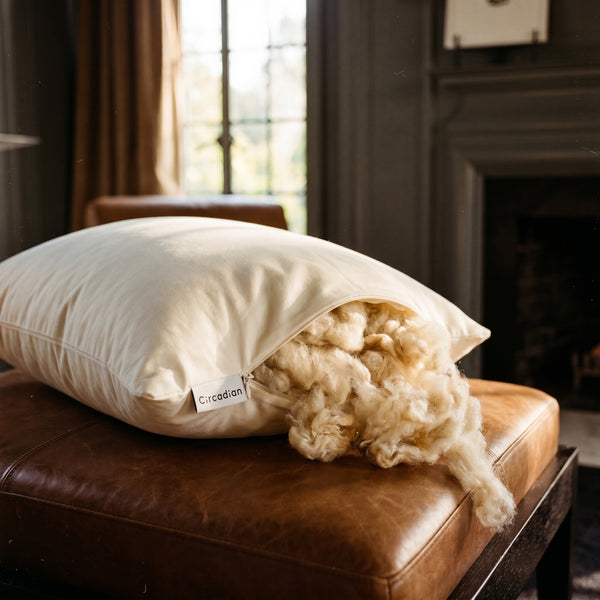
Best for: hot sleepers, dust allergies.
Wicks up to 30% of its weight in moisture. Naturally regulates temperature and holds the air too dry for dust mites.
View pillow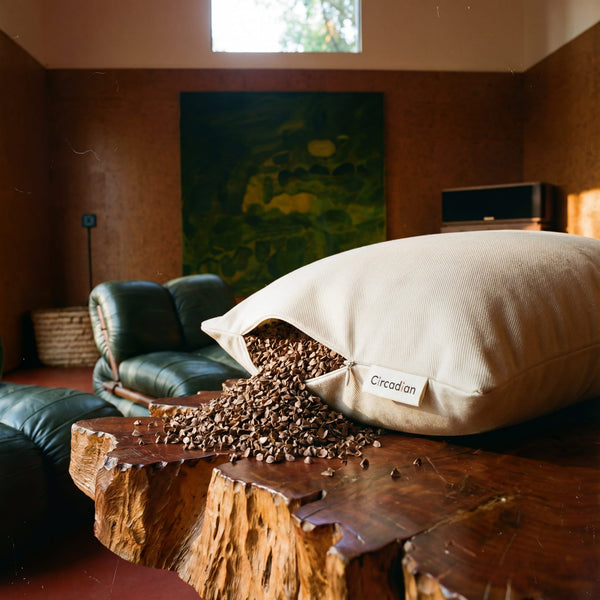
Best for: neck pain, side sleepers.
Hulls flex and lock to your neck shape. Stays cool all night, and most people get three to five years from a hull load before refreshing.
View pillow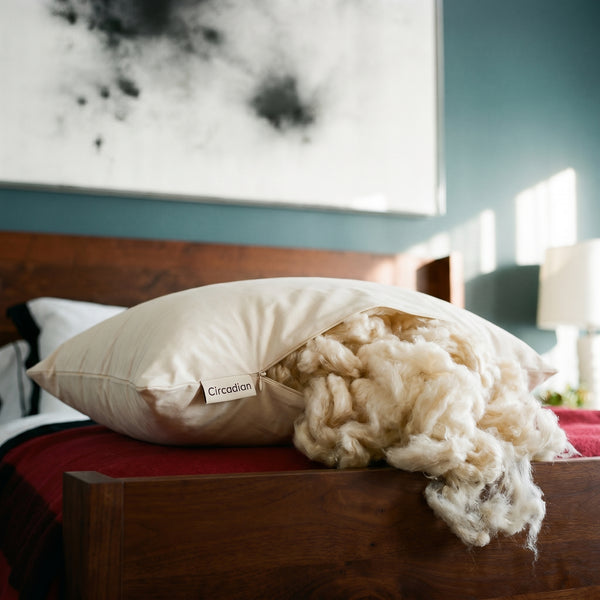
Best for: chemical sensitivities, vegans, stomach sleepers.
Plant-based and down-like. Hollow fibers are 80 to 90% air, so it sleeps cool and lofts like down.
View pillow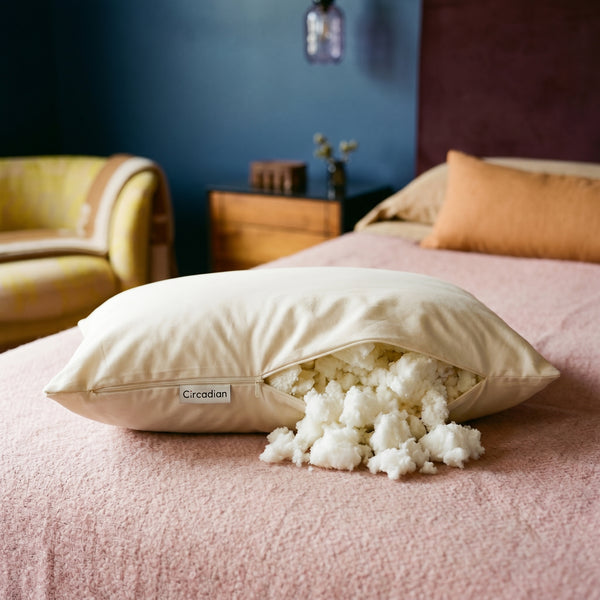
Best for: people leaving memory foam.
Slow-pour Dunlop with an open-cell structure that breathes. Light, bouncy, and responsive, it springs back instead of sinking.
View pillowWe bought every one of them
21 latex pillows, bought and slept on. Every cell below is that brand's own published wording.
| Pillow | Price | How it was made | What the certificate covers | Can you change it | Trial and returns |
|---|---|---|---|---|---|
| Circadian Tree-Tapped Latex PillowNew Jersey, handmade since 1981 | $1694.25 lbs · $39.76/lb | Slow-pour Dunlop, poured slowly and evenly, then washed and cured. Tested at Class 1 against more than 100 harmful substances. | Cover certified, fill screened not certifiedOrganic cotton cover. The latex is screened against more than 100 harmful substances. FSC certified rubber-tree source. | Full-length zipperRefill bags sold, so you can top it up | 60 nightsFree shipping |
|
What the certificate covers
Organic cotton cover. The latex is screened against more than 100 harmful substances. FSC certified rubber-tree source. How it was made
Slow-pour Dunlop, poured slowly and evenly, then washed and cured. Tested at Class 1 against more than 100 harmful substances. What we do not claim
We do not print a certificate number on this pillow. The screening covers the fill, not the finished pillow, and we will not imply a scope we do not hold. We also never call it organic latex. | |||||
| Avocado Green Pillow (Dunlop+kapok)Tecate Mexico | $1393.4 lbs · $40.88/lb | Dunlop process (poured; gelled; baked) | Licence number published | YesYes (~$35-39 refill) | 100 nightsFree returnsFree standard |
|
Certification, their words: Finished-product GOTS (Control Union CU863637); GOLS on latex (CU863637); OEKO-TEX 100 Class I (24.HUS.86422) on the finished pillow; MADE SAFE; GREENGUARD Gold; UL Formaldehyde-Free Processing, their words: Dunlop process (poured; gelled; baked) | |||||
| Lifekind Cozzy Shredded Rubber (Dunlop)Greenwood Village CO | $159~3.4 lbs · $46.76/lb | Dunlop (rubber) | Licence number published | YesNot advertised | 90 nightsExchange-basedFree |
|
Certification, their words: GOLS on latex fill (license # not published); GOTS CU 823400 (Control Union); PDP states the finished product is certified; GREENGUARD Gold not claimed by the brand Processing, their words: Dunlop (rubber) | |||||
| OMI Embrace Shredded Latex (Dunlop)Greenwood Village CO | $169 | Dunlop (natural rubber) | Licence number published | YesNot advertised | 90 nightsExchange-basedFree |
|
Certification, their words: GOTS listed in PDP cert block (Control Union CU823400; scope not stated); GOLS is a brand-level claim absent from the PDP (license # not published); GREENGUARD Gold scoped to mattresses Processing, their words: Dunlop (natural rubber) | |||||
| Sleep EZ Shredded Natural LatexAssembled USA (Phoenix AZ) | $99 | Process not named on PDP; Sleep EZ FAQ: Natural line is 100% Dunlop | No third-party certification | Yes (zippered)Yes (extra fill sold) | 90 nights90-day returns (customer pays reFree |
|
Certification, their words: No certs on PDP; cert page lists supplier-level GOLS (Arpico/Eco/LSK), OEKO-TEX (Radium; Talalay Global) and eco-INSTITUT (Radium); GOTS scoped to the Organic mattress cover only; per-pillow cert IDs not published Processing, their words: Process not named on PDP; Sleep EZ FAQ: Natural line is 100% Dunlop | |||||
| Naturepedic Adjustable Latex (Dunlop)Chagrin Falls OH | $139 | Dunlop (inferred) | Licence number published | Yes (extra fill bag included)Yes (fill ships with pillow) | 30 nightsLimited (hygiene)Free |
|
Certification, their words: GOTS on cotton (license GOTS-10233 / OT-007086, Oregon Tilth; appendix covers pillows); latex is GOLS or FSC by option (brand GOLS CU 864025 names only Luxury Latex Pillows); MADE SAFE; GREENGUARD Gold; cert IDs not on PDP Processing, their words: Dunlop (inferred) | |||||
| Savvy Rest Shredded (Dunlop+Talalay)Earlysville VA | $119 | Dunlop + Talalay shred blend | Licence number published | Yes (double casing inner+outer)Yes (arrives full, remove to fit) | No trialNo (hygiene policy)Free over $99 |
|
Certification, their words: GOTS on casing only (Savvy Rest license CB-GOTS-CU-PE-33-846965, Control Union; no latex in the GOTS appendix); GOLS, Cradle to Cradle Gold and FSC on latex are supplier scope certs; GREENGUARD Gold (cert ID not published) Processing, their words: Dunlop + Talalay shred blend | |||||
| Dreamfoam Ultimate Dreams TalalayAssembled USA | $172 | Talalay (vacuum-expanded; flash-frozen) | No third-party certification | Yes (zippered)Not advertised | 120 nightsFree returns within 120 nightsFree |
|
Certification, their words: No certs on PDP; parent 3Z Brands claims corporate GOLS, eco-INSTITUT and CertiPUR-US, none tied to this pillow; no GOTS; no OEKO-TEX on brand site Processing, their words: Talalay (vacuum-expanded; flash-frozen) | |||||
| FloBeds Twice Fluffed TalalayFort Bragg CA assembly | $119 | Talalay (vacuum-expanded; flash-frozen; shredded twice) | Claimed, no number published | Yes (unzip and remove)Yes (extra Talalay fill on request | 100 nightsGoldilocks Guarantee (free-returFree shipping not stated on PDP |
|
Certification, their words: OEKO-TEX 100 (Talalay Global slab; supplier-level); GOTS claimed brand-level for cotton ticking and wool, never on the pillow PDP (license # not published); cert page also calls the latex GOTS-compliant (latex is outside GOTS scope) Processing, their words: Talalay (vacuum-expanded; flash-frozen; shredded twice) | |||||
| Latex Mattress Factory TalalayAssembled USA; Talalay Netherlands | $1655 lbs · $33.00/lb | Talalay (vacuum-expanded; flash-frozen) | Claimed, no number published | YesYes (sold separately) | No trialNo returns (final sale)Free continental US |
|
Certification, their words: Supplier/component certs only - OEKO-TEX 100 (Talalay Global; Radium; Aprico); eco-INSTITUT + Cradle to Cradle Gold (Radium slab); GOLS scope cert applies to Dunlop, not this Talalay pillow; no GOTS; no FSC Processing, their words: Talalay (vacuum-expanded; flash-frozen) | |||||
| Sleeping Organic Shredded (Dunlop+Talalay)Charleston SC | $99 | Dunlop + Talalay shred blend | Claimed, no number published | YesYes (5 lb refill bags sold separat | No formal trialNo (5-year warranty)Free |
|
Certification, their words: Fill stated as 100% natural Talalay+Dunlop, not organic; GOLS not claimed for this pillow on the PDP (sitewide footer badge only); OEKO-TEX 100; eco-INSTITUT; LGA on latex; no cert IDs on PDP Processing, their words: Dunlop + Talalay shred blend | |||||
| Eco Terra Natural Latex (Dunlop+kapok)Southern California | $109 | Dunlop process | Claimed, no number published | YesYes (extra fill bag included) | Non-returnableNoFree |
|
Certification, their words: GOLS + eco-INSTITUT on Arpico latex (supplier scope certs); GOTS claimed for the cover in prose only - no GOTS certificate or license # published; kapok uncertified Processing, their words: Dunlop process | |||||
| PlushBeds Shredded Latex+Kapok (Dunlop)California assembly | $1123 lbs · $37.33/lb | Dunlop process | Licence number published | YesNot advertised | Non-returnableNoFree contiguous US |
|
Certification, their words: GOLS on latex (CU865931 in sitewide footer); GOTS published at company level only (Control Union CU1007386, cotton scope) - not tied to this cover on the PDP; no OEKO-TEX or GREENGUARD claim on this PDP Processing, their words: Dunlop process | |||||
| Birch Talalay Latex PillowAssembled USA | $110.66 | Talalay (vacuum-expanded; flash-frozen) | Claimed, no number published | Yes (zippered for shredded versionNo | 30 nightsFree returns within 30Free |
|
Certification, their words: OEKO-TEX on TENCEL cover only; no GOLS; no GOTS anywhere on the brand site; latex described as natural, not organic Processing, their words: Talalay (vacuum-expanded; flash-frozen) | |||||
| OrganicTextiles Shredded Latex (Dunlop)Handmade Southern CA | $90 | Dunlop process | Claimed, no number published | YesNot advertised | 30 nightsAmazon return policyFree Prime |
|
Certification, their words: GOLS on latex (supplier cert ORG-001-23); company-level GOTS certificate published sitewide but not tied to this cover on the PDP; OEKO-TEX at company level; license # not in page text Processing, their words: Dunlop process | |||||
| Talatex Adjustable TalalayThailand | $80~2.4 lbs (1.1 kg) · $33.33/lb | Talalay (vacuum-expanded; flash-frozen) | Claimed, no number published | Yes (zipper + NeckFit zone)Not advertised | 30 nights30-day returnsFree |
|
Certification, their words: No cert named in PDP text; brand page lists GOLS, OEKO-TEX 100, FSC, ISPA, eco-INSTITUT and LGA with no scope, product tie or license #s; GOLS unverified for this pillow Processing, their words: Talalay (vacuum-expanded; flash-frozen) | |||||
| Coyuchi Organic Shredded Latex (Dunlop)Imported (latex/cotton international) | $178 | Dunlop process | Claimed, no number published | Yes (double-zip)Not advertised | 30 nightsLimited; retailer-dependentYes ($150+ threshold) |
|
Certification, their words: GOLS + GOTS stated as a bare bullet; no scope split between latex and cover; license # not published Processing, their words: Dunlop process | |||||
| Pure Talalay Bliss ShreddedTalalay USA | $149.993.5 lbs · $42.85/lb | Talalay (8-step process: vacuum-expanded; flash-frozen; vulcanized; 5-stage wash) | Claimed, no number published | Yes (zippered)Available through some retailers | Varies by retailerRetailer-dependentRetailer-dependent |
|
Certification, their words: OEKO-TEX 100 stated for mattresses only (license # not published); no GOLS or GOTS claimed; eco-INSTITUT, Rainforest Alliance, FSC and Cradle to Cradle not claimed on brand site - unverified Processing, their words: Talalay (8-step process: vacuum-expanded; flash-frozen; vulcanized; 5-stage wash) | |||||
| Suite Sleep Organic Shredded (Dunlop)Colorado | $119 | Dunlop process | Claimed, no number published | YesNot advertised | No formal trialLimitedFree over $99 |
|
Certification, their words: GOLS on latex appears in the page meta description only, not body copy; visible spec lists fill as shredded latex with no cert; no license or cert IDs on PDP Processing, their words: Dunlop process | |||||
| Latex For Less Shredded (Dunlop)USA | $75 | Dunlop process | Claimed, no number published | YesNot advertised | No trialNo returns (5-year warranty)Free |
|
Certification, their words: GOLS on shredded latex per PDP FAQ; GOTS cover claim appears on the brand blog only, not the PDP; no license or cert IDs published Processing, their words: Dunlop process | |||||
| Saatva Latex PillowAmerican Talalay | $1653.25 lbs · $50.77/lb | Talalay (vacuum-expanded; flash-frozen) | No third-party certification | No (sealed core)No | 45 nightsFree returns within 45 daysFree |
|
Certification, their words: No certs stated on PDP; brand-level only - GOTS + OEKO-TEX 100 claimed for bedding generally (cert IDs not published); GREENGUARD Gold and eco-INSTITUT scoped to latex mattresses, not pillows Processing, their words: Talalay (vacuum-expanded; flash-frozen) | |||||
Sorting reorders the other pillows. Ours stays on the top row.
None of the other latex pillows we bought meet that one.
Green means the brand's own published wording meets the test, amber means it is claimed but not evidenced, grey means it does not. Open any row to read the wording it was graded on. Certifications re-checked live on 31 July 2026. Prices and policies collected May 2026 from each brand's product page; certifications re-verified 31 July 2026. How we test and rank
The list most pillow makers hope you never read. None of it is in a Circadian pillow.
Checked by someone else.
Most pillows labeled 'latex' are synthetic latex. That is petroleum-based foam that off-gasses volatile compounds and traps heat. Our latex is slow-pour Dunlop, tapped from Hevea brasiliensis rubber trees the way maple syrup is tapped. The sap is whipped, then poured slowly into the mold so air settles out between layers, giving a denser, more uniform foam than mass-market Dunlop. The block bakes until the open-cell structure sets. We break the latex into smaller pieces so the loft adjusts and air moves through the gaps between them. OEKO-TEX Standard 100, Class 1 means the finished latex has been tested for over 100 harmful compounds, the same standard applied to products made for direct infant skin contact. The cover is organic cotton.
Dunlop latex is whipped, poured into a mold, and steam-cured into a dense, springy, open-cell material. Mass-market Dunlop pours fast, which traps air voids and leaves the block uneven. The Circadian Tree-Tapped Latex Pillow uses slow-pour Dunlop, where the sap pours slowly so air settles out between layers, giving a denser, more uniform foam that holds up for years. We shred that cured block into pieces, so the pillow keeps the bouncy responsiveness of natural latex with the adjustability of an open chamber.
Natural latex and memory foam differ in heat, responsiveness, and adjustability. Memory foam traps heat because of its closed-cell structure. Slow-pour Dunlop latex pieces allow air to flow through their open cells, staying cool. Latex also bounces back faster, so your head doesn't get locked in a single impression. And because the Circadian latex pillow uses slow-pour Dunlop pieces rather than a single block, you can adjust the loft, something solid memory foam can't offer.
A new slow-pour Dunlop latex pillow has a faint rubber scent for the first three to seven nights. The scent comes from the natural tree-tapped sap and clears as the latex airs out. Unlike synthetic memory foam, there is no chemical off-gassing.
No. If you have a latex allergy, you should not use any latex pillow, whether natural or synthetic. The allergy is triggered by proteins in the latex itself, and these proteins are present in natural Dunlop latex. The organic cotton pillow, kapok pillow, or wool pillow would be safe alternatives.
OEKO-TEX Standard 100, Class 1 certification means the latex fill has been independently tested for over 100 harmful substances, including carcinogenic dyes, pesticide residue, heavy metals, formaldehyde, and phthalates. Class 1 is the strictest tier, the same standard applied to products made for direct infant skin contact. Many latex pillows on the market are not third-party tested, so the certification provides verified safety rather than brand claims alone.
Yes. Slow-pour Dunlop latex pieces can be added or removed through a zipper, unlike solid latex blocks that come in a fixed size and firmness. The Circadian Tree-Tapped Latex pillow arrives full, with more pieces inside than most people keep, so you remove some until it matches your preferred height and softness.
Yes. Slow-pour Dunlop latex pieces are one of the better pillow options for hot sleepers because air circulates through the open-cell structure between the pieces. The pillow runs cool through the night. Among the Circadian collection, it's cooler than cotton and comparable to wool, though not quite as cool as buckwheat.
Slow-pour Dunlop natural latex is one of the most durable pillow fills available, lasting five to eight years with normal use. Latex resists compression and breakdown better than cotton, wool, or synthetic foam. The adjustable zipper design extends the useful life further because you can redistribute or add pieces if one area settles.
A slow-pour Dunlop latex pillow with adjustable pieces is a natural option for people leaving memory foam. The open-cell slow-pour Dunlop structure breathes, bounces back when you move, and does not off-gas VOCs. The adjustable loft lets you set your preferred height, something solid memory foam blocks can't do.
Yes. Side sleepers typically need more fill for a taller pillow that supports the head at shoulder height. Keep the slow-pour Dunlop latex pieces relatively full for side sleeping. Latex's contouring works well for side sleepers because it cushions the ear and cheek while supporting the neck.
The natural slow-pour Dunlop latex is made from the sap of Hevea brasiliensis rubber trees grown on FSC-certified plantations in Sri Lanka. The sap is harvested by making small incisions in the bark, similar to how maple syrup is collected. The sap is then processed using the slow-pour Dunlop method in a facility that meets OEKO-TEX Standard 100, Class 1. No petrochemicals are used in the production of natural latex.
OEKO-TEX Standard 100, Class 1 means the latex fill inside the Circadian Tree-Tapped Latex Pillow has been independently tested for over 100 harmful substances, including heavy metals, formaldehyde, pesticide residues, and phthalates. Class 1 is the strictest tier of the standard, the same level required for products that touch infant skin, and the latex earns it as 100% Hevea brasiliensis tree sap made through a slow-pour small-batch Dunlop process.
The Circadian Tree-Tapped Latex Pillow is 100% Hevea brasiliensis tree sap made through a slow-pour small-batch Dunlop process, with an FSC-certified rubber-tree source in Sri Lanka and OEKO-TEX Standard 100, Class 1 certification on the finished latex (the strictest tier, the same level required for infant-skin contact). It arrives full in a side-zipper organic cotton cover so you can remove fill to set the height for your sleep position.
Slow-pour Dunlop latex lasts up to a decade with normal use, the longest of any fill in the Circadian lineup. The dense, even cell structure of a slow-pour cure resists compression and breakdown, and the pieces format lets you redistribute or add fill through the side zipper if one area ever settles.
If you have a diagnosed latex allergy, choose the Organic Wool Pillow or the Wild-Harvested Kapok Pillow. Lanolin keeps dust mites out of the wool on its own, and kapok is a hollow plant fibre with no chemical processing. The Organic Cotton Pillow is a third choice if you would rather have a familiar feel and no animal fibre. Latex allergy is triggered by proteins in Hevea brasiliensis that stay in the material after processing, so the Tree-Tapped Latex Pillow is a hard no.
It is slow-pour Dunlop latex, made from 100 percent Hevea rubber-tree sap with no synthetic blend. Slow-pour, small-batch curing gives an even, springy block from top to bottom. The finished latex carries OEKO-TEX Standard 100 Class 1, the strictest tier, plus FSC certification on the rubber-tree source.
Dunlop latex is whipped, poured into a mold, and steam-cured into a dense, springy, open-cell material. Mass-market Dunlop pours fast, which traps air voids and leaves the block uneven. Our Tree-Tapped Latex Pillow uses slow-pour Dunlop, where the sap is poured slowly so the air settles out between layers, giving a denser, more uniform foam that holds up for years. We shred that cured block into pieces, so the pillow keeps the bouncy responsiveness of natural latex with the adjustability of an open chamber.
Natural latex and memory foam both conform to your head, but they differ in heat, responsiveness, and adjustability. Memory foam traps heat because of its closed-cell structure. Slow-pour Dunlop latex pieces allow air to flow through their open cells, staying cool. Latex also bounces back faster, so your head doesn't get locked in a single impression. And because the Circadian latex pillow uses slow-pour Dunlop pieces rather than a single block, you can adjust the loft, something solid memory foam can't offer.
A new slow-pour Dunlop latex pillow has a faint rubber scent for the first three to seven nights. The scent comes from the natural tree-tapped sap and clears as the latex airs out. Unlike synthetic memory foam, there is no chemical off-gassing.
No. If you have a latex allergy, you should not use any latex pillow, whether natural or synthetic. The allergy is triggered by proteins in the latex itself, and these proteins are present in natural Dunlop latex. The organic cotton pillow, kapok pillow, or wool pillow would be safe alternatives.
OEKO-TEX Standard 100, Class 1 certification means the latex fill has been independently tested for over 100 harmful substances, including carcinogenic dyes, pesticide residue, heavy metals, formaldehyde, and phthalates. Class 1 is the strictest tier of OEKO-TEX, the same standard used for products made for direct infant skin contact. Many latex pillows on the market are not third-party tested, so the certification provides verified safety rather than brand claims alone.
Yes. Slow-pour Dunlop latex pieces can be added or removed through a zipper, unlike solid latex blocks that come in a fixed size and firmness. The Circadian Tree-Tapped Latex pillow arrives full, with more pieces inside than most people keep, so you remove some until it matches your preferred height and softness.
Yes. Slow-pour Dunlop latex pieces are one of the better pillow options for hot sleepers because air circulates through the open-cell structure between the pieces. The pillow runs cool through the night. Among the Circadian collection, it's cooler than cotton and comparable to wool, though not quite as cool as buckwheat.
Slow-pour Dunlop natural latex is one of the most durable pillow fills available, lasting five to eight years with normal use. Latex resists compression and breakdown better than cotton, wool, or synthetic foam. The adjustable zipper design extends the useful life further because you can redistribute or add pieces if one area settles.
A slow-pour Dunlop latex pillow with adjustable pieces is a natural option for people leaving memory foam. The open-cell slow-pour Dunlop structure breathes, bounces back when you move, and does not off-gas VOCs. The adjustable loft lets you set your preferred height, something solid memory foam blocks can't do.
Yes. Side sleepers typically need more fill for a taller pillow that supports the head at shoulder height. Keep the slow-pour Dunlop latex pieces relatively full for side sleeping. Latex's contouring works well for side sleepers because it cushions the ear and cheek while supporting the neck.
The natural slow-pour Dunlop latex is made from the sap of Hevea brasiliensis rubber trees grown on FSC-certified plantations in Sri Lanka. The sap is harvested by making small incisions in the bark, similar to how maple syrup is collected. The sap is then processed using the slow-pour Dunlop method, and the finished latex is certified OEKO-TEX Standard 100, Class 1. No petrochemicals are used in the production of natural latex.
Your first pillow
Leave your email and the code comes right over, along with the two-minute quiz that matches you to one of the six fills.
60-night trial · Handmade in New Jersey
Where to send it
The $10 code and the quiz link land in your inbox in about a minute.
From Jacob, the founder. One email, unsubscribe anytime.
That email doesn't look right. Mind checking it?
Done
Check your inbox in a minute. If you want a head start, the quiz takes two.
Start the quiz60-night trial · Handmade in New Jersey
